
Compare pay across hourly, monthly and annual periods, model a pay raise, or estimate income tax using a selected country and tax-year model. The tax result excludes other payroll deductions and is not your complete take-home pay.
Salary Calculator
Convert your pay between hourly, daily, weekly, bi-weekly, monthly and yearly — with holiday & vacation adjustments — then estimate your take-home pay after tax and model a pay raise.
Your pay
Full breakdown
| Pay period | Unadjusted | Adjusted* |
|---|
*Adjusted figures account for unpaid holidays & vacation. Hourly and daily inputs are treated as unadjusted; weekly and longer inputs are treated as already adjusted, following the standard 52-week / 260-workday convention.
Estimate salary after income tax
Gross salary and modeled income tax
Pay raise calculator
Disclaimer: Tax results are simplified estimates for the stated tax year and consider income tax only — they exclude items such as social security, national insurance, provincial/state taxes, surcharges, allowances and personal reliefs. This is not financial or tax advice; confirm figures with your employer or a qualified tax professional.
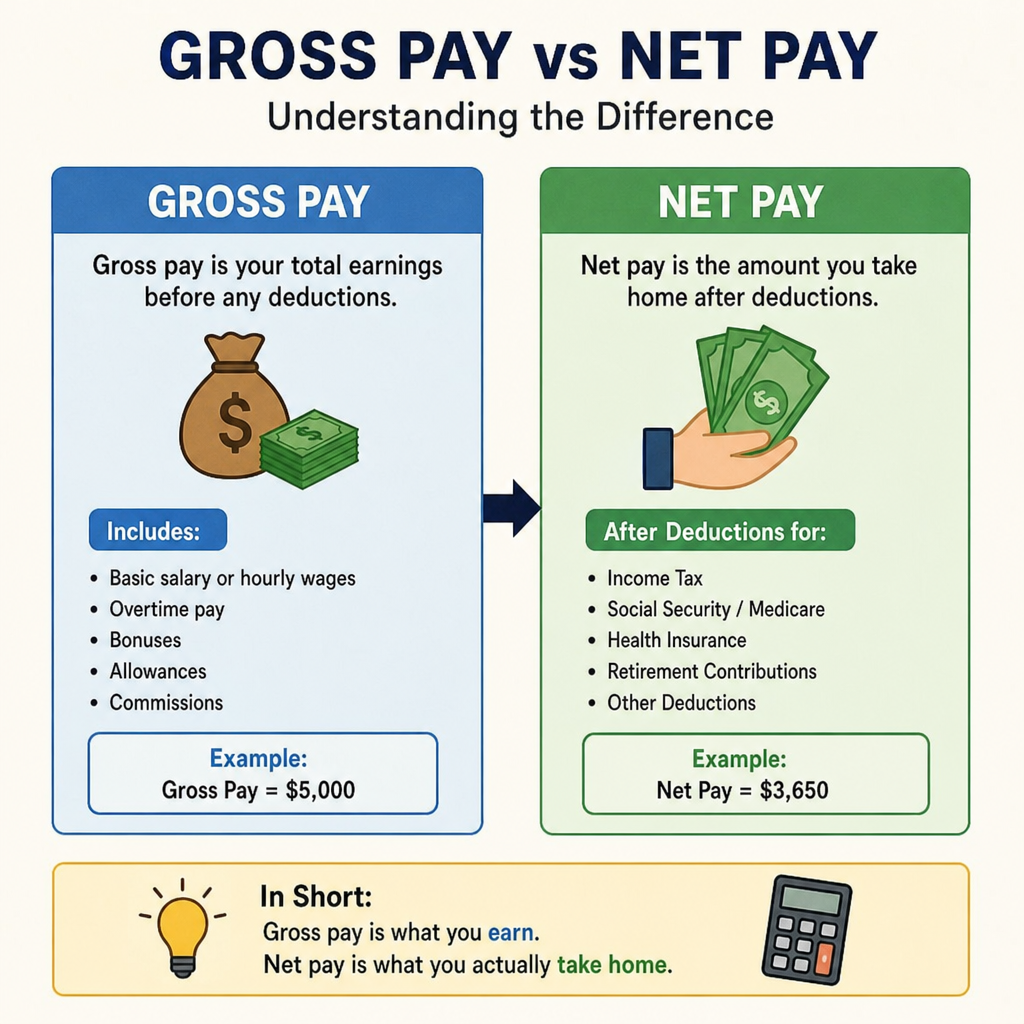



What this salary calculator can do
Use the pay converter to compare hourly, daily, weekly, biweekly, semimonthly, monthly, quarterly and annual amounts. The separate income-tax estimator subtracts modeled income tax from gross pay; it is not a complete take-home-pay calculation. The pay-raise tab compares your current annual salary with a percentage or fixed-amount increase.
Convert pay between periods
- Choose a currency label, enter your pay amount and select its pay period.
- Check hours per week, workdays per week and weeks per year.
- Enter holiday and vacation days only if you want to compare the tool’s adjusted and unadjusted scenarios.
- Calculate, then compare the annual, monthly and hourly figures in the result table.
Currency selection changes formatting only. It does not convert money using exchange rates.
Basic hourly-to-annual formula = hourly rate × hours per week × weeks per year. With a $25 hourly rate, 40 hours per week and 52 weeks, gross annual pay is $52,000 before unpaid-time adjustments and deductions. Dividing by 12 gives an average $4,333.33 per month; an actual hourly payslip depends on hours worked in that pay period.
Biweekly means 26 payments per year in this model; semimonthly means 24. These are different frequencies. The model uses 12 months and four quarters, while the weekly conversion uses your chosen weeks-per-year input.
Adjusted and unadjusted pay: understand the assumption
The tool calculates scheduled days as weeks per year × workdays per week, then subtracts the entered holiday and vacation days to obtain adjusted working days. It treats hourly and daily inputs as rates before this time-off adjustment. For weekly and longer-period inputs, it treats the entered amount as the adjusted pay and derives the unadjusted comparison.
That is a comparison convention, not a payroll entitlement rule. Paid leave should not automatically reduce an employee’s agreed salary. If leave is already paid within your quoted salary, do not interpret the adjusted column as an additional deduction. For partial-month payroll, use the written employer rule described in the per-day salary guide.
For the $25-per-hour example above, five scheduled days per week gives 260 scheduled days. If you deliberately model 20 unpaid non-working days, adjusted gross pay becomes $52,000 × 240 ÷ 260 = $48,000. This is an illustrative unpaid-time scenario, not a claim that annual leave is normally unpaid.
If you enter overtime hours, the tool displays a separate annual overtime estimate using a 1.5× multiplier and the selected weeks per year. It does not add that figure to the conversion table. Actual overtime eligibility, regular-rate calculations and premiums depend on the contract and applicable law.
Income tax only—not all payroll deductions
Enter gross pay and select its period, then select the available country or custom-rate model. Read the tax year and assumptions beside the result. An older fiscal-year option is a historical estimate and should not be treated as a current-year model.
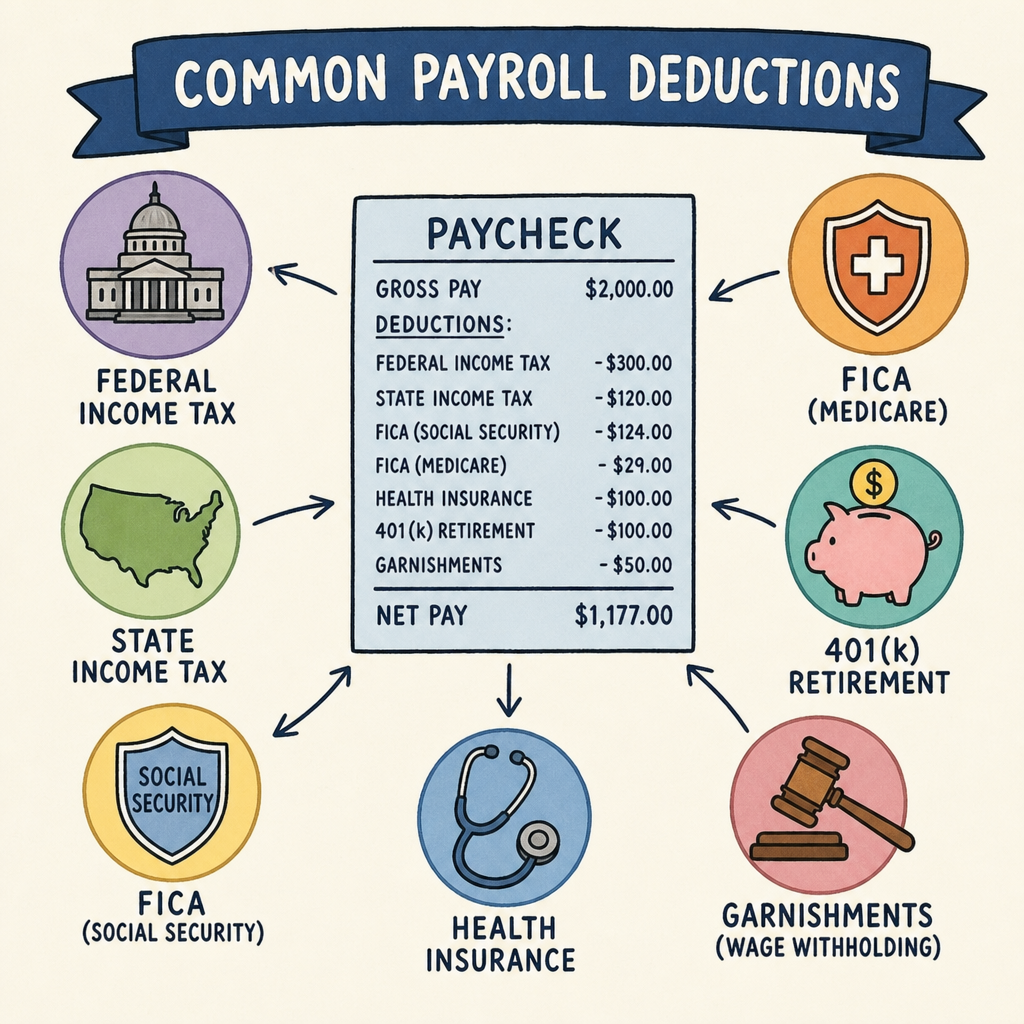
Amount after modeled income tax = annualized gross pay − estimated income tax. This amount can be higher than a payslip’s net deposit because the calculation excludes deductions such as social security, National Insurance, state or provincial taxes, pension contributions, insurance and other payroll adjustments. It does not offer a filing-status selector, state selector or retirement-contribution deduction input.
A custom flat-rate option simply applies your entered percentage to gross income. It does not reproduce a progressive tax system. A zero-income-tax setting is likewise not a claim that every worker owes no other tax or contribution.
For the UK, HMRC’s current rates and allowances are the official reference, including the personal-allowance reduction at higher income. Scotland has different employment-income bands. Use the exact jurisdiction and year stated by the implemented model; consult the appropriate authority for your personal liability.
Tax models and official references
| Selection | Model scope | Official reference |
|---|---|---|
| UK 2026–27 | Employment income in England, Wales and Northern Ireland; personal-allowance taper included. No National Insurance or Scotland model. | HMRC rates and allowances |
| US 2026 | Federal single-filer ordinary-income model with the standard deduction. Excludes FICA, state/local taxes, credits and alternative minimum tax. | IRS 2026 inflation adjustments |
| Pakistan FY2025–26 / tax year 2026 (archive) | Base salaried-income slabs. Excludes surcharge and other taxes or adjustments. | FBR tax-year-2026 rate card |
| India FY2025–26 / AY2026–27 (archive) | New-regime resident salary-only example, including ₹75,000 standard deduction, modeled rebate and marginal relief, and 4% cess. Excludes surcharge and special-rate income. | Income Tax Department: salaried individuals, AY2026–27 |
The archived models are for those specific earnings years, not a statement about current payroll rules. These references explain the rules; they do not endorse CalcRange or turn the simplified results into tax advice.
Calculate a pay raise
Enter your current annual salary and choose a percentage increase or a fixed annual amount. A 5% raise on $50,000 adds $2,500, producing $52,500 annually or $4,375 per average month. These are gross figures; tax and other deductions are separate.
For the formulas and negotiation context, see hourly-to-salary conversion, payslip deductions explained and how to ask for a raise.
Frequently asked questions
Why is my monthly conversion different from my paycheck?
The converter reports an annual average. A payslip reflects its actual pay period, hours, adjustments and deductions. Biweekly pay also does not produce the same number of payments in every calendar month.
Does this tell me my exact take-home salary?
No. The separate tax estimate covers only its stated income-tax model. Check the listed exclusions and compare the breakdown with payroll, not just the final figure.
Does changing USD to GBP convert the amount?
No. The currency dropdown labels the same numeric amount. Use an exchange-rate service separately if you need a currency conversion.
Which year should I use?
Select the tax model for the earnings period you are estimating. If the required year or jurisdiction is not available, do not substitute an old option and call the result current.
Can I save the result?
Use the print option and your browser’s PDF destination if available. Keep the inputs, country, tax year and exclusions with the result.
Source references checked September 10, 2026. This is an educational pay-conversion and income-tax estimation tool, not individualized payroll or tax advice. See CalcRange’s editorial and correction policy.