
BMI Calculator
Calculate adult BMI in metric or US units. This screening tool is for ages 20 and older; children and teens need age- and sex-specific assessment.
It’s a good idea to see a doctor or dietitian if: your BMI is outside the healthy range, your weight has changed quickly without trying, you have other health concerns, or you’d simply like personalised, safe advice. BMI is just a starting point — a professional can look at the full picture.
Helpful things to ask: “Is my weight affecting my health?”, “What healthy changes would you suggest for me?”, and “Should I have any tests done?”
Find doctors near me →BMI is a useful general screening tool, but it doesn’t measure body fat directly or account for muscle, bone, age or ethnicity. Athletes and very muscular people may read “high” while being healthy. It’s not a diagnosis — please use it as a guide and talk to a healthcare professional about what’s right for you.
Understand your BMI result
Body mass index (BMI) compares weight with height. It is a screening measure, not a direct measurement of body fat or a verdict on your health. This calculator’s standard categories are intended for adults aged 20 and older, following the scope of the CDC adult BMI calculator.
The formula and a checked example
BMI = weight in kilograms ÷ height in metres squared. For a height entered in centimetres, divide by 100 first. For pounds and inches, an equivalent approximation is 703 × weight in pounds ÷ height in inches squared.
At 70 kg and 175 cm, height is 1.75 m. Squaring it gives 3.0625 m². Then 70 ÷ 3.0625 = 22.86, displayed as 22.9 to one decimal place. A rounded display can sit close to a category boundary; the calculation should use the unrounded value.
Standard adult BMI categories
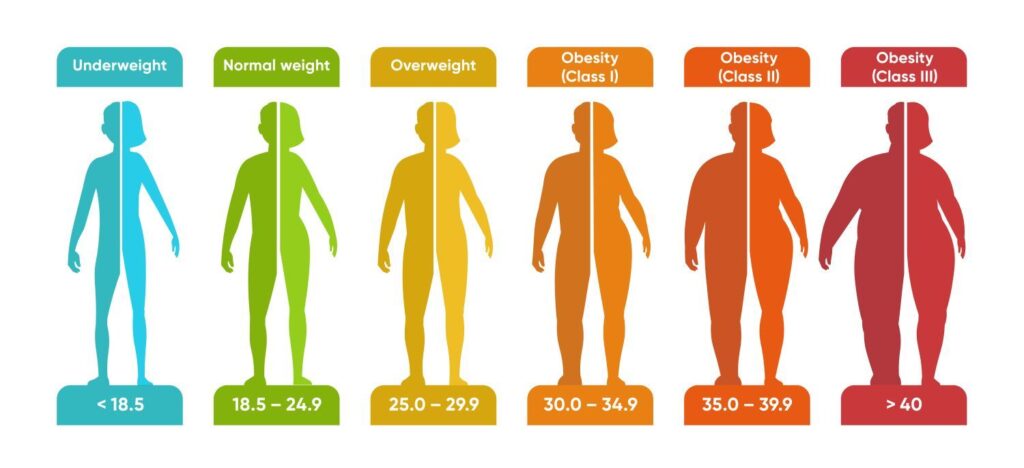
| BMI (kg/m²) | Category |
|---|---|
| Below 18.5 | Underweight |
| 18.5 to below 25 | Healthy weight |
| 25 to below 30 | Overweight |
| 30 or higher | Obesity |
These categories summarize a screening result. The same BMI can mean different things for different people. Review the CDC’s adult category explanation and discuss an unexpected result with a healthcare professional.
Why background and body composition matter
BMI does not distinguish muscle from fat. It can therefore be harder to interpret in a muscular person, and it does not identify where body fat is stored.
Clinical guidance can use lower thresholds for particular populations. NICE guideline NG246, recommendation 1.9.11, uses 23 to below 27.5 for overweight and 27.5 or above for obesity in adults with a South Asian, Chinese, other Asian, Middle Eastern, Black African or African–Caribbean background. These are clinical screening thresholds, not a separate BMI formula. They should not be presented as a universal diagnosis or a replacement for personal assessment.
NICE also advises caution with high muscle mass and in adults aged 65 or older. A number inside a category labelled “healthy weight” does not rule out a health problem.
Children and teenagers need a different interpretation
For ages 2 through 19, BMI is interpreted using age- and sex-specific percentiles. Do not use an adult category or adult weight-change target for a child. Use the CDC child and teen calculator and discuss growth concerns with a qualified clinician.
How to avoid common input mistakes
- Check the selected units before entering weight or height.
- Use 175 in a centimetre field and 1.75 in a metre field.
- In feet-and-inches mode, enter the two components separately; 5 feet 10 inches is not 5.10 feet.
- Use consistent measurement conditions when comparing results over time.
Should I change my weight because of this result?
A category alone is not enough to set a personal weight goal. Consider your health history, body composition and other measurements with a healthcare professional. Do not use this page to prescribe a diet, assess pregnancy weight or interpret unexplained weight changes.
Is BMI the same as body-fat percentage?
No. BMI uses only height and weight. A body-fat estimate uses different measurements and assumptions, and it has its own limits. Read our editorial policy or report an incorrect result.