
Child and teen BMI uses the same height-and-weight arithmetic as adult BMI, but the result is interpreted differently. A child’s number must be assessed in relation to age and sex on an appropriate growth reference. The CalcRange BMI Calculator is an adult tool with an age range starting at 20. Do not enter a different age just to make a child’s measurements fit.
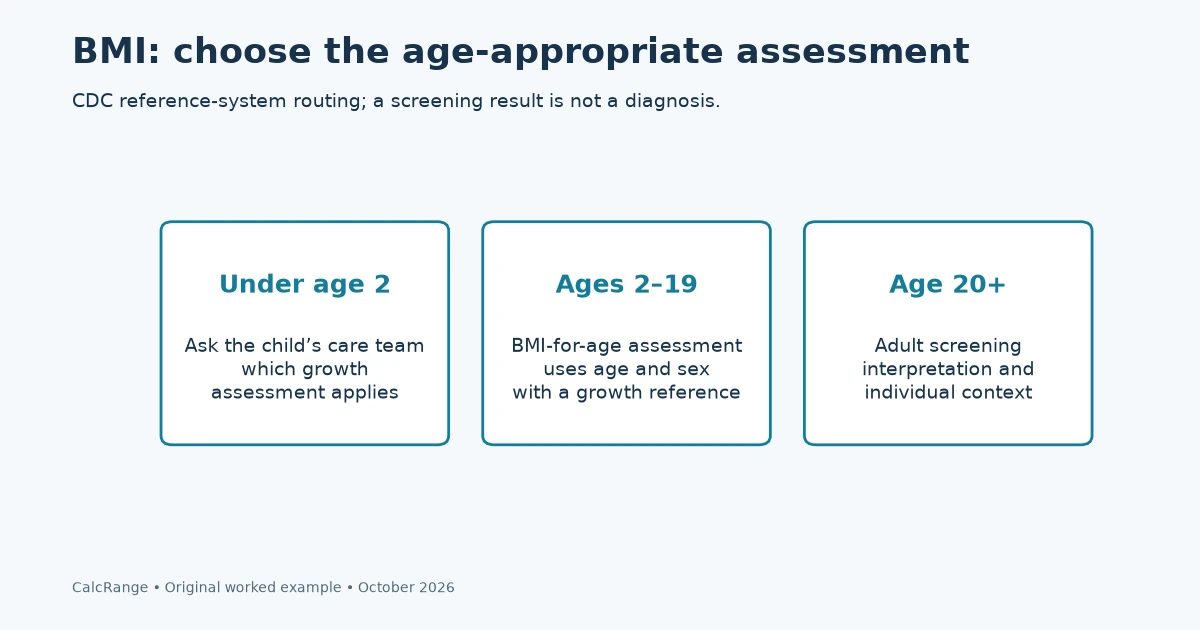
Table of Contents
Child and teen BMI: choose the assessment for the age
The CDC child and teen guidance uses BMI-for-age assessment for ages 2 through 19 and directs people aged 20 or older to its adult calculator. These are the boundaries of that reference system; they are not a declaration that everyone under 20 has the same growth pattern.
| Age or situation | Appropriate route | Do not do this |
|---|---|---|
| Under 2 years | Ask the child’s healthcare team which growth assessment applies | Apply an adult BMI category |
| 2 through 19 years | Use a validated age- and sex-specific child BMI reference | Substitute adult category cutoffs |
| 20 years or older | An adult BMI screening calculation may be relevant | Treat a category as a diagnosis |
| Uncertain age or growth history | Resolve the input with a healthcare professional | Guess a date of birth |
A 19-year-old who has reached adult height still falls within the CDC child and teen calculator’s stated age range. If your local health service uses a different established growth reference, use that service’s tool and interpretation consistently. Avoid mixing a percentile from one system with a label from another.
Child and teen BMI: separate arithmetic from interpretation
Consider two fictional people, each 1.50 m tall and weighing 45 kg. Their arithmetic is identical: 45 ÷ (1.50 × 1.50) = 20 kg/m². This calculation alone contains no age, development history or growth reference.
| Example | Calculation | What is still needed |
|---|---|---|
| Fictional adult, age 30 | 45 ÷ 1.50² = 20 | Adult screening interpretation and clinical context |
| Fictional child, age 10 | 45 ÷ 1.50² = 20 | Age- and sex-specific growth assessment and clinical context |
The second row deliberately has no invented percentile or category. A pediatric percentile cannot be recovered by relabeling the adult result. It requires the appropriate reference calculation and accurate age information.
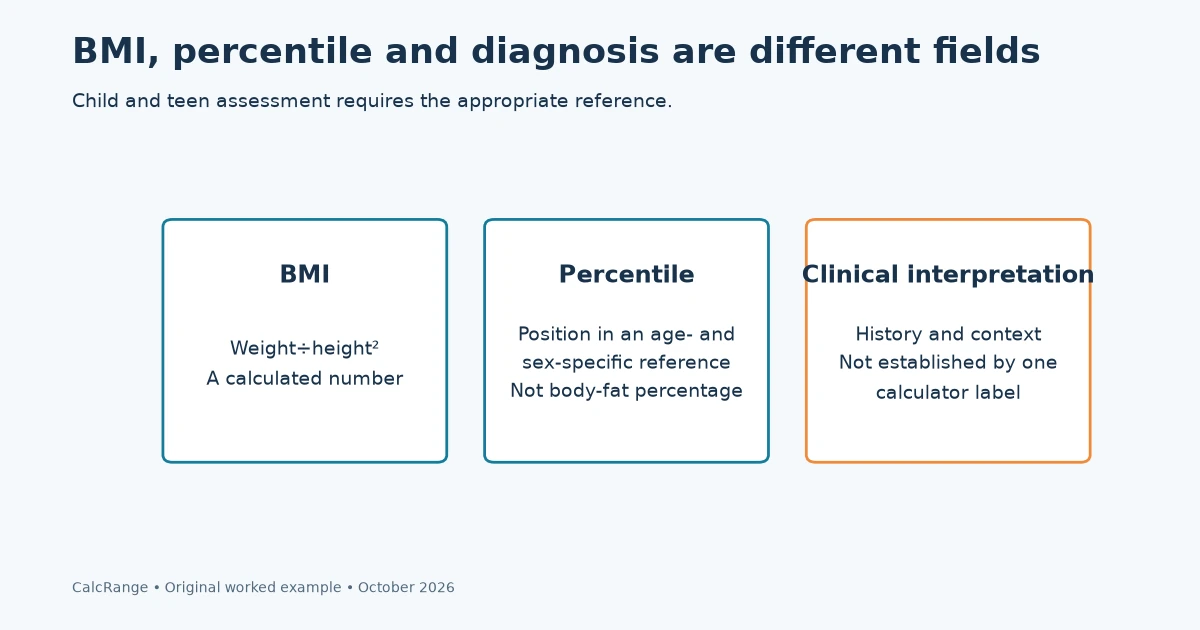
Likewise, BMI 20 does not mean 20% body fat, and an 80th percentile does not mean 80% body fat. A percentile describes a position relative to a reference distribution. Keep the numeric BMI and the percentile in separate fields when copying results.
Child and teen BMI: verify the measurement record
Record the date of measurement, date of birth, measured height, measured weight and units before entering anything. A child’s age at the time of measurement matters; using today’s age with last year’s height and weight produces a mismatched record.
Use the measurement instructions supplied by the validated child tool or healthcare service. A copied clothing size is not a measured height. If a scale displays pounds, do not enter that number into a kilograms field.
For a simple input check, 150 cm must become 1.50 m in the metric BMI formula. Entering 150 as metres changes the squared denominator enormously. Keep the original units in your notes so another person can reproduce the calculation without guessing.
Do not round a child’s age to a convenient whole number merely because an adult form accepts only years. Use the pediatric form’s requested dates and precision. If an old record lacks the needed information, label that limitation instead of creating an apparently exact percentile.
Fourth check: decide what the result can answer
CDC describes BMI as a screening measure, to be considered alongside other health information. A single reading cannot establish why a child is following a particular growth pattern or what intervention, if any, is appropriate.
Take the measurement history and the tool’s name to a healthcare professional if you have a concern. A sequence of properly recorded measurements provides different information from one isolated screenshot. Avoid using a calculator label to set a child’s calorie restriction or target weight.
| Keep | Why it helps |
|---|---|
| Tool and reference used | Makes the interpretation reproducible |
| Measurement date and age information | Prevents mixed dates |
| Original height and weight with units | Allows arithmetic checks |
| BMI and percentile in separate columns | Prevents confusing two different outputs |
| Questions for the healthcare team | Keeps interpretation separate from calculation |
For adults using CalcRange, the age field’s 20-year minimum is a useful boundary, not an obstacle to bypass. The article on BMI reference ranges discusses screening categories, and BMI’s limitations explains why height and weight do not directly measure body composition.
This guide’s task is choosing and documenting the correct kind of assessment. It does not reproduce a pediatric growth chart or offer individual growth, diet or treatment advice.
Work through a height-input recheck
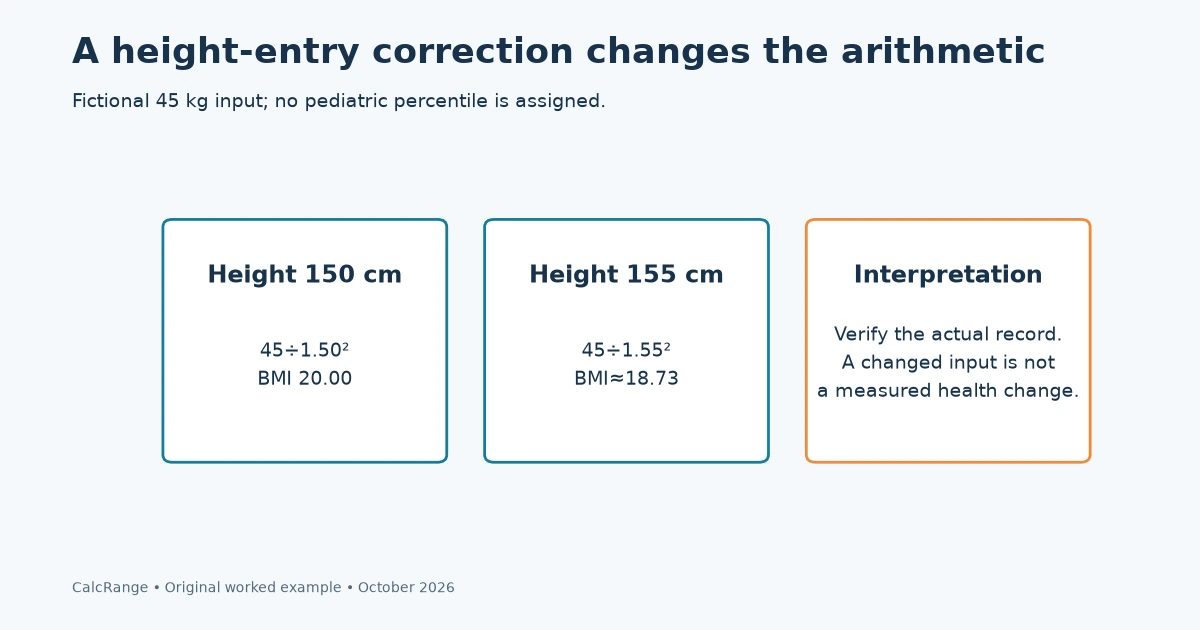
Suppose a fictional record contains 45 kg and 150 cm. Converting 150 cm to 1.50 m gives BMI 20. If the true recorded height was instead 155 cm, the arithmetic becomes 45 ÷ 1.55², approximately 18.73. A five-centimetre transcription difference changes the calculated BMI even before any interpretation occurs.
This is not an example of someone becoming healthier through a different entry. It is an example of input quality. Correcting a record and observing a body change are different events, and both should remain labelled in a log.
| Weight | Height entry | Calculated BMI | Meaning |
|---|---|---|---|
| 45 kg | 150 cm | 20.00 | First entered calculation |
| 45 kg | 155 cm | 18.73 | Calculation with a different height |
| 45 kg | Actual measured height needed | Not resolved by this table | Verify the source record |
For child and teen BMI, a corrected numeric result still needs the appropriate growth reference. Do not attach an adult category to either row. Keep the original entry, corrected entry, correction date and reason together so that a future reader can distinguish a transcription fix from a new measurement.
Build a dated growth-record handoff
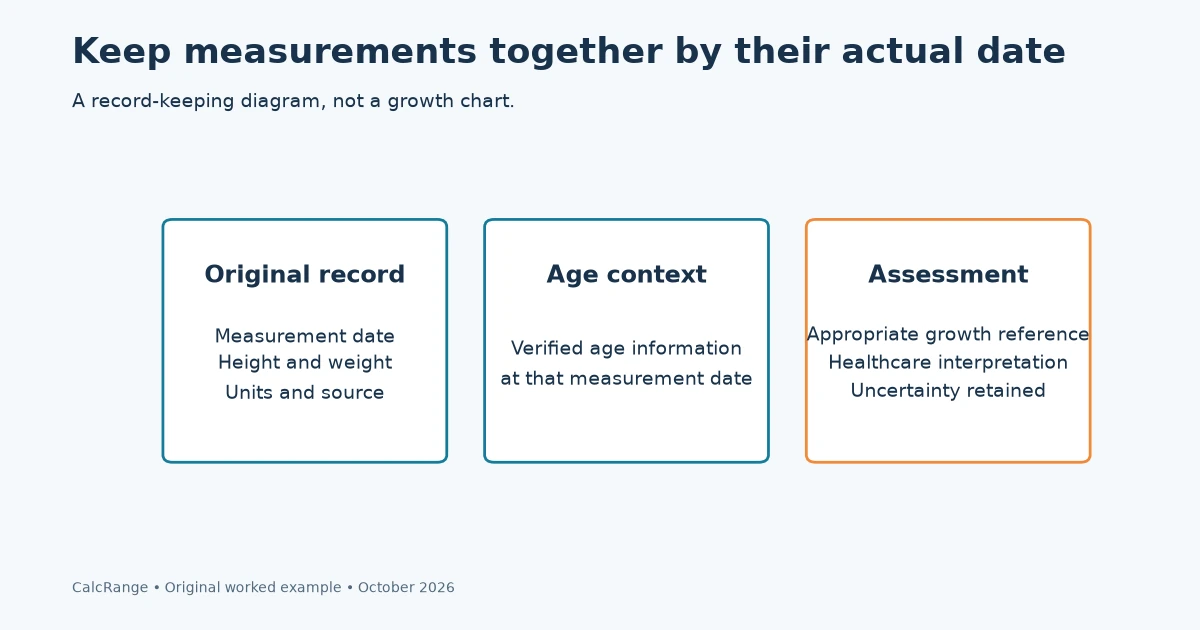
A useful handoff starts with the records already available. Put each measurement on its actual date and retain the original units. Avoid combining a height measured at school with a weight measured months later and presenting them as a single contemporaneous assessment.
Use a worksheet with columns for measurement date, date of birth or verified age information, height, weight, units, measurement source and any uncertainty. Leave an unknown value blank with a note rather than borrowing it from the nearest row.
For a historical result, save which tool or reference produced it. If a newer tool shows a different result, compare the input dates, growth reference and rounding before assuming either tool has made an arithmetic error.
Do not infer a growth trend from two unlabelled screenshots. Ask the healthcare team how the available history should be interpreted and which additional measurements, if any, are useful. This guide does not establish a schedule of examinations or a treatment threshold.
The practical benefit is traceability: someone can see where each number came from without needing to reconstruct it from memory. It does not require publishing a child’s identifiable medical record online.
Copy the result without changing what it means
When saving a child and teen BMI result, keep the numeric BMI, percentile and reference category in separate fields. If the validated tool supplies an explanation, preserve its context rather than copying only a coloured label.
A result can be misquoted in several ways: calling a percentile a body-fat percentage, using today’s age with old measurements, treating an adult calculator’s output as a pediatric assessment, or rounding dates before entering a growth tool. None is repaired by making the final chart more visually precise.
Before sharing a result, check whether the question actually needs that personal detail. A general question about how the calculation works can be asked using an explicitly fictional example such as the 45 kg and 1.50 m case above.
If your aim is understanding adult screening, use the adult tool within its age boundary. If your concern is a child’s growth, take a correctly dated measurement history to an appropriate healthcare professional. The routing decision comes before interpreting the number.
A concise result note should therefore say what was calculated, which age-specific system was used and what remains uncertain. It should not claim a diagnosis, a recommended diet or a personal goal that the calculator never established.
Child and teen BMI: common questions
Can I use an adult BMI calculator for a teenager?
Do not use its adult category to assess a teenager. For the CDC system, ages 2 through 19 require an age- and sex-specific BMI-for-age assessment.
Does the BMI formula change for a child?
The basic kilograms-divided-by-metres-squared arithmetic is the same. The interpretation changes because a child’s result needs an appropriate growth reference.
Is a percentile a body-fat percentage?
No. A percentile is a position within a reference distribution, not the percentage of body weight made up of fat.
Sources and calculation notes
The two-person example is original arithmetic with fictional measurements. It intentionally assigns no pediatric percentile or individual health recommendation. Sources checked October 30, 2026.