Mortgage Calculator 2026 – Free Monthly Home Loan Payment

Home ownership is likely one of the biggest purchases you’ll ever make, and your monthly mortgage payment is likely the number that will have the biggest effect on your budget for years. Our free mortgage calculator makes that task simple by instantly providing an estimated monthly payment along with loan amount, total interest amount paid over loan term, total cost over loan life cycle and estimated loan term remaining.

Viewing all four figures at once is an empowering way to test how a larger down payment lowers payments, lower interest rates can save money, or compare 15-year terms versus 30-year ones – effectively turning what could otherwise be an overwhelming decision into clear and comparable figures before ever speaking with lenders. You can check EMI through our calculator Click Here:

Mortgage Calculator

Estimate your monthly mortgage payment including taxes, insurance, PMI and HOA — and see your full amortization schedule. Add extra payments to see how much faster you could pay off your home.

Optional monthly & yearly costs

⚠ Estimate only. Property tax, insurance and PMI vary by location and lender; PMI is assumed to drop once the loan balance falls below 80% of the home price. Confirm exact figures with your lender. Not financial advice.

How to Utilize This Mortgage Calculator

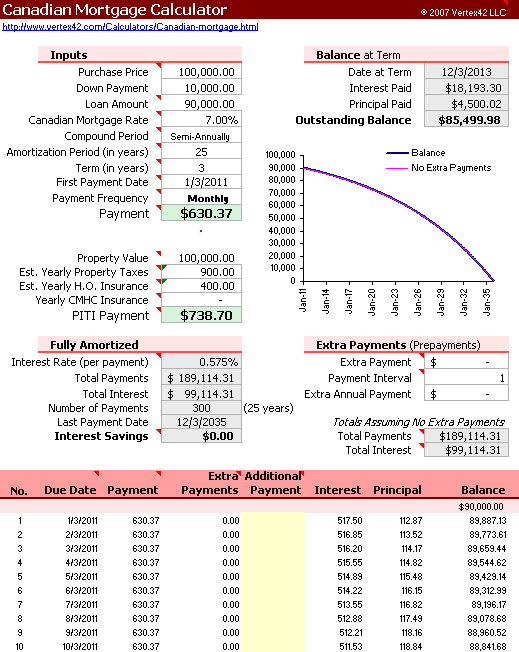
This calculator requires four inputs to calculate. Enter the Home Price as the total price, the Down Payment as the upfront cash payment and an Annual Interest Rate as a percentage – then choose either 10, 15, 20 or 30 years as your Loan Term dropdown option. When you press calculate, your results are instant: monthly payment amount due, loan amount (home price minus down payment), total interest you’ll pay across term as well as total cost including interest are displayed instantly on a chart. By changing any input you can quickly compare different scenarios side-by-side!

mortgage calculator

What Goes into a Mortgage Payment?

At its core, mortgage payments consist of two components: principal (which reduces your total amount owed) and interest. This calculator focuses on both aspects, which collectively form your monthly base payment in fixed-rate loans.

Realistically, a monthly housing payment often entails more than principal and interest. These items might include property taxes set by local governments; homeowners insurance that protects the property; private mortgage insurance (PMI), which protects lenders; homeowners association (HOA) fees depending on location; some properties also carry homeowners association dues (HOA fees); these extra expenses vary widely by location and property type – this calculator estimates only your core principal-and-interest payments while you should budget separately for taxes, insurance premiums and any association dues when making your budgeting commitments.

Mortgage Payment Calculator – How Can You Stay within Your Monthly Budget When Shopping for a home

he calculator utilizes an amortizing loan formula to estimate monthly principal and interest payments:

M = P x [r(1 + r)n]/[r(1 + r)n – 1]

Where: At each monthly payment date (yr x 12), M stands for monthly payment; P refers to loan amount minus down payment (home price less down payment); R is monthly interest rate (12×100/100); and N stands for number of years with 12 monthly payments each.

Example: A $300,000 loan at 6.5% interest over 30 years results in an approximate monthly principal and interest payment of approximately $1896. Using amortization technology, payments will be spread evenly over time so your base monthly payment remains predictable from month to month – something known as amortization.

mortgage calculator

How Your Down Payment Alters the Entire Picture

Your down payment can have an immense effect on your mortgage. As your loan balance shrinks, so too do monthly payments and total interest costs over the life of the loan. Lenders generally prefer 20% as this threshold often requires private mortgage insurance payments until your remaining balance drops below 80% of original home value; any less requires PMI premium payments for an added monthly cost. A larger down payment can help qualify you for more favorable interest rates; use this calculator to see exactly how increasing it lowers both monthly payments and total costs over time.

Loan Terms Available: 15 Year Versus 30 Year Loan Options

Loan terms can have a huge effect on your total cost. Stretching out payments over 30 years spreads the total payment out over more payments, making each monthly installment lower and more affordable – but with interest accruing much longer, total interest payment increases significantly. Shorter terms like 15 years have higher monthly payments but dramatically less total interest paid; shorter loans usually also feature lower interest rates too. A 30-year fixed loan is generally considered the more cost-effective choice, however running both through our calculator can show you real numbers on both ends.

Tips to Reduce Mortgage Costs

Beyond selecting an appropriate term, several strategies can help significantly lower what you pay. A larger down payment reduces both monthly payments and total interest, helping to eliminate private mortgage insurance (PMI). Searching around for lower interest rates makes a tremendous difference over decades. Making extra principal payments early also cuts back on future interest accrual allowing you to pay off the loan sooner – this calculator lets you simulate lower rates with bigger down payments to see the savings before committing yourself.

Mortgage Calculator: Estimate Your Monthly Home Loan Payment with Confidence

Buying a home is one of the biggest financial commitments most people ever make, and the hardest part is often the uncertainty. What will the payment actually be each month? Can the budget really stretch that far? A mortgage calculator answers those questions before any paperwork is signed, turning a nerve-wracking guess into a clear, dependable number. It is the single most useful tool a buyer can reach for at the start of the journey.

This guide explains how a mortgage calculator works, what goes into a monthly payment, and how the choices a buyer makes — from the loan term to the down payment — shape the final cost. Whether someone is a first-time buyer or weighing a move, understanding these moving parts makes the whole process far less intimidating.

What a Mortgage Calculator Does

A mortgage calculator is a tool that estimates the monthly cost of a home loan based on a handful of inputs. Rather than wrestling with a complex formula, a person enters the loan amount, the interest rate, and the loan term, and the result appears instantly. Many people use a home loan calculator and a mortgage calculator to mean the same thing, and a mortgage payment estimator does exactly what its name promises: it projects the payment a buyer can expect.

The beauty of these tools is the freedom to experiment. Someone can raise or lower the home price, adjust the down payment, or stretch the loan term and watch the monthly figure respond in real time. That kind of testing helps a buyer settle on a comfortable budget long before talking to a lender, which is why a mortgage calculator is usually the very first step toward confident homeownership.

The Four Parts of a Monthly Payment

A common surprise for new buyers is that the monthly payment is not just loan repayment. It usually bundles four separate costs together, often shortened to PITI: principal, interest, taxes, and insurance. A good calculator accounts for all of them, which is why its estimate tends to match reality far better than a quick back-of-the-envelope sum.

Principal and Interest

The core of every payment is principal and interest. The principal balance is the amount still owed on the loan, and a slice of each payment chips away at it. Interest is the lender’s charge for the loan, and prevailing interest rates have an enormous effect on the monthly payment — even a small change in the rate can move the figure noticeably. In the early years, a large share of each payment goes toward interest, with the balance gradually shifting toward principal as the loan matures.

Taxes and Insurance

The other two parts are easy to overlook but very real. Property taxes are charged by local government based on the home’s value, and homeowners insurance protects the property against damage. Lenders usually collect both through an escrow account, spreading the annual cost across twelve monthly installments. If the down payment is small, a buyer may also pay private mortgage insurance, known as PMI, which protects the lender until enough equity is built up. Homes in managed communities can carry HOA fees on top. A thorough mortgage calculator lets a person add property taxes, insurance, PMI, and HOA fees so the estimate reflects the true monthly outlay rather than just the loan itself.

How the Calculation Works

Behind the scenes, a mortgage calculator uses the loan amount, the interest rate, and the loan term to work out a fixed monthly payment that will clear the debt exactly on schedule. The result is best understood through an amortization schedule, which is a month-by-month table showing how each payment splits between interest and the principal balance over the life of the loan.

That schedule reveals something many buyers find eye-opening. Early payments lean heavily toward interest, so the principal balance barely moves at first. As the years pass, the balance tips, and later payments make a much larger dent in what is owed. Studying the amortization schedule also makes the total interest paid clear, which is often a far bigger number than people expect and a powerful argument for paying a loan down faster where possible.

Choosing a Loan Term

One of the most consequential decisions is the loan term, the number of years over which the loan is repaid. The thirty-year term is the most popular because it keeps the monthly payment low and manageable. A fifteen-year term, by contrast, demands a higher monthly payment but clears the debt in half the time and slashes the total interest paid.

There is no single right answer here. A longer term eases monthly pressure, which suits a tight budget, while a shorter term saves a great deal of money overall. Running both through a mortgage calculator side by side is the clearest way to see the trade-off, and the contrast in total interest paid often surprises people enough to reshape their plans.

Fixed-Rate Versus Adjustable-Rate Mortgages

Another major fork in the road is the type of interest rate. A fixed-rate mortgage locks the interest rate for the entire term, so the principal-and-interest portion of the payment never changes. This predictability makes long-term budgeting simple and is why so many buyers prefer it.

An adjustable-rate mortgage, often called an ARM, usually starts with a lower introductory rate that can rise or fall later based on market conditions. It can save money in the early years, but it carries the risk of higher payments down the line. A calculator helps a buyer model both paths and decide which balance of stability and potential savings fits their situation and their tolerance for uncertainty.

The Down Payment and Building Equity

The down payment is the upfront sum a buyer contributes, and it shapes everything that follows. A larger down payment means borrowing less, which lowers both the monthly payment and the total interest paid. It also helps a buyer avoid or shorten the period of paying PMI, since reaching a certain threshold of ownership reassures the lender.

From day one, the down payment establishes home equity, the portion of the property a buyer truly owns. Equity grows as the principal balance shrinks and, ideally, as the home’s value rises over time. That growing equity is one of the quiet rewards of homeownership, and it can later be tapped for renovations or other major needs.

What Lenders Look At

Before approving a loan, lenders weigh a few key factors, and understanding them helps a buyer prepare. The debt-to-income ratio compares a person’s monthly debt payments to their income, and a lower ratio signals that a new mortgage payment is comfortably affordable. Lenders look closely at this number when deciding how much to offer.

Credit score impact is just as important. A stronger credit score typically unlocks better interest rates, which can save a fortune across a long loan, while a weaker score may mean higher rates or tougher terms. Many buyers begin with mortgage pre-approval, a lender’s conditional commitment based on a review of finances. Pre-approval clarifies the realistic budget and signals to sellers that a buyer is serious, which can be a genuine advantage in a competitive market.

How Much House Can You Afford

Beyond the monthly payment, the bigger question is affordability. A mortgage payment estimator helps here by working backward: a buyer can see what home price keeps the payment within a comfortable share of their income. Lenders and financial planners often suggest keeping housing costs to a sensible portion of monthly earnings, leaving room for savings, emergencies, and ordinary life.

It is also wise to budget beyond the mortgage itself. Closing costs, maintenance, utilities, and the recurring taxes and insurance already mentioned all add up. A calculator that includes these extras gives a far more honest picture of what a home will truly cost, helping a buyer avoid stretching themselves too thin.

Refinancing and Paying Off Early

A mortgage is not necessarily fixed forever. When interest rates fall or finances improve, a refinance calculator can show whether replacing the existing loan with a new one would lower the payment or shorten the term. Refinancing carries its own costs, so the calculator’s job is to reveal whether the long-term savings outweigh them.

Making extra payments is another powerful lever. Putting additional money toward the principal balance, even occasionally, reduces the total interest paid and can bring the payoff date forward by years. A good mortgage calculator lets a person model these extra payments and see the impact, which is often motivating enough to make them a habit.

Frequently Asked Questions

What does a mortgage calculator include in the monthly payment? A complete estimate covers principal, interest, taxes, and insurance, often with options to add PMI and HOA fees. Together these reflect the true monthly cost rather than just the loan repayment.

How do interest rates affect my mortgage? Interest rates strongly influence the monthly payment and the total interest paid over the life of the loan. Even a small rate difference can change the payment meaningfully, which is why a strong credit score and shopping around matter so much.

Should I choose a 15-year or 30-year loan term? A thirty-year term keeps monthly payments lower, while a fifteen-year term raises them but greatly reduces the total interest paid. Comparing both in a mortgage calculator is the clearest way to decide.

What is the difference between a fixed-rate and adjustable-rate mortgage? A fixed-rate mortgage keeps the same interest rate for the whole term, giving predictable payments. An adjustable-rate mortgage starts lower but can change over time with the market.

How does my down payment affect the loan? A larger down payment reduces the amount borrowed, lowers the monthly payment and total interest, builds immediate home equity, and can help a buyer avoid paying PMI.

Final Thoughts

A home loan can feel overwhelming, but it rests on a handful of understandable parts: the principal balance, the interest rate, the loan term, and the taxes and insurance that round out each payment. A mortgage calculator brings all of them together into one clear figure, and a mortgage payment estimator lets a buyer test scenarios until the numbers feel right. By experimenting with the down payment, comparing loan terms, and watching the amortization schedule unfold, a buyer trades anxiety for understanding. That clarity is what turns the dream of owning a home into a confident, well-planned decision.

FAQs

How is a monthly mortgage payment calculated?

Using the amortization formula M = P × [r(1 + r)^n] ÷ [(1 + r)^n − 1], where P is the loan amount, r is the monthly rate, and n is the number of monthly payments. This calculator does the math instantly.

What should my mortgage payment include?

This calculator calculates principal and interest; a complete housing payment may also include property taxes, homeowners insurance premiums (if your down payment falls under 20%) or even HOA fees.

How Much Should My Down Payment Be?

Lenders typically prefer at least 20% down as this helps avoid private mortgage insurance and secures better interest rates. A larger down payment reduces both monthly payments and total interest costs over time.

What Is PMI?

Private mortgage insurance (PMI) is often mandatory when your down payment falls below 20%. This insurance protects lenders, typically being cancelled once loan balance falls to below 80% of original value of home purchased.

Which mortgage term should I select: 15-year or 30-year mortgages?

A 30-year term has lower monthly payments but more total interest. A 15-year term typically involves higher payments but far less overall interest overall and usually has a lower rate; ultimately it comes down to your budget and what works for you.

How Does Interest Affect My Payments?

A small rate change can have a big effect over a long loan’s lifetime; even minor fluctuations have an immense ramification on both monthly payments and total interest payments, potentially saving tens of thousands over its duration.

What Is Amortization?

Amortization refers to spreading out your payments evenly over the loan term – early payments go mostly toward interest, while later ones shift more heavily toward principal. Your total monthly payment remains constant as a result.

Can making extra payments save me money?

Yes. Extra payments reduce your principal balance early, which reduces interest charges over time and can speed up loan payoff – potentially saving a considerable amount in interest over time.

Does This Calculator Include Taxes and Insurance?

No-this calculator only estimates a principal-and-interest payment; taxes, insurance premiums and HOA fees vary based on location – plan accordingly when budgeting separately in addition to what this calculator estimates.

Is This Mortgage Calculator Free and Unlimited?

Yes! Absolutely free and without signup requirements – feel free to compare as many home prices, down payments, interest rates and terms as desired!

Scroll to Top