
Calculate your GPA from course grades and credits on the fixed 4.0 scale below, or estimate the average needed to reach a target GPA. Compare this scale with your school’s policy before using the result.
GPA Calculator
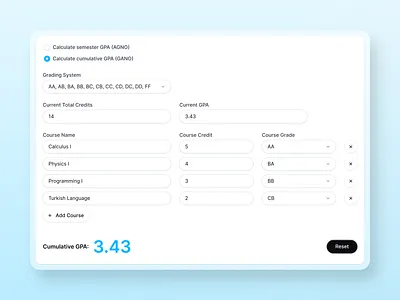
Enter your courses, the number of credits (or units) for each, and the grade you earned. Course names are optional. Works for high school, college and university on the standard 4.0 scale.
GPA Planning Calculator
Find out the minimum GPA you need in your upcoming courses to reach (or maintain) a target GPA.
Grade Scale (4.0 System)
How to use this GPA calculator
- Enter each course’s credits and select its letter grade. A course name is optional.
- Add more rows if needed. Only rows with positive credits and a selected grade enter the result.
- Select Calculate and check the course breakdown, total credits and quality points.
- Compare the scale below with your school’s policy before using the result for planning.
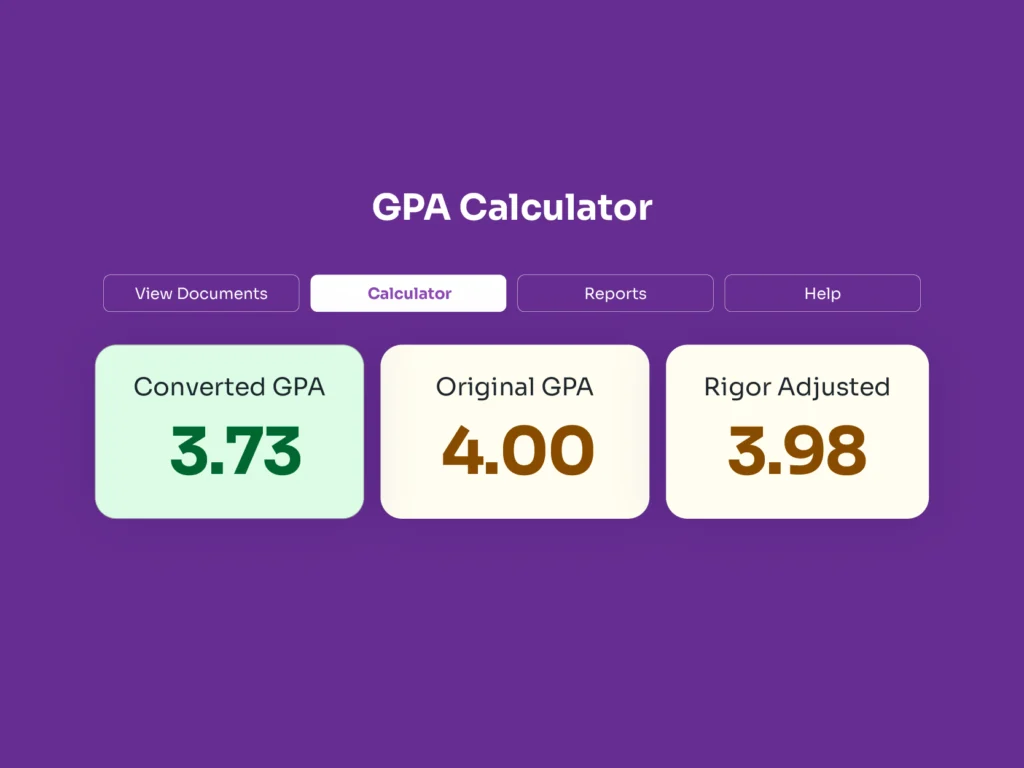
The result is a credit-weighted GPA displayed to two decimal places. It is an estimate, not an official transcript. This calculator uses a fixed 4.0 scale; it does not add honors, AP or IB bonus points or let you define a custom scale.
The grading scale used here
| Grade | Points per credit |
|---|---|
| A+ or A | 4.0 |
| A− | 3.7 |
| B+ | 3.3 |
| B | 3.0 |
| B− | 2.7 |
| C+ | 2.3 |
| C | 2.0 |
| C− | 1.7 |
| D+ | 1.3 |
| D | 1.0 |
| D− | 0.7 |
| F | 0.0 |
This is the tool’s implemented scale, not a universal standard. For example, the University of Wisconsin–Green Bay grading policy uses AB = 3.5 and BC = 2.5. If your institution uses different point values, calculate from its published values instead of substituting the nearest dropdown grade.
GPA formula and a worked example
Quality points for a course = course credits × grade points.
GPA = total quality points ÷ total GPA credits.
| Course | Credits | Grade | Quality points |
|---|---|---|---|
| Course 1 | 3 | A (4.0) | 12.0 |
| Course 2 | 4 | B (3.0) | 12.0 |
| Course 3 | 3 | B+ (3.3) | 9.9 |
| Total | 10 | — | 33.9 |
33.9 ÷ 10 = 3.39 GPA. A simple average of the three grade-point values would not give the correct result because one course carries four credits and the others carry three. For another walkthrough, see how to calculate GPA.
Use the target GPA planner
Enter your current GPA, the credits included in that GPA, your target GPA and the additional credits you plan to complete. The planner estimates the average needed across those additional credits on this 4.0 scale.
Required future GPA = [(target GPA × total credits after study) − (current GPA × current credits)] ÷ additional credits.
For example, a 2.80 GPA across 30 credits followed by 15 more credits requires a 3.40 future average to finish at 3.00: [(3.00 × 45) − (2.80 × 30)] ÷ 15 = 3.40. A required average above 4.00 is not achievable within the selected number of credits on this scale. The estimate assumes the current credits remain in the GPA; it does not apply a repeated-course replacement policy.
Frequently asked questions
Is credit weighting the same as a weighted high-school GPA?
No. Credit weighting gives a higher-credit course more influence. A weighted high-school GPA may separately award extra points for advanced classes. This tool performs credit weighting without advanced-course bonus points.
Should I enter pass/fail, withdrawal or transfer courses?
Include only courses and credits that your institution includes in GPA. Do not turn a passing non-graded course into an A or enter all transfer credits automatically. The registrar determines which grades affect GPA.
Can I combine semester GPAs?
Yes, mathematically, if they use the same scale and you weight each semester by its GPA credits: add each semester GPA multiplied by its credits, then divide by the combined credits. Averaging the semester GPAs directly works only when their credit totals are equal. Previously rounded semester GPAs can introduce a small difference.
Why does my transcript show a different result?
Check grade-point values, repeat rules, excluded courses and the institution’s rounding policy. The displayed two-decimal estimate should not replace the GPA on an official transcript.
Can I convert GPA to a percentage or letter grade?
Only the institution can supply an authoritative conversion. The illustrative GPA-to-letter chart explains why mapping an average back to one letter can hide the original grades. The percentage conversion guide describes similar limitations.
Method: the course-credit formula and fixed dropdown scale shown above. Source reference checked September 10, 2026. School-specific grading and transcript decisions remain with the registrar. See CalcRange’s editorial and correction policy.