
When retaking a course, GPA changes depend on the institution’s repeat policy. Replacing an old grade in the GPA is different from counting both attempts. The same new A can therefore produce different cumulative averages without either calculation being arithmetically wrong.
Use the GPA calculator after establishing which attempts belong in your GPA. It can calculate weighted grades from the rows you enter, but it does not identify your school’s grade-replacement eligibility or automatically remove an earlier attempt.
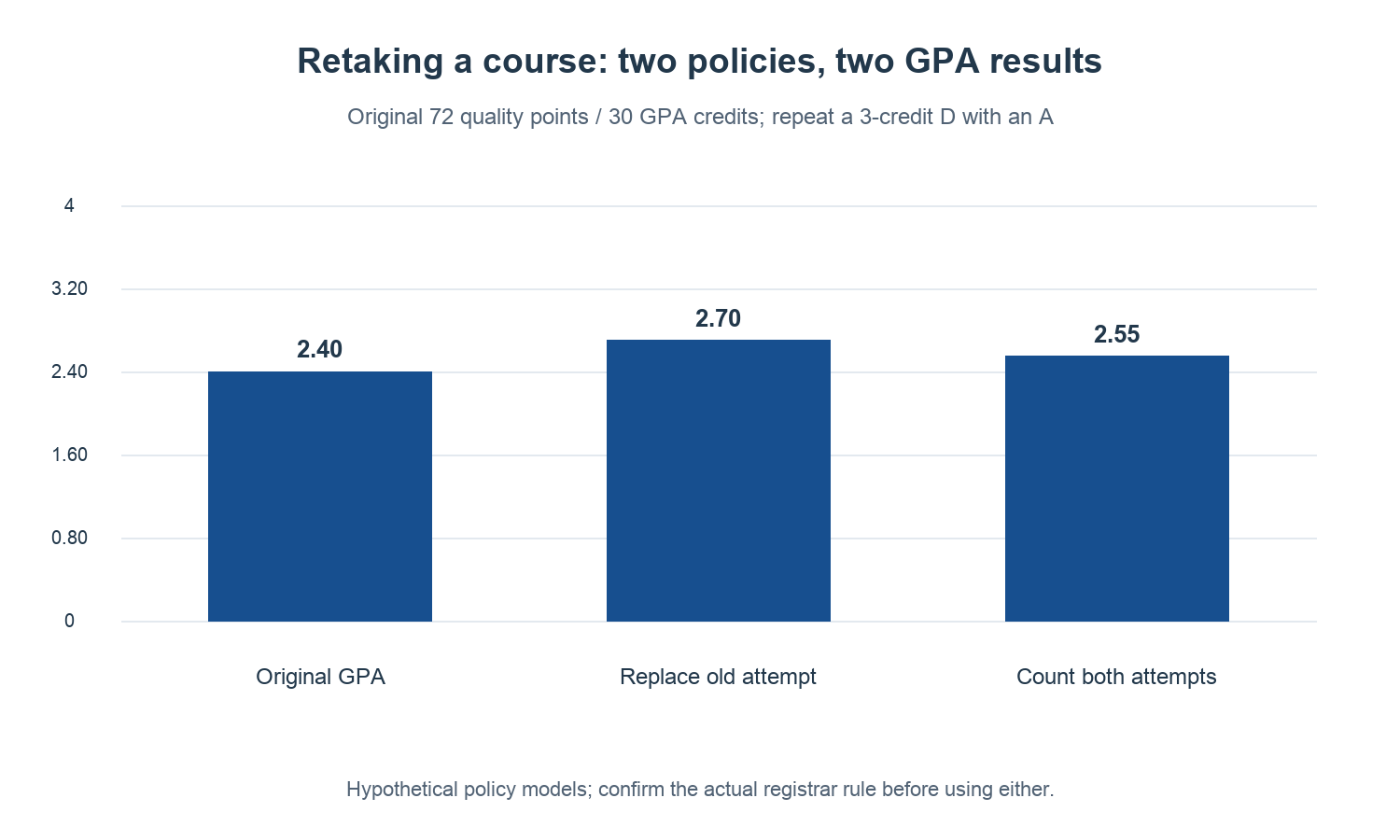
Table of Contents
Before retaking a course, check the GPA policy
Ask the registrar whether the old attempt is excluded, whether both attempts count, whether the latest or highest grade is used, and whether any repeat limit or application process applies. Also confirm whether the rule changes for transfer work, a different course number or a particular program.
A concrete example of policy variation is the University of Washington’s undergraduate repeat policy: its published guidance includes both the original and second grades in GPA while counting course credit once. That is one institution’s policy, not a universal definition of a retake.
The two models below are explicitly hypothetical. Model A removes the old attempt from the GPA and inserts the new one. Model B retains the old attempt and adds the new one. Neither model decides which courses count toward a degree or whether a student qualifies to repeat a course.
Retaking a course: 30 GPA credits at 2.40
Assume a transcript has 30 GPA credits and 72 quality points. Its GPA is 72 ÷ 30 = 2.40. Included in those totals is one three-credit course with a D worth 1.0 grade point per credit, contributing three quality points.
The student repeats that same three-credit course and earns an A worth 4.0 points per credit. The new attempt contributes 3 × 4 = 12 quality points. This example uses a stated 4.0 scale; your institution’s grade values may differ.
| Step | Model A: replace old attempt | Model B: count both attempts |
|---|---|---|
| Starting quality points | 72 | 72 |
| Remove old D’s points | −3 | No removal |
| Add new A’s points | +12 | +12 |
| New quality points | 81 | 84 |
| New GPA-credit denominator | 30 − 3 + 3 = 30 | 30 + 3 = 33 |
| New cumulative GPA | 81 ÷ 30 = 2.70 | 84 ÷ 33 ≈ 2.55 |
Model A improves the GPA by 0.30. Model B improves it by about 0.15 after display rounding. The difference comes from the treatment of the old attempt and the denominator, not from a different value assigned to the new A.
Do not remove the old grade’s points but leave its credits in the denominator. That mixes policies. Similarly, do not add the new points without adding its GPA credits when both attempts are supposed to count.
Compare possible grades when retaking a course
Using the same initial 72 points and 30 GPA credits, the following table shows three possible grades for the new three-credit attempt. All values are arithmetic scenarios, not a recommendation or prediction of a student’s grade.
| New grade | New attempt’s points | Replacement model | Both-attempts model |
|---|---|---|---|
| A = 4.0 | 12 | 81 ÷ 30 = 2.70 | 84 ÷ 33 ≈ 2.55 |
| B = 3.0 | 9 | 78 ÷ 30 = 2.60 | 81 ÷ 33 ≈ 2.45 |
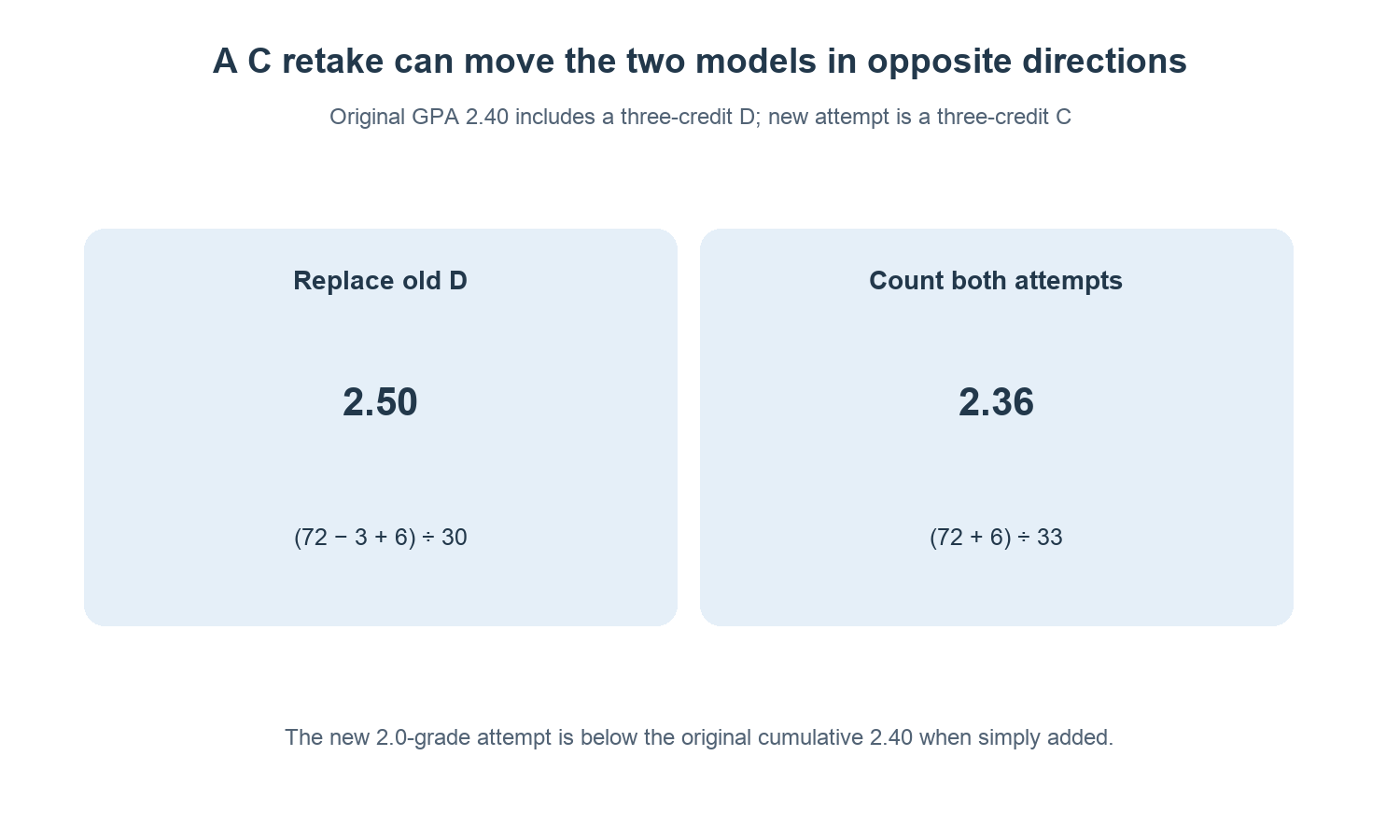
| C = 2.0 | 6 | 75 ÷ 30 = 2.50 | 78 ÷ 33 ≈ 2.36 |
The C example reveals a useful distinction. Replacing the old D with a C improves this student’s GPA. Adding a C while retaining the D lowers the cumulative 2.40, because the added attempt’s 2.0 average is below the existing cumulative average.
A retake can therefore be necessary for a course requirement without automatically improving every GPA calculation. Keep the academic requirement and the arithmetic projection as separate questions when planning with an adviser.
GPA credits are not always degree credits
The denominator used in a GPA calculation is the set of credits included under that GPA’s rules. It is not necessarily identical to credits earned toward graduation, registered credits or attempted credits used in a financial-aid calculation.
For example, a school may count both graded attempts in the GPA but award degree credit for the course only once. Conversely, an excluded grade may remain visible on the transcript. A recalculated GPA does not imply that an earlier record disappears.
Use the transcript’s labelled GPA hours and quality points where available. Multiplying a rounded displayed GPA by total credits can introduce a small approximation; the original quality-point total is a more precise starting point.
Build a worksheet that matches the confirmed policy
- List the currently included courses with their GPA credits and grade-point values.
- Mark the old attempt clearly so it cannot be lost or counted twice accidentally.
- For a confirmed replacement model, exclude the old row and include the new attempt.
- For a confirmed both-attempts model, retain both rows with their own credits.
- Check the final quality-point numerator and credit denominator independently.
The calculator’s target-GPA section models additional credits. A retake that replaces an old attempt is not simply an ordinary addition: first adjust the existing totals according to the policy. Otherwise a correct target formula can answer the wrong scenario.
Our semester vs cumulative GPA guide explains why averages need credit weighting, while planning a GPA improvement covers the effect of the size of the existing record.
Retaking a course: audit the old quality points first
Before modelling retaking a course, check that the old course is actually included in the starting total. A planning mistake occurs when someone uses a transcript total that already excludes the original grade and then subtracts that grade again.
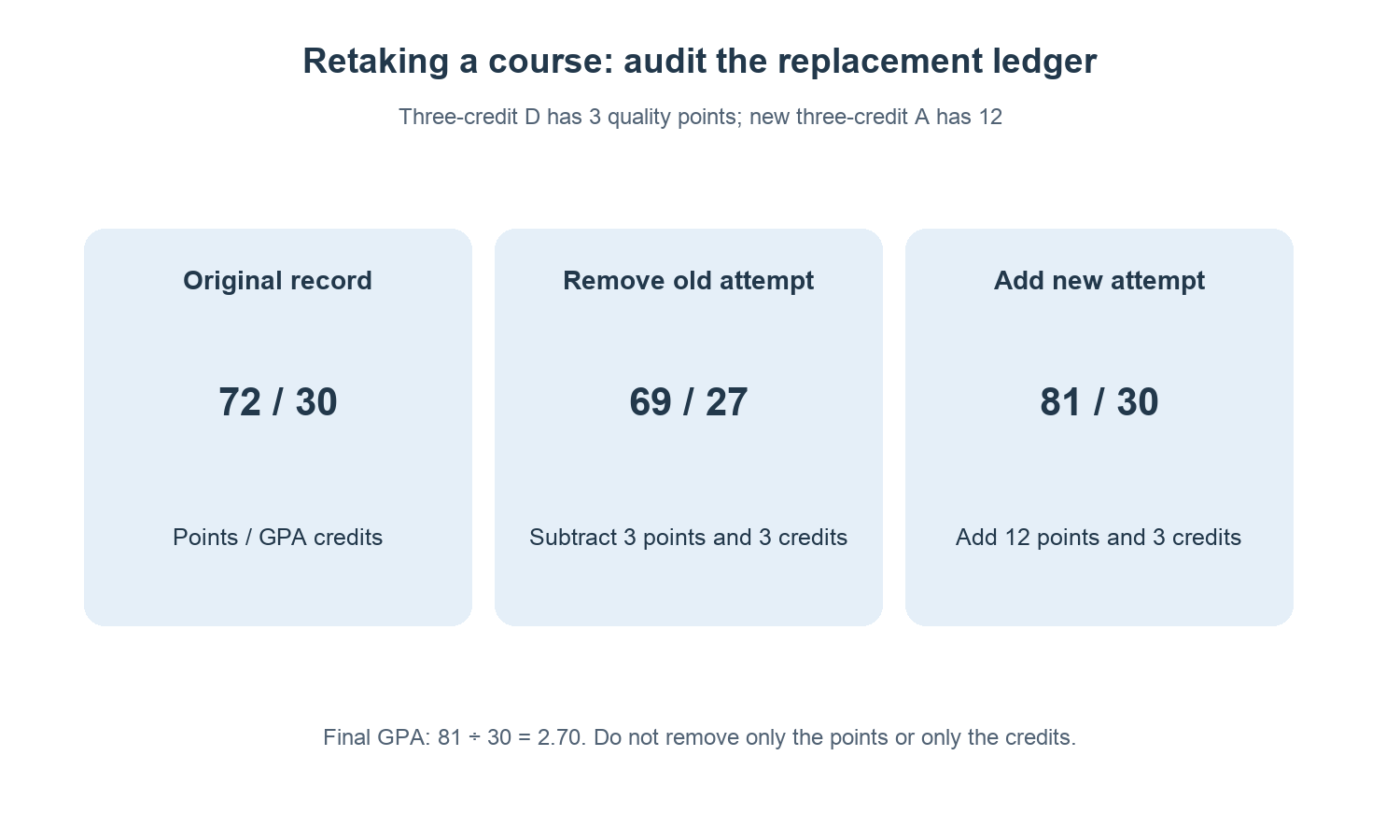
For the original 30-credit example, the old three-credit D contributes three points. Removing it leaves 27 GPA credits and 69 points. That remaining record has an average of 69 ÷ 27 ≈ 2.5556. Adding the new three-credit A then returns the denominator to 30 and raises the numerator to 81.
| Stage | GPA credits | Quality points |
|---|---|---|
| Original record including D | 30 | 72 |
| After removing the old attempt | 27 | 69 |
| After adding the new A | 30 | 81 |
This audit trail is useful even if the final tool only shows a GPA. It reveals exactly which numerator and denominator changed. Save it with the policy assumption so a later change in eligibility can be modelled without rebuilding the transcript from memory.
Retaking a course with different credits
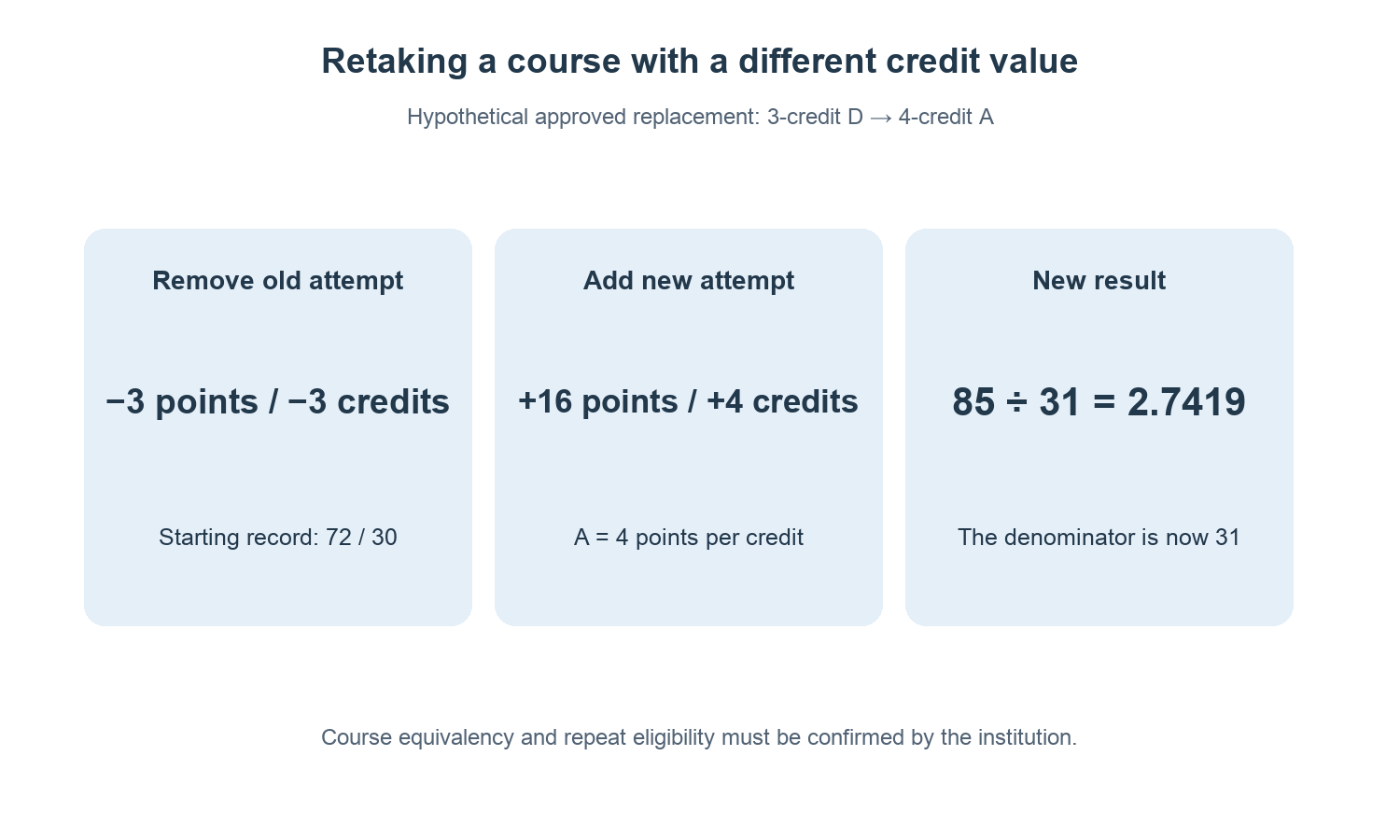
Suppose, only as an arithmetic model approved by a hypothetical policy, a three-credit D is replaced by a four-credit A. Starting from 72 points over 30 credits, remove three points and three credits, then add sixteen points and four credits. The result is 85 ÷ 31 ≈ 2.7419.
Leaving the denominator at 30 would overstate the result. Adding four credits without removing the original three would instead create a both-attempts denominator. Which treatment is permitted is an institutional question; the worksheet must implement the confirmed policy rather than selecting the result that looks best.
Also check whether the new course is considered equivalent to the old one. Similar titles or a larger credit value do not establish substitution eligibility. Obtain that answer before treating the example as a personal projection.
A rounded starting GPA can hide quality points
A transcript might display 2.40 while storing a more precise underlying value. If the actual quality points are 71.94 over 30 credits, the underlying GPA is 2.398, which rounds to 2.40. Reconstructing it as 2.40 × 30 invents 72 points instead of 71.94.
Under the same D-to-A replacement, the exact starting total would produce (71.94 − 3 + 12) ÷ 30 = 2.698. That still displays as 2.70 to two decimal places, but other thresholds or future calculations can expose the difference.
Use official quality points where available and report a result as approximate when it begins from a rounded GPA. Extra decimal places in an online output do not restore precision that was missing from the input.
Keep academic planning separate from a projected number
A useful record for retaking a course includes the course identifier, old grade and credits, proposed new credits, repeat-policy source, whether approval is needed and the particular GPA being projected. A major GPA, institutional GPA and an external admissions recalculation may use different included courses.
Take those labelled scenarios to an adviser rather than presenting one calculator number as a guaranteed transcript outcome. The purpose of the comparison is to see how the confirmed rules affect the arithmetic and to identify which missing policy detail could change the result.
Checks and common questions
Does retaking a course always erase an F?
No. The treatment of the old attempt, repeat eligibility and transcript display depend on the institution. A generic GPA calculator cannot confirm that an F will be removed.
Can I average the old D and new A first?
For equal-credit attempts that both count, their combined grade-point average is (1 + 4) ÷ 2 = 2.5 over six GPA credits. That grouping can reproduce the same numerator, but it must not be entered as one three-credit course.
What if the repeated course has different credits?
Use the actual credits and the registrar’s treatment of the substitution. The simple unchanged-denominator replacement example assumes both attempts carry three GPA credits.
Confirm the repeat policy, then use the GPA calculator as a transparent arithmetic worksheet rather than a policy decision.