 Skip to content
A semester GPA summarizes the eligible graded courses in one semester. A cumulative GPA combines the eligible graded courses across the relevant terms. When terms have different credit loads, the cumulative figure is a credit-weighted average, not a simple average of the term GPAs.
The GPA Calculator can help check the grade-and-credit arithmetic. Use your institution’s grade scale and inclusion rules when comparing the result with an official transcript.
A two-semester example
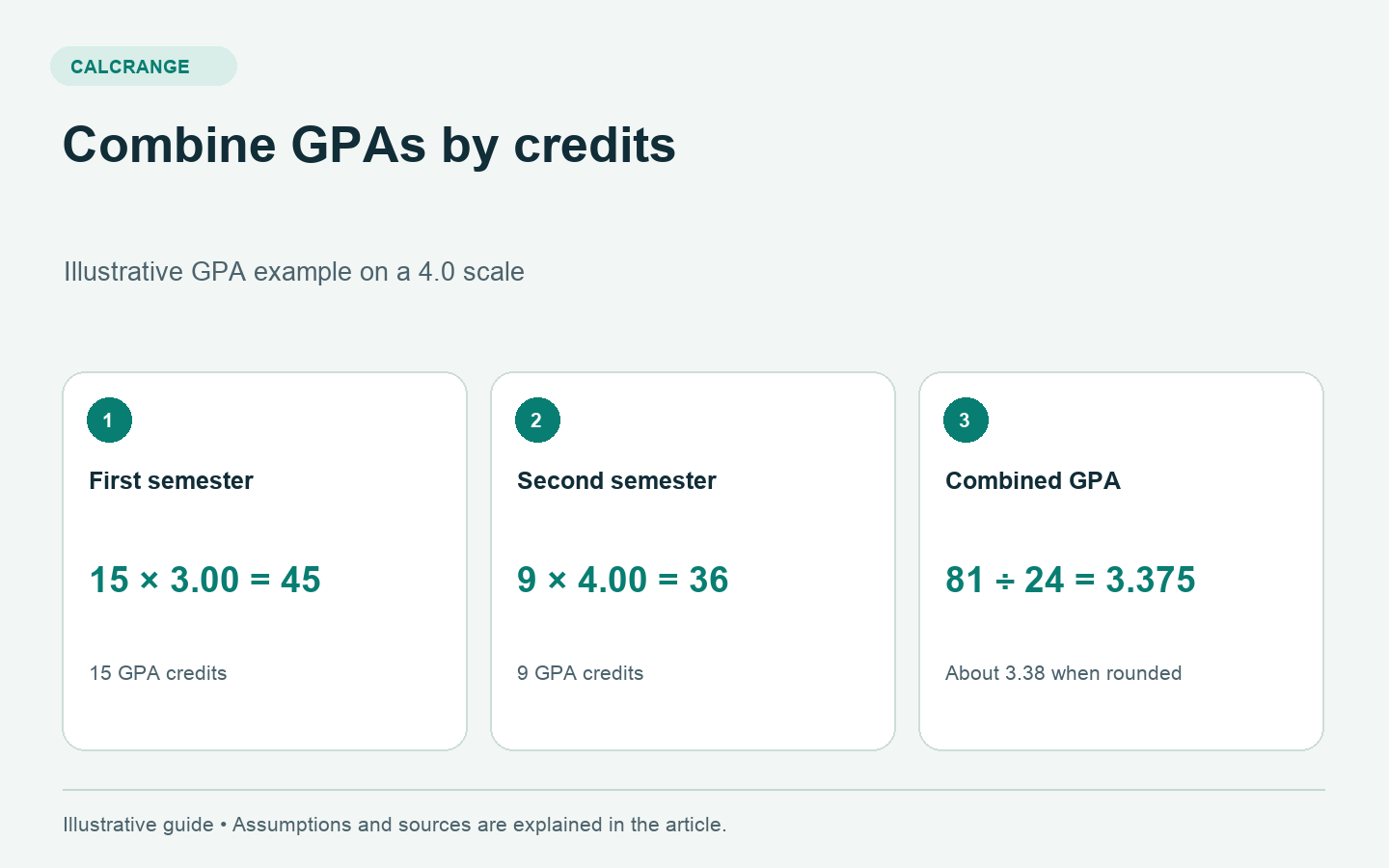
Suppose the first semester has 15 GPA credits and a 3.00 GPA. The second has 9 GPA credits and a 4.00 GPA. Each term’s quality points equal its GPA multiplied by the credits included in that GPA.
| Term | GPA credits | GPA | Quality points |
|---|---|---|---|
| First semester | 15 | 3.00 | 45.00 |
| Second semester | 9 | 4.00 | 36.00 |
| Combined | 24 | 3.375 | 81.00 |
The combined calculation is (45 + 36) ÷ (15 + 9) = 3.375, or 3.38 if the chosen display rounds to two decimals. Simply averaging 3.00 and 4.00 gives 3.50, which overweights the shorter second semester.
When is a simple average valid?
A simple average of term GPAs works when every term has the same number of GPA credits and the supplied term GPAs retain sufficient precision. For example, two 12-credit terms with GPAs of 3.00 and 4.00 combine to 3.50.
But equal numbers of courses do not necessarily mean equal credits. Three 4-credit courses and three 3-credit courses have different weights. Nor does the number of credits earned always equal the number used in a GPA calculation.
Use GPA credits, not every credit on the record
Transcript labels vary, but look for the credits or hours specifically used in grade-point calculations. Pass/fail work, transfer credit, withdrawals, incompletes and repeated courses may be treated differently by different institutions.
For a concrete policy example, the University of Washington’s grading system distinguishes numerically graded coursework from its satisfactory/not-satisfactory scheme when explaining quarterly and cumulative GPA. That is a university-specific rule, not a universal conversion standard.
If your transcript already provides cumulative quality points and GPA hours, those totals are usually better inputs than reconstructing them from rounded semester averages. Carry the full totals through the calculation and apply the school’s display convention at the end.
Why a strong new semester moves the cumulative GPA slowly
Suppose you have 90 GPA credits at 3.00, equivalent to 270 quality points. A new 15-credit semester at 4.00 contributes 60 points. The combined result is 330 ÷ 105 ≈ 3.143.
The semester is still a 4.00 achievement, but it represents only 15 of the 105 combined credits. This explains why the cumulative number can change modestly even after a substantial improvement in current grades. It is an arithmetic effect, not evidence that the new term was ignored.
How to reconcile a calculator with your transcript
- Identify whether you are checking a term, cumulative, major-only or institution-only GPA.
- List the courses included in that particular figure.
- Use the correct grade-point values and credits for each course.
- Apply the institution’s rules for repeats and nonnumeric grades.
- Compare the unrounded total quality points and GPA credits before comparing the displayed GPA.
If a discrepancy remains, ask the registrar which courses and credits are included. A general calculator cannot know whether a repeated grade was replaced or whether a transfer course is excluded from your official total.
For a clear arithmetic check, enter the relevant courses in the GPA Calculator. Keep “semester” and “cumulative” labels next to the results so you compare the same measure.