 Skip to content
A goat’s pregnancy averages about 150 days, roughly five months. Merck Veterinary Manual gives a gestation range of 145–155 days and identifies breed, litter weight, environment and previous kidding history as influences on timing.
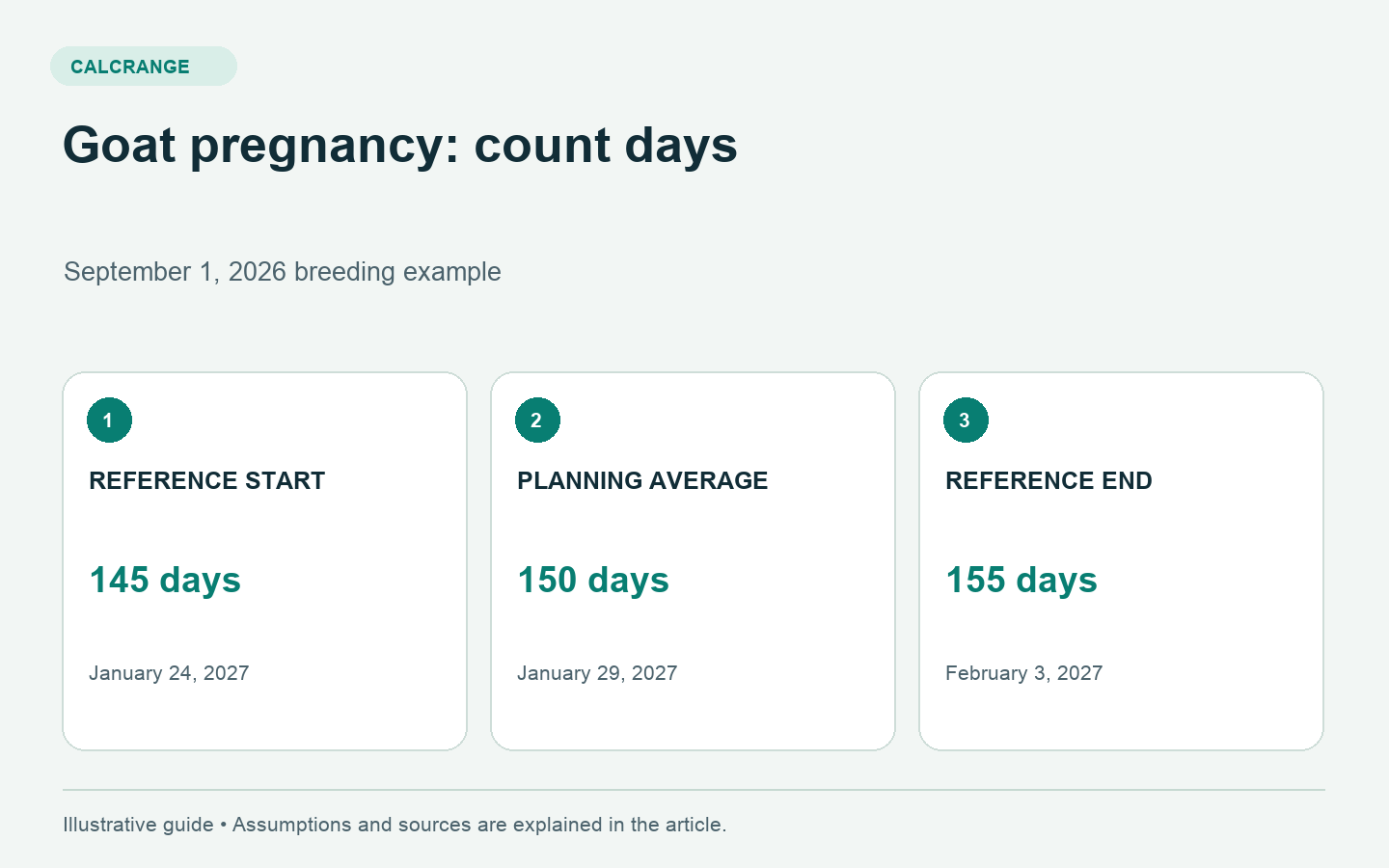
Use the Goat Gestation Calculator to translate a recorded breeding date into a central estimate and planning window. That estimate is most useful when you preserve the actual breeding record and separately document veterinary pregnancy confirmation.
Why five months is only shorthand
Calendar months contain different numbers of days. Adding five months to September 1 gives February 1; adding 150 elapsed days to September 1, 2026 gives January 29, 2027. Both can sound like “five months,” but they differ by three days.
For repeatable records, use a fixed number of days and write the assumption down. This avoids having one person count calendar months while another uses the calculator’s day interval. It also makes records easier to compare across years with different February lengths.
Worked example: September breeding
Suppose doe G17 has a witnessed mating on September 1, 2026. Using the Merck gestation reference gives these planning dates:
| Days after mating | Calendar date | How to label it |
|---|---|---|
| 145 | January 24, 2027 | Lower reference |
| 150 | January 29, 2027 | Central estimate |
| 155 | February 3, 2027 | Upper reference |
The window spans two months, which is why recording only “January kidding” loses useful detail. Mark the full dates in the calendar. Do not interpret the endpoints as proof that every healthy pregnancy must finish within them or that it is safe to wait when the doe seems unwell.
What if the buck stayed with the does?
An exposure date is not necessarily a mating date. If a buck was introduced on September 1 and removed on September 21, conception could relate to a later service. Those two exposure endpoints are 20 days apart. A calculation from the first day alone hides that extra uncertainty.
Keep an exposure interval in the records, then add any witnessed matings and examination findings. Ask the veterinarian how the evidence changes the expected kidding period. Do not assign the middle of the exposure period as a confirmed conception date.
A simple kidding record
- Doe identity: use a permanent tag or other unambiguous identifier.
- Breeding event: distinguish a witnessed mating from general buck exposure.
- Pregnancy check: record the date, method and veterinarian’s findings.
- Planning dates: retain the gestation assumption and calculated window.
- Actual kidding: record the date after birth rather than changing the original estimate.
These fields help someone covering the herd understand both the plan and its uncertainty. If the doe kids earlier than the central estimate, the record shows whether that difference came from date selection or variation in the pregnancy.
Use the estimate to prepare care
Penn State’s dairy-goat guidance also describes a 145–155-day gestation range and emphasizes the importance of nutrition during pregnancy. Feeding, vaccination and other care decisions need a plan suited to the animal and herd; a calendar alone cannot supply one.
Discuss preparation and observation with the veterinarian before the expected period. A late-pregnant doe that stops eating, becomes weak or shows neurological signs needs urgent veterinary care; Merck identifies serious pregnancy-related metabolic disease among the concerns. Do not attempt treatment or induction from a due-date result.
After kidding, the best improvement to the next calculation is a clearer record. Save the actual date, the breeding evidence and any veterinary explanation for a revised estimate. One pregnancy does not establish a guaranteed personal gestation length for every future kidding.
Sources and method
Sources checked September 18, 2026. Numerical examples are illustrative calculations, not patient or animal records.