
A goat kidding calendar is most useful when it assigns practical tasks before the estimated window begins. A due-date reminder alone does not tell someone where the records are, who has checked the shelter or which veterinary number to call.
This kidding calendar organizes nonclinical preparation. It does not prescribe feed, vaccinations, medicines, induction or delivery procedures. Those need a plan specific to the doe and herd from the veterinary team. The dates below are owner-selected organization deadlines, not biological milestones or universal care intervals.
Start with the Goat Gestation Calculator, then preserve the breeding evidence behind its estimate. If only buck exposure is known, keep the whole interval; a convenient single date should not conceal uncertainty.
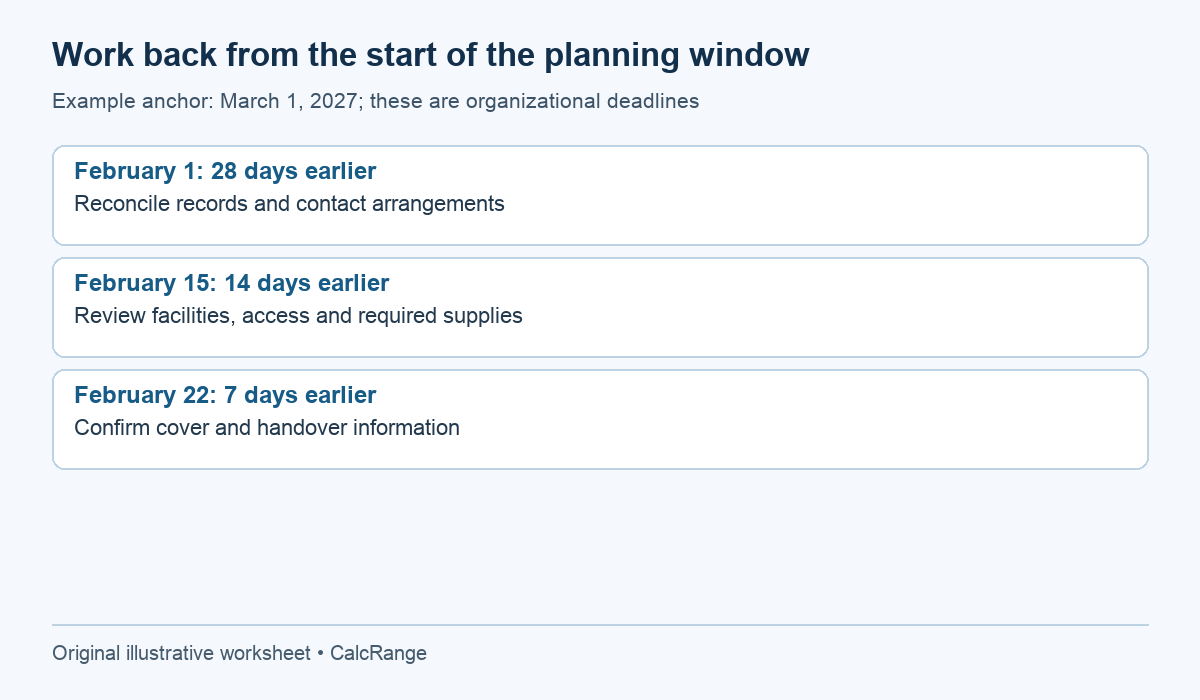
Table of Contents
Choose the kidding calendar readiness anchor
Assume the current documented planning window for one doe is March 1–11, 2027. This article starts from that supplied interval; it does not claim to diagnose gestational age. To organize tasks, use March 1 as the readiness anchor rather than waiting until the central estimate.
Cornell’s example goat management calendar emphasizes adapting a calendar to the animals and recording breeding activity. We use that recordkeeping principle here. Its clinical and husbandry protocols should not be copied into a different herd without appropriate advice.
Write the anchor as a full date with year. A deadline “two weeks before kidding” is not directly actionable when the actual date is unknown. “Facility check by February 15, based on the current March 1 planning start” explains both the task and its assumption.
Build a four-week goat kidding calendar
| Deadline | Offset from March 1 | Organizational task | Evidence of completion |
|---|---|---|---|
| February 1, 2027 | 28 days earlier | Reconcile records and confirm contact arrangements | Dated record and verified contact list |
| February 15, 2027 | 14 days earlier | Review shelter, access and required supplies | Named person’s checklist |
| February 22, 2027 | 7 days earlier | Confirm cover and handover instructions | Accepted rota and accessible instructions |
| Before the planning window | Based on the herd plan | Recheck outstanding tasks with the responsible person | Unresolved items clearly assigned |
The offsets are ordinary date subtraction: March 1 minus 28 days is February 1 in 2027. The same month-and-day shortcut may fail in a leap year. Use actual dates each season rather than copying last year’s deadlines without checking.
Tasks can be completed earlier, and some may already be part of normal year-round care. A deadline does not mean it is appropriate to postpone a problem until that day. If the plan needs clinical review now, contact the veterinary team now.
Prepare a kidding calendar record someone else can understand
Create one sheet per doe with a clear identifier, recorded breeding events, exposure dates if relevant, pregnancy-examination references and the current planning interval. Keep the original dates even if a later examination changes the estimate.
Add the veterinarian’s individualized instructions in their own section. Use the actual written guidance where available rather than rewriting it from memory. Record who issued it and when. A calendar deadline, a calculator-generated milestone and a veterinary instruction should not look interchangeable.
| Field | What to record |
|---|---|
| Animal | Permanent ID and relevant herd reference |
| Dating evidence | Witnessed mating, exposure interval or documented veterinary timing |
| Current estimate | Window, assumption and date calculated |
| Care instructions | Current veterinary plan and where to find it |
| Responsibility | Named primary person and cover contact |
| Updates | Date, observation, action and person recording it |
A note such as “checked” is hard to interpret. Prefer “contact details confirmed with the clinic on February 1” or “access gate repair assigned to Sam, due February 10.” The purpose is to make the plan verifiable, not to create paperwork for its own sake.
Check facilities without turning the worksheet into a treatment guide
Review whether the chosen area and access arrangements meet the needs already agreed for the herd. Identify missing bedding, lighting, cleaning materials or record supplies before the expected period. Check that the responsible person can locate them and knows which equipment they are trained to use.
Alabama Extension’s facility-planning guidance discusses shelter and property preparation. Local climate, facilities and animal needs differ; a generic online list cannot specify the complete setup for every holding.
Do not treat possession of a kit as authorization to administer medication or perform a procedure. Store any veterinary products according to their instructions and the herd’s professional plan. This calendar deliberately avoids doses, treatment decisions and instructions for assisting a difficult birth.
Assign observation cover and communication
Agree who is responsible during each period and how observations will be handed over. The observation schedule itself should follow the herd’s veterinary plan; this worksheet does not prescribe a universal frequency.
Make the primary and emergency contact details accessible to whoever is covering. Confirm the clinic’s current arrangements rather than relying on an old number copied from a previous season. Keep transport and access information where it can be found without searching through a phone’s photo library.
Use a dated observation log with separate columns for what was seen and what action was taken. “Doe did not approach at the usual feeding check; called the clinic at 08:20” is more useful than an unexplained status of “late.” The record should communicate facts without attempting a diagnosis.
Three practical checks for the kidding calendar
Check 1: revise an anchor without postponing an existing problem
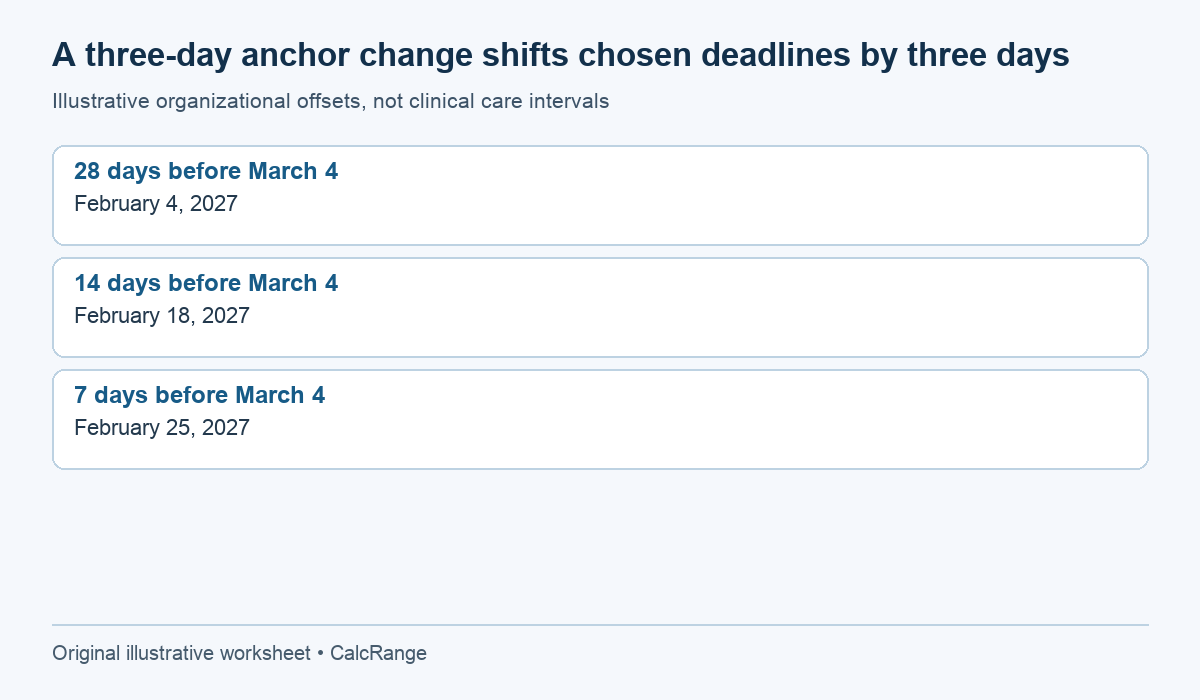
Suppose the recorded planning start changes from March 1 to March 4, 2027 after the responsible professional reviews the dating evidence. Applying the same organizational offsets produces February 4 for the 28-day task, February 18 for the 14-day task and February 25 for the seven-day task. Each shifts by three days because the planning anchor shifted by three days.
These are updated paperwork deadlines, not permission to postpone a repair or a care concern. If a gate is already unsafe or the current veterinary plan requires action, address that issue according to the appropriate instructions. A kidding calendar does not override what is happening in front of you.
Keep completed tasks marked complete. Record why the anchor changed and replace only the reminders that genuinely depend on it. A checked contact list does not become unchecked merely because the estimate moves. Likewise, a task that has not been done should remain visibly open rather than disappearing when the sheet is copied.
Check 2: turn “someone will do it” into a named handover
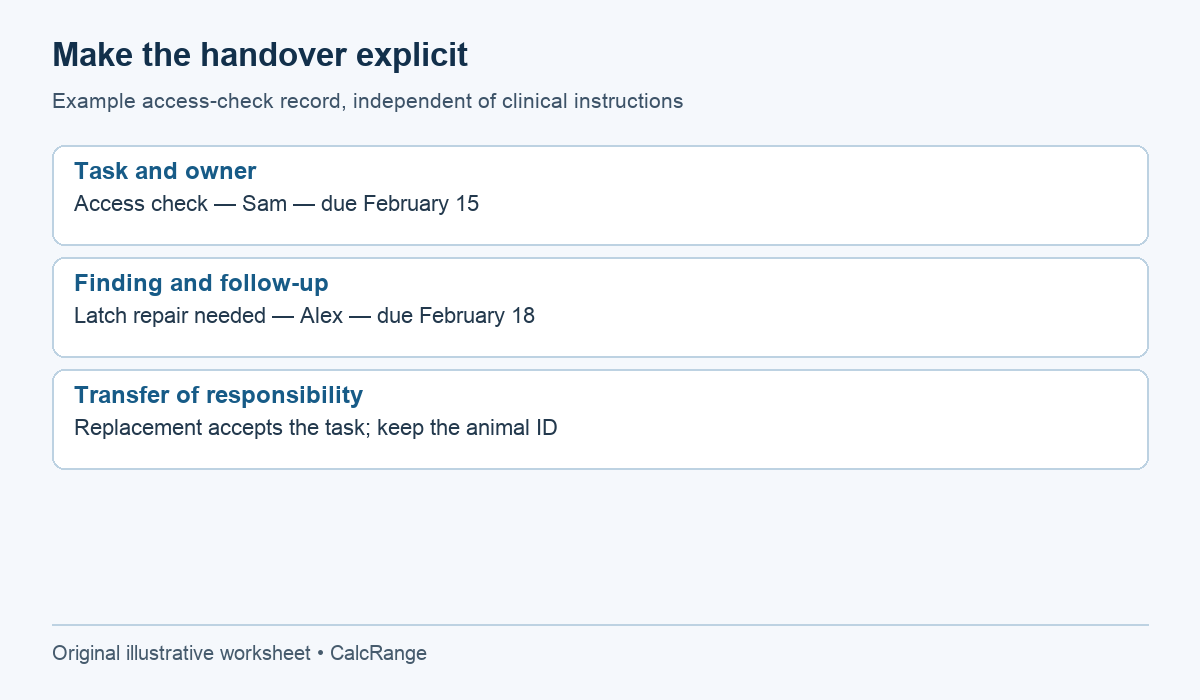
Consider a facility-access check assigned to Sam for February 15. A useful record includes the task, owner, due date, result and any follow-up. “Access checked; replacement latch required; Alex to arrange repair by February 18” communicates more than a single tick beside “shelter.”
If Sam becomes unavailable, the handover should name the replacement and show that the person accepted it. Merely putting a second name in a spreadsheet does not establish that they know about the task. Keep the original deadline unless the responsible person deliberately changes it and explains why.
For cover arrangements, record which contact is primary and which is backup, where current instructions are stored and how to report an observation. The frequency and clinical content of animal checks remain governed by the herd’s professional plan. This organizational sheet only makes responsibility visible.
A person covering one animal should be able to find that animal’s identifier and current record without relying on appearance alone. If two does have similar names, use their permanent IDs on both the rota and the record sheet. A correct calendar linked to the wrong animal is still an unreliable handover.
Check 3: close tasks with evidence, then check the exceptions
In the kidding calendar, use a small set of clear task states such as open, assigned and completed. An unresolved issue can carry a separate note explaining the blocker. Avoid a single green status that hides which part of the preparation is still incomplete.
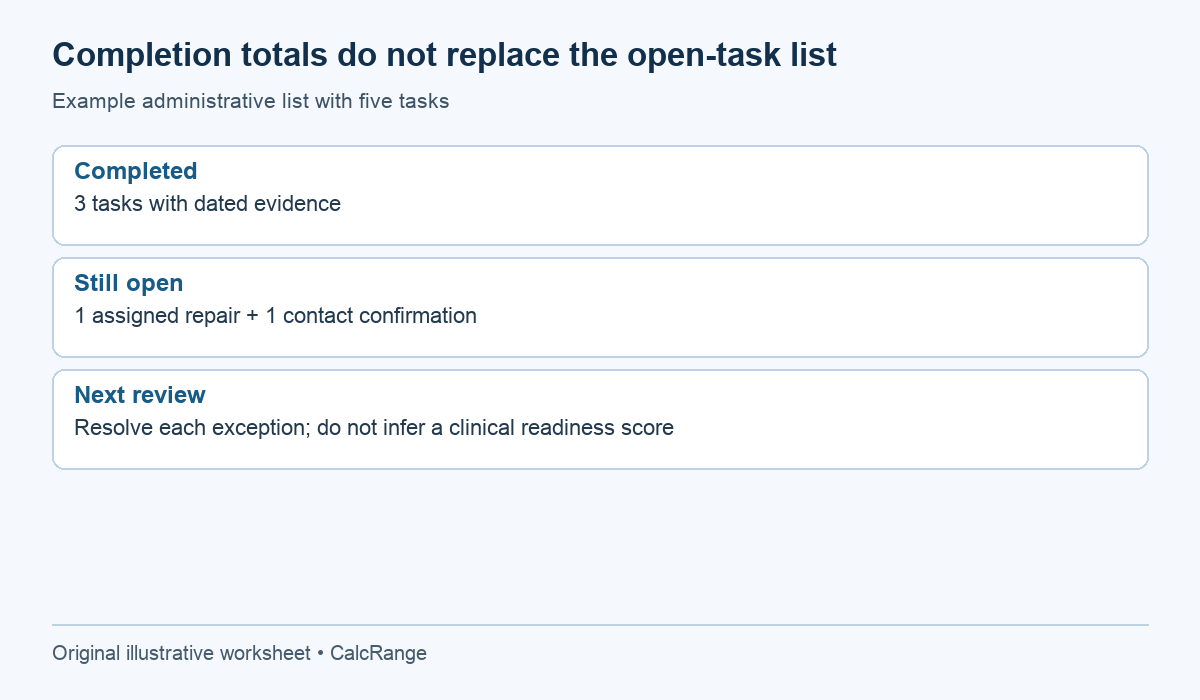
For example, five listed tasks might include three completed checks, one assigned repair and one contact arrangement awaiting confirmation. “Three of five complete” is an administrative summary, not a measure of animal readiness or a clinical safety score. The two unfinished tasks still need individual owners and decisions.
Before handing over, read the exceptions rather than only the completion total. Confirm that the veterinary instructions being referenced are the current version and that contact details are usable by the covering person. Keep an accessible paper copy if that is part of the farm’s plan; a phone link is less useful when the person has no signal or access permission.
After the period ends, record what actually caused confusion and improve the next blank template. A missed phone number, ambiguous task owner or inaccessible folder can be corrected without turning the calendar into a treatment protocol. Preserve clinical questions for the veterinary team and use the worksheet to support clear communication.
Revise the kidding calendar when dating evidence changes
If the veterinary team revises the expected interval, update future deadlines and retain a note of the old window. Do not erase completed tasks. A changed estimate does not make earlier preparation wasted, and an overdue central date does not itself identify the animal’s condition.
After kidding, add the actual date and the records the veterinary team or herd protocol requires. Then review practical gaps: missing contacts, unclear cover or supplies stored in the wrong place. That operational review is separate from concluding that one doe will always have the same gestation length.
For the arithmetic behind the initial window, see the goat gestation-date guide. For a consistent record format across animals, see the breeding-record worksheet. A concerning change in the doe or a difficult delivery warrants veterinary contact regardless of the calendar.