
An ultrasound due date and a last-period due date can differ because they use different evidence and assumptions. A calculator can reproduce date arithmetic, but deciding the best obstetric estimate is a clinical task. If your care team has established a due date, the Pregnancy Due Date Calculator has an “I already know my due date” option so that date can be retained.
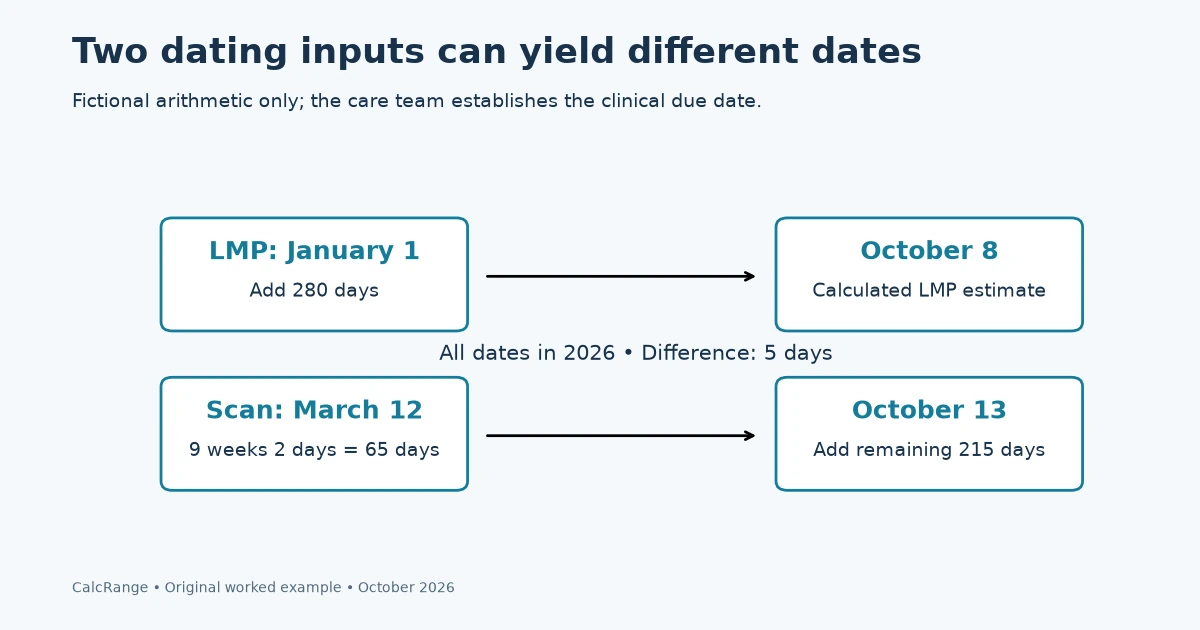
Table of Contents
Ultrasound due date vs last period: identify the inputs
ACOG’s dating guidance describes the conventional LMP estimate as 280 days after the first day of the last menstrual period. That convention assumes a 28-day cycle with ovulation around day 14; uncertain dates or different timing can affect the estimate.
An ultrasound-based calculation instead needs the scan date and the gestational age assessed at that scan. It does not mean adding 280 days to the scan date. Part of the estimated pregnancy duration has already elapsed.
| Basis | Needed information | Common copying error |
|---|---|---|
| Last menstrual period | First day of the period and relevant cycle context | Using the last day of bleeding |
| Ultrasound dating | Scan date and assessed weeks plus days | Entering decimal weeks as weeks and days |
| Known due date | Date established by the care team | Replacing it with a new generic estimate |
| Assisted reproduction | Clinic’s treatment-specific dating information | Substituting an assumed menstrual date |
For clinical interpretation, the timing and quality of the evidence matter. A later scan’s size estimate is not automatically a reason to overwrite an established due date.
Compare a fictional ultrasound due date with a period estimate
Suppose a fictional record lists January 1, 2026 as the first day of the last period. Adding 280 days gives October 8, 2026.
A separate fictional scan record dated March 12, 2026 lists gestational age as 9 weeks and 2 days. That is 9 × 7 + 2 = 65 elapsed gestational days. The remaining interval to 40 weeks is 280 − 65 = 215 days. March 12 plus 215 days gives October 13, 2026.
| Input basis | Arithmetic result |
|---|---|
| LMP January 1, 2026 | October 8, 2026 |
| Scan March 12 at 9 weeks 2 days | October 13, 2026 |
| Difference between estimates | 5 calendar days |
The five-day difference is an arithmetic comparison, not a recommendation to choose the later date. A clinician considers the reliability of the LMP, scan timing and relevant guidance. This worksheet intentionally does not provide a threshold for self-redating.
Notice that 9 weeks 2 days is not 9.2 weeks: 0.2 of a week is 1.4 days. Enter the weeks and days in their separate fields. A one-day input error moves the calculated due date by one day.
Keep an ultrasound due date separate from the established date
ACOG identifies first-trimester ultrasound as the most accurate method to establish or confirm gestational age. Its guidance also emphasizes documenting the selected due date and reserving later changes for uncommon circumstances. This is a clinical process, not a competition to choose whichever calculator result feels most reassuring.
The ACOG patient explanation describes comparing ultrasound dating with the menstrual estimate. Ask your care team which date they have recorded and the basis for it if your app shows something different.
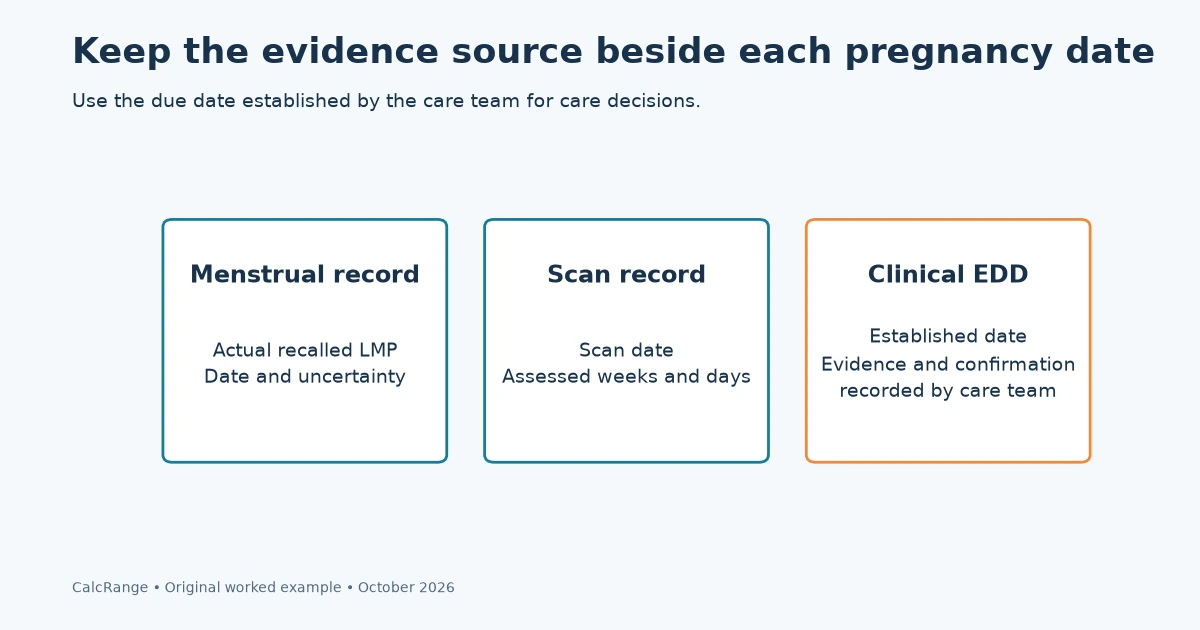
Keep a simple record with the established EDD, date it was confirmed and the source of that information. You do not need to recreate a medical report in a public website form. Never enter identifying clinical details into an untrusted service merely to perform date arithmetic.
Choose the matching calculator mode
- For an LMP illustration, use the actual first day of the period and requested cycle length.
- For a scan-based illustration, use the actual scan date and the gestational age recorded for that scan.
- For an established EDD, choose the known-due-date mode and enter that date directly.
- For IVF, use the clinic’s embryo-age and transfer information in the appropriate method.
- Compare the resulting dates with their labels and inputs, not as unlabeled alternatives.
A calendar date is not a guarantee of the delivery day. Nor can this arithmetic assess fetal growth, pregnancy viability or the need for treatment.
The guide to gestational age versus fetal age explains the two clocks. For treatment-specific dates, use the IVF dating guide alongside the clinic’s instructions.
Ultrasound due date questions for an appointment
If dates disagree, bring the original dates rather than only the final outputs. Useful questions include: Which estimated due date is in my record? Which evidence established it? Does this later scan change dating, or is it being used for another assessment?
Check transcription before assuming a clinical disagreement. Month/day order, a mistyped year and confusion between gestational weeks and weeks since conception can all produce different arithmetic.
The goal is one clearly documented clinical reference with other estimates labeled around it. Keep changes traceable and follow the care team’s advice for appointments and pregnancy management.
Audit weeks-and-days arithmetic before comparing dates
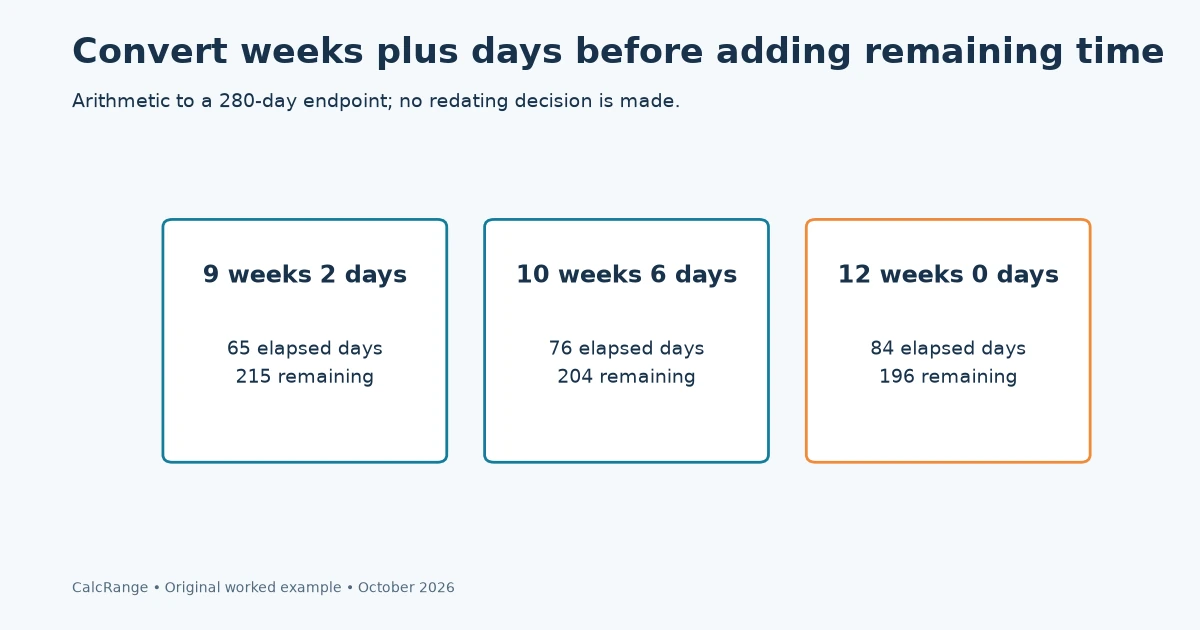
Gestational age uses weeks plus days, with seven days per week. A scan notation of 10 weeks 6 days means 10 × 7 + 6 = 76 days. It is not 10.6 weeks, which would equal 74.2 days.
The remaining interval to the conventional 280-day endpoint is 280 − 76 = 204 days. Add that interval to the actual scan date for the arithmetic estimate. Do not add both the full 280 days and the gestational age.
| Notation | Elapsed days | Remaining to 280 days |
|---|---|---|
| 9 weeks 2 days | 65 | 215 |
| 10 weeks 6 days | 76 | 204 |
| 12 weeks 0 days | 84 | 196 |
These are conversion checks, not statements about fetal measurements or clinical accuracy. The scan’s assessed gestational age must come from the appropriate clinical record; the calculator cannot generate it from a photograph or symptoms.
If the report gives a due date directly, confirm whether that is the date the care team has adopted. Avoid reverse-engineering a different weeks-and-days value and then treating its rounded result as new medical evidence.
Record the source of an ultrasound due date
Use one row per source of dating information. Record the source date, the kind of information, the value exactly as supplied and whether it has been adopted by the care team. This prevents several unlabeled app estimates from looking like several independent clinical opinions.
For example, a row might contain “LMP recalled as January 1,” while another contains “scan dated March 12, reported as 9 weeks 2 days.” The clinical EDD belongs in its own clearly labelled field.
If a record is corrected, preserve the old value and the reason rather than deleting the history. A transcription error in a month or year is different from a clinical redating decision.
Write dates with the month name when sharing a comparison. The numeric date 03/04 can mean March 4 or April 3 in different regional formats. A valid-looking date can still be the wrong input when the convention changes.
The worksheet need not contain names, identity numbers or complete medical documents. Keep sensitive information in the appropriate private clinical record, and use fictional examples when asking a general arithmetic question.
Explain a date difference without choosing a clinical winner
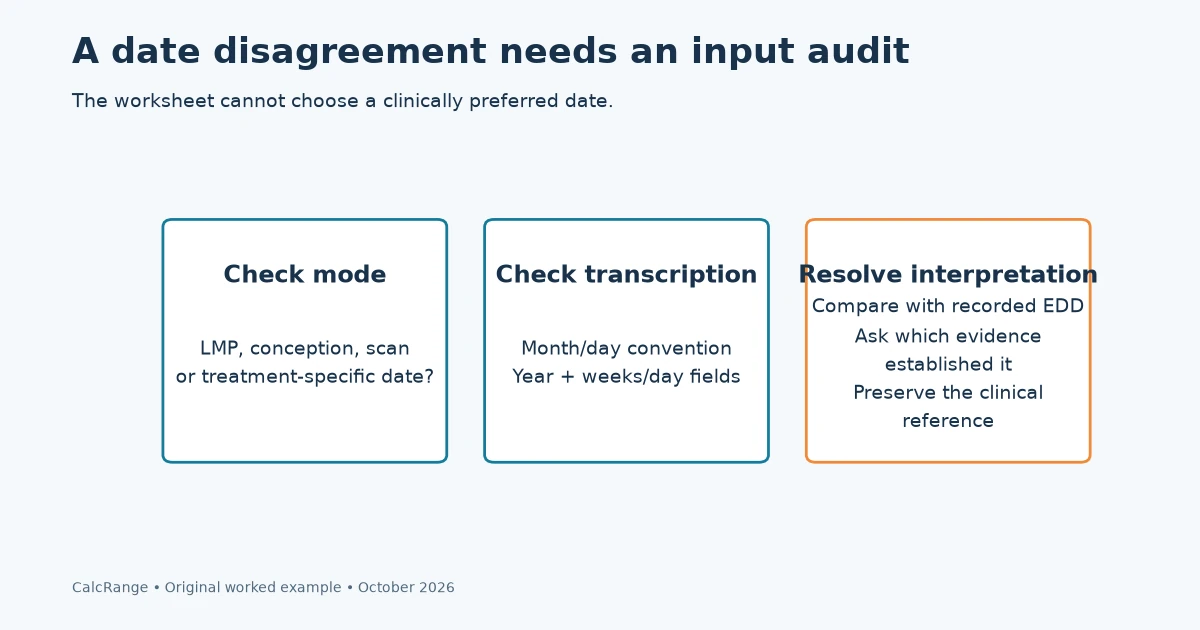
When two calculator dates differ, check the method labels first. An LMP calculation, a conception-date calculation and a scan-date calculation do not share the same starting point. Entering one date in the wrong mode can produce a large difference even when the arithmetic works correctly.
Next, check the first day of bleeding, cycle-length input, scan date and separate weeks/day fields. For assisted reproduction, use the clinic’s treatment-specific information rather than making an assumption about a natural-cycle date.
Finally, compare the result with the established EDD. If the care team’s date differs, ask which evidence supports it. Do not replace it merely because a consumer calculator offers a later date or a more detailed-looking timeline.
In the fictional five-day example, both arithmetic calculations can be reproduced. That is the limit of the worksheet’s conclusion. It does not establish which date should guide appointments, monitoring or care.
A useful closing note is “Two estimates differ by five calendar days; their inputs are listed; clinical EDD remains the date in the care record.” This preserves the uncertainty and avoids implying that a mathematical comparison can assess growth or determine a delivery plan.
If new information is supplied, update the record with its source and date. Keep arithmetic, clinical interpretation and any subsequent care decision as separate steps rather than allowing an app’s automatically refreshed display to silently overwrite them.
Ultrasound due date questions
Should I automatically choose the ultrasound date?
No. Your clinician evaluates the scan timing and other evidence to establish the best obstetric estimate. A calculator cannot make that clinical decision.
Does every later scan create a new due date?
No. A later measurement is not automatically a reason to replace the established date. Ask the care team how it should be interpreted.
What does 9 weeks 2 days mean in the calculator?
It is 65 gestational days. Enter 9 in the weeks field and 2 in the days field, not 9.2 as decimal weeks.
Sources and calculation notes
The two dates are independently calculated fictional examples. No clinical redating threshold, diagnosis or delivery-day prediction is inferred. Sources checked October 30, 2026.