 Skip to content
Gestational age is the pregnancy age used for clinical care. It is commonly counted from the first day of the last menstrual period, then confirmed or adjusted using appropriate clinical information. Time since fertilization starts later. These two clocks can describe the same pregnancy without giving the same number of weeks.
The Pregnancy Due Date Calculator offers different dating inputs. Select the one supported by your information, and use the due date established by your pregnancy-care team for medical decisions.
Why pregnancy dating starts before conception
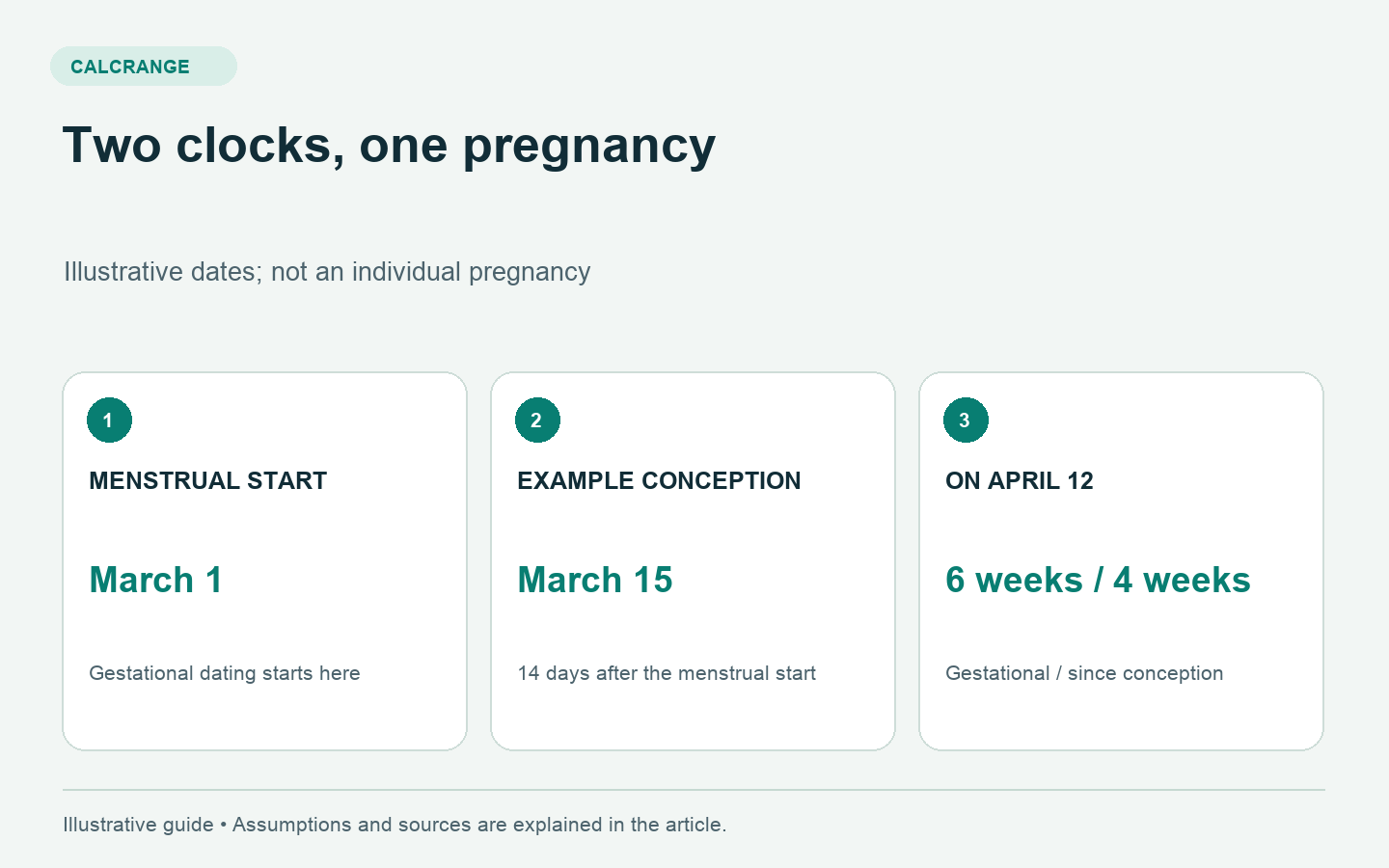
Menstrual dating provides an identifiable starting point when the precise fertilization date is unknown. In the familiar 28-day-cycle example, conception occurs around two weeks after the menstrual starting point. That is why a pregnancy can be described as six weeks gestational age when fertilization occurred roughly four weeks earlier.
ACOG explains the menstrual starting point and the role of ultrasound when dates are uncertain. The two-week difference is an approximation, not a rule proving exactly when conception occurred in every pregnancy.
Worked example with two known dates
Imagine the last menstrual period began March 1 and, purely for this example, fertilization occurred March 15. On April 12, 42 days have elapsed since March 1 and 28 since March 15.
| Clock | Start | Elapsed time on April 12 |
|---|---|---|
| Menstrual gestational dating | March 1 | 42 days = 6 weeks |
| Time since fertilization | March 15 | 28 days = 4 weeks |
| Difference | 14 days between starts | 2 weeks |
The arithmetic does not imply development occurred before fertilization. It means the clinical convention starts counting earlier. The phrase “fetal age” is sometimes used loosely for time since conception; ask what a particular app or report means rather than assuming every label uses the same definition.
Why simply subtracting two weeks can mislead
If ovulation occurred later than the example assumes, the difference between the menstrual start and fertilization would be longer. A remembered period date may also be uncertain. Subtracting exactly 14 days from a clinically assigned gestational age cannot reconstruct an exact conception date.
The same limitation applies to estimating a date of intercourse. A calendar calculation is not proof of paternity or of a particular encounter. Clinical dating estimates pregnancy timing; it does not identify which day intercourse caused conception.
Read weeks and days correctly
A report showing 6 weeks 3 days means 6 × 7 + 3 = 45 completed days in that dating system. It is not 6.3 decimal weeks: 6.3 × 7 = 44.1 days. Keep weeks and days in separate fields when transferring a clinical result into a calculator.
Similarly, a person at 6 weeks 3 days has completed six weeks and is partway through the next week. Everyday phrases such as “in the seventh week” can therefore sound different while referring to the same point. For appointments, repeat the exact weeks-and-days notation from the clinical record.
Which age should guide pregnancy care?
ACOG identifies first-trimester ultrasound as the most accurate ultrasound period for establishing or confirming gestational age. The care team combines relevant evidence and documents an estimated due date. Later calculator outputs should not independently replace that date.
When comparing an app with a scan report, write down the starting method, the date the estimate applies to and the weeks-and-days value. An estimate from last week’s appointment should increase with elapsed time; comparing it with today’s app without that adjustment creates an avoidable discrepancy.
Use the calculator for understanding and planning. Ask the pregnancy-care team about uncertain dates or differences between reports, especially before interpreting screening windows, fetal growth or delivery timing. A mathematical age conversion cannot assess pregnancy health.
Sources and method
Sources checked September 18, 2026. Numerical examples are illustrative calculations, not patient or animal records.