 Skip to content
Protein still matters on rest days. A day without a workout can be part of the recovery period from earlier exercise. You do not need to reset your protein intake to zero or automatically add a supplement simply because the training calendar changed.
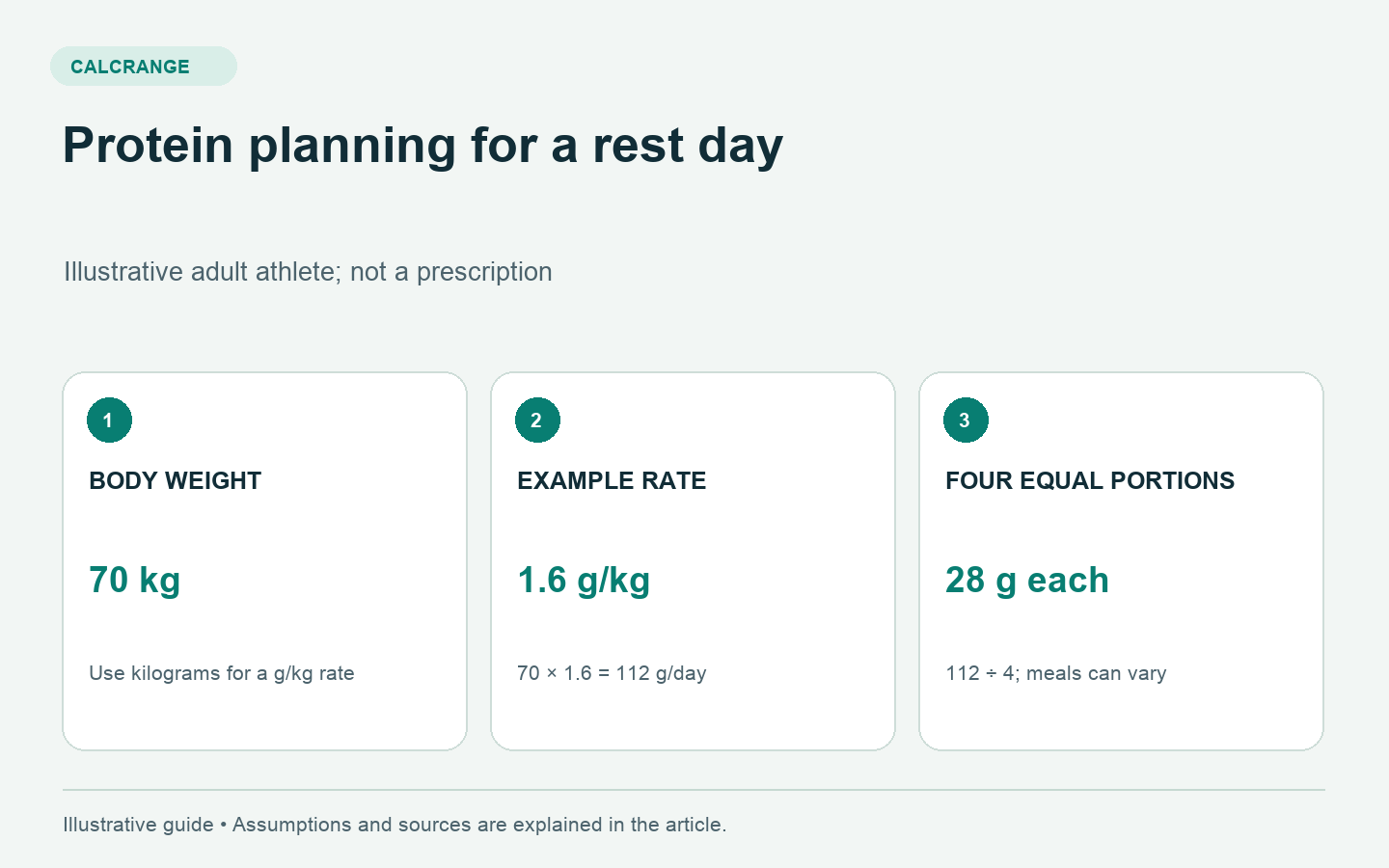
The Protein Requirement Calculator converts a selected grams-per-kilogram value into a daily amount. The appropriate value depends on the person and training context; the worked example below demonstrates the arithmetic rather than prescribing a universal target.
Why a rest day is still part of training
The NIH Office of Dietary Supplements describes increased muscle-protein synthesis during recovery after exercise. Its overview cites daily protein guidance of roughly 1.2–2.0 g/kg for athletes, with needs influenced by training and circumstances.
That range is not a claim that everyone who exercises needs its upper end. It is also not a rule that training days and rest days require completely different calculations. ACSM’s sports-nutrition guidance emphasizes recovery and overall energy balance alongside protein.
A transparent daily example
For an illustrative adult athlete weighing 70 kg, choose 1.6 g/kg/day for the example. Multiply 70 × 1.6 = 112 g protein per day. The selected rate is an assumption; the multiplication is the calculator’s job.
| Selected rate | Calculation at 70 kg | Daily amount |
|---|---|---|
| 1.2 g/kg | 70 × 1.2 | 84 g |
| 1.6 g/kg | 70 × 1.6 | 112 g |
| 2.0 g/kg | 70 × 2.0 | 140 g |
The table is a sensitivity comparison, not three competing prescriptions. It makes the effect of the selected rate visible. Increasing the rate by 0.4 g/kg adds 28 g for this example, whether the calendar calls the day training or rest.
Divide the example into meals
Four equal portions of the 112 g example would be 28 g each. Three equal portions would be about 37.3 g each. Meals do not have to be mathematically identical; this division simply makes a daily total easier to plan.
For another distribution, 25 g at breakfast, 30 g at lunch, 32 g at dinner and 25 g across other food adds to 112 g. Those are illustrative amounts, not a prescribed menu. Check the protein listed for actual portions rather than assuming every food in a category contains the same amount.
Food weight is not protein weight
A 100 g serving of a food does not normally mean 100 g of protein. The label reports protein separately. If a label lists 8 g protein per serving and you eat one and a half servings, the contribution is 8 × 1.5 = 12 g.
Add protein from all relevant foods before deciding whether a supplement fills a gap. If recorded meals already total the example’s 112 g, adding another 25 g produces 137 g; it does not somehow improve the original calculation. The need for the extra amount is a nutrition question, not an arithmetic requirement.
What to keep consistent on a rest day
- Use the same body-weight units and explain the chosen g/kg rate.
- Record the actual portion sizes used in your meal estimate.
- Consider the training week and recovery context, not only today’s workout.
- Review the plan when training volume or health circumstances change.
If you have kidney disease, another condition affecting protein intake, or a medically prescribed diet, ask your clinician or registered dietitian before adopting an athletic range. A general calculator does not account for every clinical situation. Protein also cannot replace adequate total food intake, sleep and recovery time; a more elaborate gram target is not automatically a better plan.
Sources and method
Sources checked September 18, 2026. Numerical examples are illustrative calculations, not patient or animal records.