 Skip to content
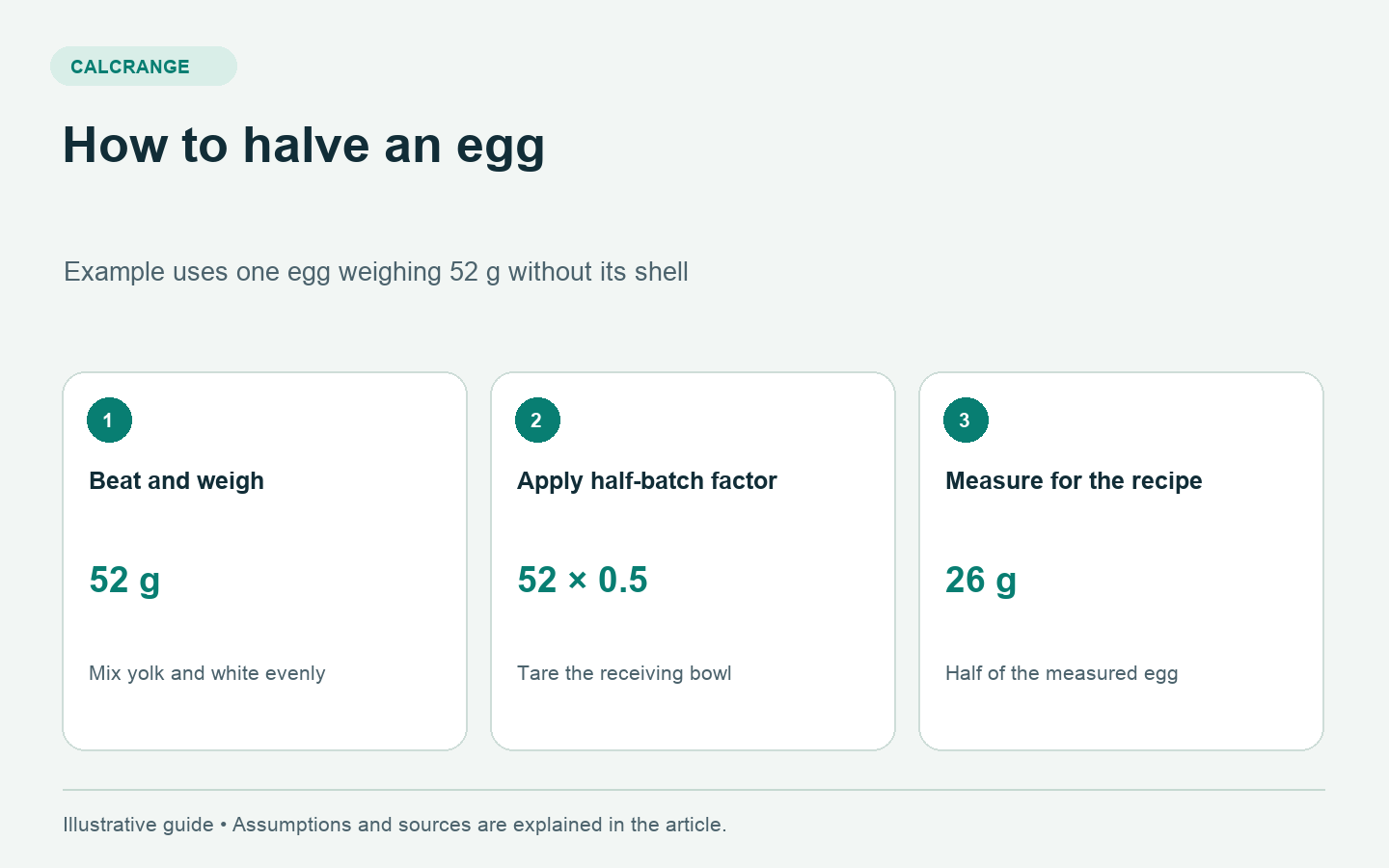
To halve a whole egg for a recipe, crack it into a bowl, beat the yolk and white together until evenly mixed, weigh the mixture and use half its weight. If the beaten egg weighs 52 grams, use 26 grams. Do not weigh the shell.
The Recipe Scaler will calculate the ingredient proportion, but a kitchen scale helps turn a result such as “½ egg” into a repeatable measurement.
The weighed-egg method, step by step
- Place a clean small bowl on the scale and tare it to zero.
- Crack the egg into the bowl and remove any shell pieces.
- Lightly beat the yolk and white together until the mixture is uniform.
- Read the egg’s weight and divide it by two.
- Transfer that amount to the recipe using a second tared bowl, or measure the amount remaining as you pour.
In the 52-gram example, stop when the receiving bowl contains 26 grams. Alternatively, if the original bowl remains on the scale, pour until 26 grams remain. Either approach works as long as the bowl’s own weight has been excluded.
Is half an egg always 25 grams?
No. A large egg’s contents are often approximated as 50 grams, so 25 grams is a useful half-egg estimate. King Arthur Baking’s recipe-reduction guide recommends weighing beaten egg when dividing it. Individual eggs vary, so half of your measured egg is more precise than assuming every egg is exactly 50 grams.
If the recipe already specifies egg in grams, use that recipe weight directly. A recipe requiring 60 grams of beaten egg needs 30 grams for a half batch, regardless of the size category printed on your carton.
What if the full recipe uses three eggs?
A half batch needs one and a half eggs. You can use one whole egg and half of a second beaten egg, provided the eggs match the recipe’s intended size. For closer proportional measurement, beat the three eggs together, weigh the combined contents and use half.
For example, if three beaten eggs total 153 grams, a half batch uses 76.5 grams. A scale reading only whole grams cannot measure the final half gram precisely; 76 or 77 grams is a small rounding choice. Keep the same precision for the other ingredients instead of implying the entire recipe is exact to a tenth of a gram.
Scale the rest of the recipe consistently
If the recipe makes 12 portions and you want 6, the scaling factor is 6 ÷ 12 = 0.5. An illustrative ingredient list changes as follows:
| Ingredient | Original amount | Half batch |
|---|---|---|
| Flour | 240 g | 120 g |
| Sugar | 100 g | 50 g |
| Butter | 80 g | 40 g |
| Beaten whole egg | 52 g | 26 g |
This table demonstrates scaling, not a tested stand-alone recipe. Use your actual recipe’s ingredients and method. If you enter measured grams in the Recipe Scaler, keep the result in grams rather than converting back to an approximate count of eggs.
Whole eggs, whites and yolks are different ingredients
If a recipe asks for one yolk, halve the yolk amount rather than substituting half a whole egg. If it asks for whites, measure whites. Mixing yolks into a recipe that depends on separated whites changes more than the quantity.
Recipes that build structure by whipping eggs or separating components also need their original method followed. Proportional ingredient arithmetic does not guarantee that the same mixing equipment or baking time works for a much smaller batch.
Handle the remainder safely
Keep raw egg refrigerated, use clean utensils and follow USDA egg-handling guidance. Do not leave the extra beaten egg on the counter while waiting for another baking project. The USDA advises refrigeration at 40°F or below and prompt cooking or refrigeration of dishes containing raw egg.
Write the measured egg amount beside the scaled recipe. That note is more useful for repeating the batch than “about half an egg.”