INTRO
Your GPA, or Grade Point Average, is the single number that sums up your academic performance and it follows you into college applications, scholarship forms, internship screenings, and graduate school admissions. Working it out by hand means converting every letter grade to points, multiplying by credit hours, adding it all up, and dividing carefully. One slip and the number is wrong. This free GPA calculator does the whole thing for you in seconds.
This is simple GPA Calculator Just pick the grade for each course, enter how many credits it carried, and add as many courses as you need. The calculator instantly returns your GPA on the standard 4.0 scale along with your total credit count. It works for a single semester or your full cumulative record, and it’s equally useful for high school and college students. Visit our other Calculators.
GPA Calculator
Enter your courses, the number of credits (or units) for each, and the grade you earned. Course names are optional. Works for high school, college and university on the standard 4.0 scale.
GPA Planning Calculator
Find out the minimum GPA you need in your upcoming courses to reach (or maintain) a target GPA.
Grade Scale (4.0 System)
How to Use This GPA Calculator
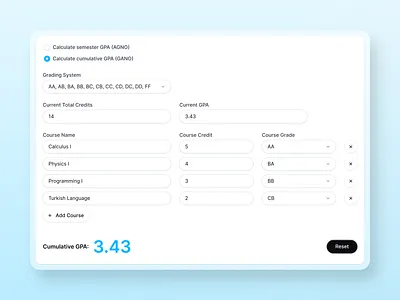
Using the tool takes under a minute. Each row represents one course. For every course, choose the letter grade you earned from the dropdown and type in the number of credit hours (also called credit units) the course was worth. Click “+ Add Course” to add another row, and repeat until every class for the period you’re calculating is listed. When you’re done, press “Calculate GPA” and your result appears instantly, showing your GPA out of 4.0 and the total credits you entered.
If you want your GPA for a single semester, enter only that semester’s courses. If you want your cumulative GPA across your whole degree, enter every course from every semester. The math is identical — only the list of courses changes.
What Is a GPA and Why Does It Matter?
GPA stands for Grade Point Average. It is a numerical representation of your academic performance, designed so that schools, universities, and employers in different places can compare students fairly using one standardized figure. Instead of reading through a transcript full of letter grades, an admissions officer or recruiter can glance at a single number and get an immediate sense of how a student has performed overall. GPA Calculator helps you to maintain your GPA throughout your semester.
That convenience is exactly why GPA carries so much weight. University admissions teams use it as a primary filter, often setting minimum thresholds an applicant must clear before the rest of the file is even read. Scholarship committees attach funding to GPA bands. Many employers ask new graduates for their GPA on job applications. And graduate programs frequently treat undergraduate GPA as one of the most important parts of the application. A strong, accurate GPA opens doors; a miscalculated one on a form can cost you opportunities.
How Is GPA Calculated? The Formula
GPA is calculated using what’s known as the quality-points method. The formula is:
GPA = (Sum of grade points × credits for each course) ÷ Total credits
Here’s the step-by-step logic the calculator follows:
- Convert each letter grade to its point value on the 4.0 scale (A = 4.0, B = 3.0, and so on — the full table is below).
- Multiply each course’s grade points by its credit hours. This gives the “quality points” for that course. A 4-credit A is worth more than a 1-credit A, which is exactly how it should be.
- Add up the quality points from all courses.
- Add up all the credit hours.
- Divide total quality points by total credits. The result is your GPA.
For example, suppose you took three courses: an A (4.0) worth 3 credits, a B (3.0) worth 4 credits, and a B+ (3.3) worth 3 credits. Quality points are (4.0 × 3) + (3.0 × 4) + (3.3 × 3) = 12 + 12 + 9.9 = 33.9. Total credits are 3 + 4 + 3 = 10. GPA = 33.9 ÷ 10 = 3.39. The calculator runs this same arithmetic instantly no matter how many courses you add.

The 4.0 Grade Scale Explained
This calculator uses the standard United States 4.0 unweighted scale, which is the most widely recognized grading scale in the world and the one most international applications expect. Each letter grade maps to a point value:
- A / A+ = 4.0
- A− = 3.7
- B+ = 3.3
- B = 3.0
- B− = 2.7
- C+ = 2.3
- C = 2.0
- C− = 1.7
- D = 1.0
- F = 0.0
One detail worth knowing: the minus grades carry a real penalty. An A− is 3.7, not 4.0 that 0.3 drop is significant, and a student with straight A−grades finishes at a 3.7 rather than a perfect 4.0. This is why that extra percentage point to push a grade from an A− to an A genuinely matters for your final average.
Weighted vs. Unweighted GPA
There are two main ways schools calculate GPA, and it’s important to know which one applies to you. An unweighted GPA treats every course equally on the 4.0 scale, regardless of difficulty. An A in a standard class and an A in an advanced class are both worth 4.0. This is the most common scale and the one this calculator uses, because it’s the cleanest for comparing students across different schools.
A weighted GPA adds bonus points for harder courses commonly +0.5 for Honors classes and +1.0 for Advanced Placement (AP), International Baccalaureate (IB), or dual-enrollment courses. Under a weighted system, an A in an AP class might be worth 5.0 instead of 4.0, which is how some students end up with GPAs above 4.0, often on a 5.0 scale. Weighted GPAs reward students who challenge themselves with a tougher course load. If your school reports a weighted GPA, you can still use this calculator for your unweighted number, which most selective colleges recalculate and evaluate separately anyway.
Cumulative GPA vs. Semester GPA
Your semester GPA covers only the courses from one term. Your cumulative GPA (sometimes shown as CGPA) is the running average across all the terms you’ve completed for example, all four years of high school or your entire degree so far. Colleges almost always look at the cumulative figure because it reflects sustained performance rather than a single good or bad semester. To find your cumulative GPA with this tool, simply enter every course you’ve taken across all terms into the calculator. A strong upward trend across terms — even if early grades were weaker is a well-understood and respected pattern in admissions.
Tips to Improve Your GPA
Because high-credit courses move your average more than low-credit ones, focusing your effort where the credits are concentrated gives you the biggest return. Prioritize strong performance in your heaviest courses, stay consistent rather than relying on a single standout term, and use this calculator throughout the semester to model “what if” scenarios see exactly what grade you’d need in a remaining course to hit a target GPA. Knowing the number you’re aiming for makes it far easier to plan your study time.
Understanding Your GPA: A Friendly Guide to How the Numbers Really Work
Few little numbers carry as much weight in a student’s life as the one that sits at the bottom of a transcript. Scholarships, internships, graduate school applications, and even a bit of personal pride can all hinge on it. Yet for something so important, the way it gets worked out can feel surprisingly mysterious. That is where a good GPA calculator earns its keep, and where a clear explanation of the math behind it can save a lot of late-night confusion.
This guide walks through what the number means, how it is figured out, and why two students with identical report cards can sometimes end up with different results. It is written for anyone who has ever stared at a grade sheet and wondered how it all adds up.
What Is a GPA, Exactly?
Plenty of people use the term every day without ever pausing to ask what is GPA in the first place. The GPA full form is grade point average, and the short version is exactly what it sounds like: an average of the points earned across a set of courses. The longer answer is a touch more interesting.
When someone asks what does GPA stand for, the honest reply is that it stands for a tidy way of turning a pile of letter grades into a single, comparable figure. Instead of leaving an A in one class and a C in another sitting side by side with no common scale, the system assigns each letter a numeric value, weights it by how many credits the course was worth, and blends everything into one tidy result. So when a student wonders what is a GPA on an application form, they are really being asked for this blended score.
The GPA meaning becomes clearer with a quick example. An A is usually worth 4.0 points, a B is worth 3.0, a C is worth 2.0, and so on down the line. Add a few plus and minus modifiers and the picture gets a little more detailed, but the core idea stays the same. The grade point average is simply the weighted average of all those values.

How a GPA Calculator Takes the Stress Out of the Math
The reason a GPA calculator has become such a popular tool is that doing this by hand, term after term, gets tedious fast. A reliable calculator lets a student punch in each grade and credit value and see the result update instantly, which is far kinder than juggling a long list of fractions on scrap paper.
These tools go by a handful of names. Some students search for a GPA checker when they want to confirm a number they already suspect, while others reach for a GPA finder or a GPA tracker to watch their progress build over a degree. Whatever the label, the engine underneath is the same. A quick GPA calc takes the guesswork out of the process, and even a stripped-down GPA cal on a phone can handle the arithmetic in seconds.
The real value is not just speed, though. A good tool lets someone test scenarios. What happens to the average if that tricky chemistry grade climbs from a B to an A-? How much breathing room is there before the number slips below a target? Being able to answer those questions in a few clicks turns a static grade report into something a student can actually plan around.
How to Calculate GPA by Hand
For anyone curious about the mechanics, learning how to calculate GPA without a tool is genuinely useful. It demystifies the whole thing, and it makes the numbers from any calculator easier to trust.
The process to calculate GPA comes down to three steps. First, each letter grade is converted into its point value using the standard GPA scale. Second, that point value is multiplied by the number of credits the course carried, which produces what are often called quality points. Third, the total quality points are divided by the total number of credits attempted. That final division is the answer.
Here is a simple walk-through for someone who wants to calculate my GPA on the back of an envelope. Imagine three courses: an A in a 3-credit class, a B in a 4-credit class, and a C in a 2-credit class. The A gives 4.0 times 3, or 12 points. The B gives 3.0 times 4, or 12 points. The C gives 2.0 times 2, or 4 points. Add those together for 28 quality points, then divide by the 9 total credits. The result, just over 3.1, is the GPA.
Understanding how is GPA calculated this way also clears up a common surprise. A high grade in a low-credit elective nudges the average far less than the same grade in a heavyweight core course. That credit weighting is the single most important thing to grasp when figuring out how to find GPA on your own, and it is exactly the part that a GPA chart of grade values cannot show by itself.
Weighted GPA vs. Unweighted GPA
Once the basics click, a fork in the road appears, and it trips up a lot of people. There are two common flavors of the calculation, and they can produce noticeably different numbers from the very same transcript.
An unweighted GPA treats every course the same. An A is worth 4.0 whether it came from a gentle elective or a demanding honors seminar. A simple unweighted GPA calculator caps the top of the scale at 4.0 and keeps things refreshingly straightforward.
A weighted GPA, on the other hand, rewards difficulty. Advanced, honors, or college-level courses taken in high school often carry bonus points, so an A in one of those classes might be worth 5.0 rather than 4.0. A weighted GPA calculator builds those bonuses into the math, which is why a student loaded with tough classes can sometimes post an average above the usual ceiling. Neither approach is wrong; they simply answer slightly different questions, and it always pays to know which one a school or scholarship is asking for.
Semester, Cumulative, and Term GPA
Another layer worth understanding is the timeframe a number covers, because the same student can have several valid figures at once.
A semester GPA calculator looks at a single block of study, showing how one particular term went in isolation. A term GPA calculator does the same thing for whatever a school happens to call its grading periods. These short-window numbers are great for spotting trends, since a strong recent term can signal real momentum even when the longer record is uneven.
The cumulative GPA, by contrast, zooms all the way out. The cumulative GPA meaning is simply the average across every course a student has ever taken at an institution, rolled into one running total. A cumulative GPA calculator keeps that figure current as new grades come in, and it is usually the number that admissions offices and employers care about most, since it reflects the whole journey rather than a single stretch.
College and High School GPA Differences
Grade systems shift as students move up the ladder, and the tools tend to follow. A high school GPA calculator often has to handle weighted classes and the bonus points described earlier, since that is where advanced coursework usually appears.
A college GPA calculator, meanwhile, generally works on a clean four-point system and leans heavily on credit hours, which vary far more in higher education than they do in secondary school. Anyone tracking a college GPA quickly learns that a single five-credit course can swing the average more than two smaller classes combined. Because the college grading scale and credit structure differ so much from earlier years, a dedicated college grade calculator usually gives cleaner results than trying to force high school habits onto university transcripts.
CGPA and How It Differs
Students in many parts of the world will be more familiar with a slightly different acronym. A CGPA, or cumulative grade point average, plays the same role as a cumulative GPA but often sits on a different scale, such as a ten-point system, depending on the country and institution.
A CGPA calculator handles that wider range and the local conventions that come with it. The instinct behind how to calculate CGPA is identical to the GPA method: convert grades to points, weight by credits, and average the lot. The only real difference is the scale and the occasional naming quirk, so anyone comfortable with one system can usually pick up the other in a few minutes.
Converting Between Percentages and GPA
Conversions are where a lot of cross-border confusion lives, especially for students applying to schools abroad. Plenty of institutions report results as raw scores, which leaves applicants hunting for a way to translate them.
A percentage to GPA conversion maps a numeric score onto the four-point scale, while a GPA to percentage conversion runs the same logic in reverse for forms that want a percentage instead. A flexible GPA converter handles both directions and saves a great deal of manual cross-referencing. For schools that work on the standard system, a GPA calculator out of 4 is the most common setup, and it lines up neatly with how most North American programs read an application.
The thing to remember is that no conversion is perfectly universal. Different schools use slightly different cutoffs, so these tools give a strong, sensible estimate rather than an official ruling. When a number really matters, it is always worth checking the specific scale a target institution publishes.
What Counts as a Good GPA?
This is the question lurking behind nearly every search, and the honest answer is that it depends on the goal. Still, some general landmarks help.
People asking what’s a good GPA are usually trying to gauge where they stand against peers and expectations. A 4.0 GPA represents a perfect unweighted record, a flawless run of A’s. A 3.7 GPA sits comfortably in the strong range that competitive programs like to see, while a 3.0 GPA marks a solid, respectable B average that keeps most doors open. Curiosity about whats the highest GPA tends to come down to the weighted systems above, where the bonus points can push results past the usual four-point cap.
For perspective, the average GPA at many institutions hovers somewhere in the low threes, so anyone wondering what is the average GPA can use that as a rough yardstick. Grade-by-grade questions fit here too. A b+ GPA usually lands around 3.3, and students asking what is a b+ are simply trying to see how a single grade nudges the bigger picture. None of these figures is a verdict on a person’s worth; they are just reference points on a shared scale.
Keeping Track Over Time
The smartest move a student can make is to stop treating the number as a once-a-year surprise. Checking in regularly turns it from a source of dread into a manageable target.
A simple grade calculator used throughout the term shows the impact of each assignment before final grades are locked in, which makes it far easier to adjust effort where it counts. Knowing how to check GPA at any moment, rather than waiting for an official report, gives students real control. Anyone who has ever typed what is my GPA into a search bar at midnight knows the relief of finally seeing a clear answer instead of a vague worry.
In the end, the grade point average is just a tool, and like any tool it works best when it is understood rather than feared. A reliable calculator handles the arithmetic, a little knowledge of the method makes the results trustworthy, and a habit of checking in keeps the whole thing from ever becoming a shock. With those three pieces in place, that small but mighty number stops being a mystery and starts being something a student can confidently steer.
Content:
A GPA calculator is the fastest way for any student to turn a list of letter grades into one clear score. Instead of working through the math by hand, a quick GPA calc does it in seconds, and a good tool covers every situation, from a high school GPA calculator to a college GPA calculator.
So what is a GPA? The GPA full form is grade point average, and the GPA meaning is simple. Each letter grade becomes a number, where an A is 4.0, a B is 3.0, and so on. That value gets weighted by course credits and averaged into a single figure. For anyone unsure what is GPA on an application, that blended number is the answer.
Learning how to calculate GPA by hand is easy once the steps click. Multiply each grade’s point value by its credit hours, add the results, then divide by the total credits. A cumulative GPA calculator simply repeats this across every term to track long-term progress.
Students outside the four-point system often need a CGPA instead. A CGPA calculator follows the same logic on a different scale, so anyone who knows how to calculate CGPA can move between systems with ease.
A few extra options make these tools even handier. A weighted GPA rewards advanced courses with bonus points, while a percentage to GPA converter helps international applicants translate their scores. A general grade calculator can even show the impact of a single assignment before final grades land.
Whether someone wants a quick GPA check, a full college grade calculator, or simply a clearer GPA, the right tool turns a stressful number into something easy to understand and steer.
FAQ’s
How do I calculate my GPA?
Convert each course’s letter grade to points on the 4.0 scale, multiply by the course’s credit hours to get quality points, add up all the quality points, then divide by your total credit hours. This calculator does all of that automatically — just enter your grades and credits.
Is this a college or high school GPA calculator?
Both. The 4.0 scale and the quality-points method are the same for high school and college. Enter your courses, grades, and credits and it works for either level.
What is a good GPA?
On the 4.0 scale, a GPA of 3.5 and above is generally considered strong, 3.0–3.5 is solid, and below 2.0 is usually a warning sign. “Good” is relative to your goals — competitive universities and scholarships often expect 3.7 or higher.
What’s the difference between weighted and unweighted GPA?
Unweighted GPA puts every course on the 4.0 scale regardless of difficulty. Weighted GPA adds bonus points (often +0.5 for Honors, +1.0 for AP/IB), so it can exceed 4.0. This calculator computes the standard unweighted 4.0 GPA.
How do I calculate my cumulative GPA?
Enter every course from every semester into the calculator at once. The result is your cumulative GPA across all those terms.
Do credit hours affect my GPA?
Yes. Courses with more credits have a bigger impact on your GPA because each course’s grade is multiplied by its credit hours before averaging. A high grade in a 4-credit class helps more than the same grade in a 1-credit class.
How much does one bad grade hurt my GPA?
It depends on how many total credits you have. With few credits completed, one low grade moves your GPA a lot; with many credits, the effect is smaller because it’s averaged across more coursework.
Can my GPA be higher than 4.0?
Not on the standard unweighted scale this calculator uses — 4.0 is the maximum. GPAs above 4.0 come from weighted scales that give bonus points for AP, IB, or Honors courses.
What is a quality point?
A quality point is a course’s grade value multiplied by its credit hours. For example, a B (3.0) in a 3-credit course earns 9 quality points. Total quality points divided by total credits gives your GPA.
Is this GPA calculator free?
Yes, completely free with no sign-up. Add as many courses as you need and calculate as often as you like.