
Currency exchange fees can be a fixed amount, a percentage, a margin built into the rate, or a combination. To compare two offers fairly, start with the same total budget and calculate how much destination currency the recipient actually gets.
The currency converter provides manual-rate, spread and fixed-fee controls. The original examples below use a fictional rate of 0.90 destination units per source unit. They are arithmetic comparisons, not live quotes, recommended providers or a forecast of exchange rates.
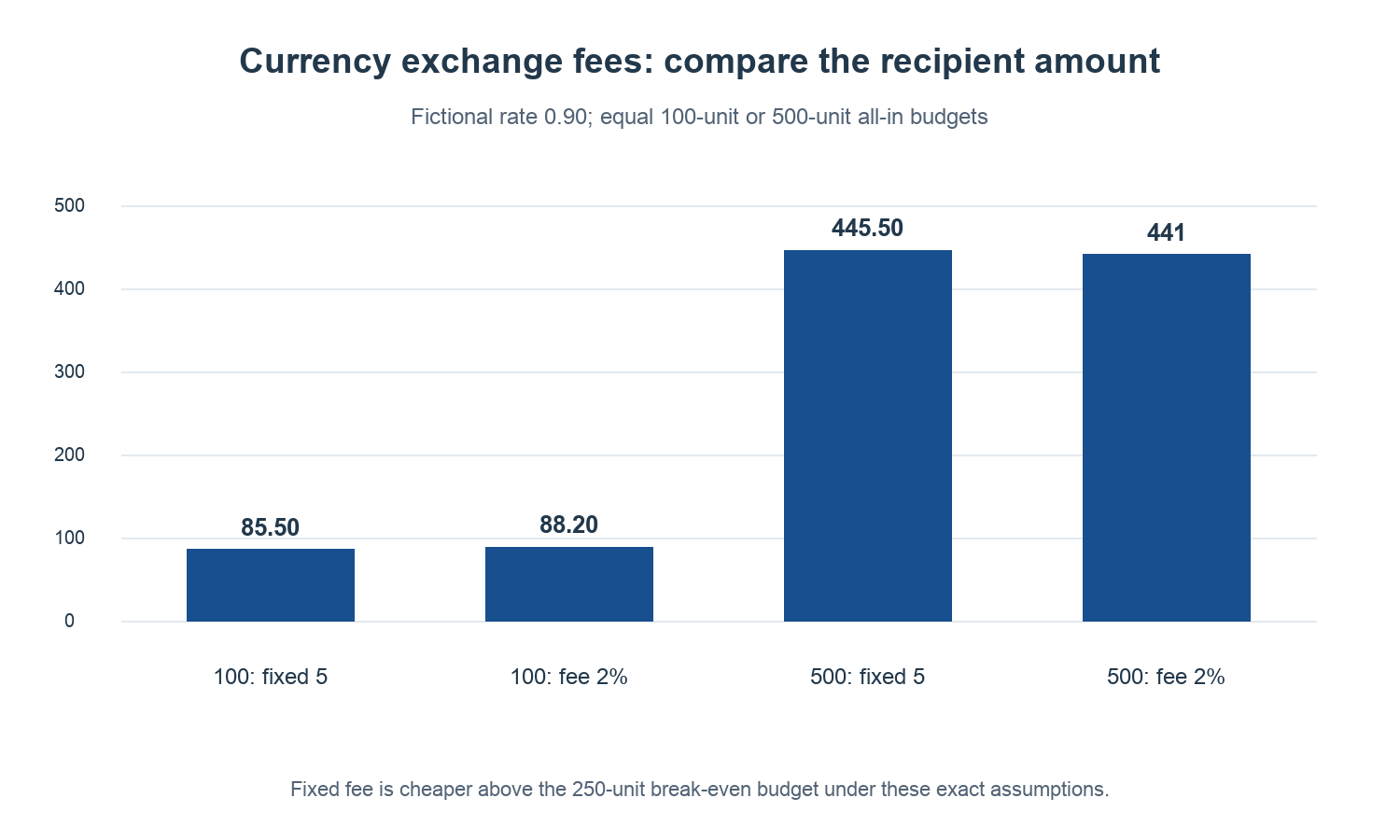
Table of Contents
Currency exchange fees: define what is included
A budget of 100 can mean either “I will spend 100 in total” or “convert 100, and charge fees on top.” Those are different comparisons. This guide first assumes a fixed all-in budget: the fee is removed before the remaining money is converted.
Under that assumption, a fixed fee F and rate r give:
Recipient amount = (budget − F) × r
If a fee p is charged as a fraction of that same budget, the calculation is:
Recipient amount = budget × (1 − p) × r
Real terms may instead calculate a percentage on the transfer principal, add a fee to the payment, impose a minimum fee or deduct a charge in the destination currency. Write the actual fee basis down before choosing a formula.
Currency exchange fees: fixed 5 versus 2%
Offer A removes a fixed fee of 5 source units. Offer B removes 2% of the source-unit budget. Both then convert at the same fictional rate of 0.90. There are no other charges in this illustration.
| Total source budget | A: fixed fee | A: recipient gets | B: 2% fee | B: recipient gets |
|---|---|---|---|---|
| 100 | 5 | 95 × 0.90 = 85.50 | 2 | 98 × 0.90 = 88.20 |
| 250 | 5 | 245 × 0.90 = 220.50 | 5 | 245 × 0.90 = 220.50 |
| 500 | 5 | 495 × 0.90 = 445.50 | 10 | 490 × 0.90 = 441.00 |
The percentage fee is cheaper for the 100-unit budget. The fixed fee is cheaper for the 500-unit budget. At 250, the two fees and recipient amounts match. Neither fee format is always preferable.
This also explains why a transfer that looks economical for a large amount can be expensive for a small one. A fixed 5-unit fee is 5% of a 100-unit budget but only 1% of a 500-unit budget.
Find the break-even for currency exchange fees
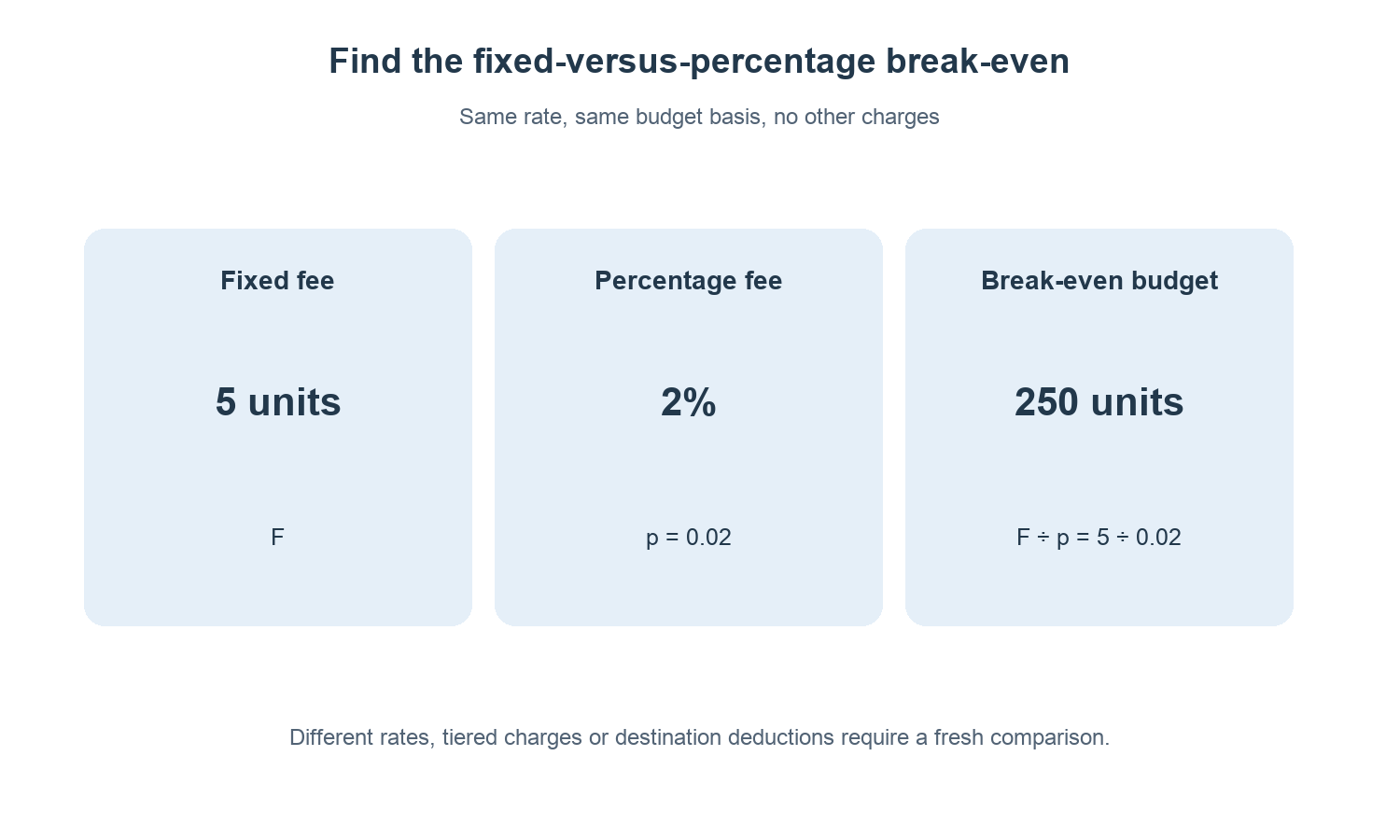
With equal rates and the same fee basis, set the fees equal: F = p × budget. Rearranging gives break-even budget = F ÷ p. Here, 5 ÷ 0.02 = 250.
Use 0.02 for 2%, not 2. The result is in source-currency units because the fixed fee is in source currency. If the fees are expressed in different currencies, convert them consistently before comparing.
The simple break-even formula stops being sufficient when rates differ, fees have tiers or minimums, or one provider charges the recipient separately. It is then more reliable to calculate the final recipient amount directly for your actual budget.
A better rate can outweigh a lower fee
Consider a second, separate 500-unit comparison. Offer C charges no explicit fee but exchanges at 0.88. The recipient gets 440. Offer D removes a 5-unit fee but exchanges at 0.90. The recipient gets 445.50. In this example, paying an explicit fee delivers 5.50 more destination units.
This does not identify the best provider; it shows why “zero fee” does not settle the calculation. Australia’s Moneysmart guide lists exchange rate, fixed or percentage charges and receiver fees as separate comparison factors.
The U.S. Consumer Financial Protection Bureau’s transfer guide likewise explains the exchange rate, charges and recipient amount shown in relevant transfer disclosures. Applicable protections depend on the service and jurisdiction.
Reproduce the example without confusing spread and fee
In the converter, choose the two currencies you are using for an illustration, select manual rate and enter 0.90. Treat that rate as destination units for one source unit. For Offer A, enter the budget as the amount, a fixed fee of 5, zero spread and “deduct fee before conversion.”
For Offer B, calculate 2% of the budget separately and enter that result as the fixed fee for this one scenario. At a budget of 100, use 2; at 500, use 10. Keep spread at zero because this example describes an explicit budget-based fee, not a provider’s exchange-rate margin.
A 2% rate reduction can happen to produce the same recipient number as a 2% pre-conversion budget deduction in this simple setup. That mathematical coincidence does not mean the disclosure labels or fee bases are interchangeable.
If fees are added on top, compare total cost as well as amount converted. Converting 100 at 0.90 and adding a 5-unit fee costs 105 and delivers 90. It cannot be compared directly with a 100-unit all-in budget without adjusting one side.
A worksheet for currency exchange fees
- Record when the quote was obtained and whether the rate is locked.
- Write the rate direction: destination units per source unit, or its inverse.
- Record the total source amount you will pay.
- List sending fees, destination deductions and any known taxes separately.
- Compare the final recipient amount using the same payment and receipt method.
- Check transfer timing and practical collection requirements alongside the arithmetic.
For related differences, see why a quoted rate differs from a reference rate and dynamic currency conversion at checkout. Those are separate issues from the fixed-versus-percentage comparison here.
Currency exchange fees with the same transfer principal
The first comparison fixed the total budget. A different useful question fixes the amount converted instead. Suppose both offers convert 500 source units at 0.90 and charge their fees on top. Both recipients receive 450 destination units, but the sender’s total payment differs.
| Offer | Principal converted | Additional fee | Total source payment | Recipient amount |
|---|---|---|---|---|
| Fixed 5 | 500 | 5 | 505 | 450 |
| 2% of principal | 500 | 10 | 510 | 450 |
The comparison now asks how much it costs to deliver the same amount, rather than how much arrives from the same budget. Either framing can be useful, but mixing them in one table would favor an offer merely because more money was sent.
A percentage fee added on top needs a different equation
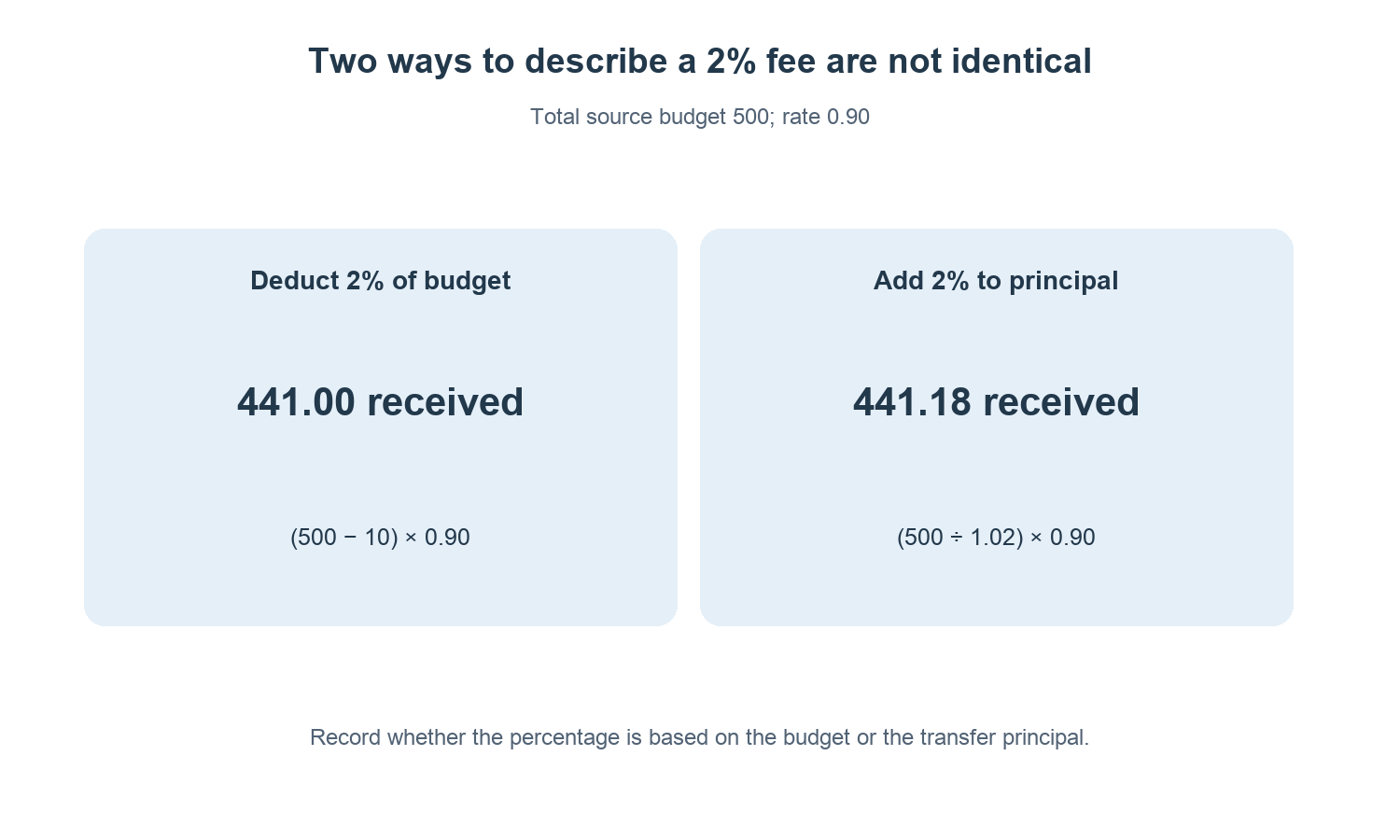
If your total budget is 500 and the provider adds a 2% fee to the transfer principal, principal plus fee equals principal × 1.02. The principal that fits the budget is 500 ÷ 1.02 ≈ 490.1961. The fee is approximately 9.8039.
At the fictional 0.90 rate, the recipient gets approximately 441.1765, or 441.18 after two-decimal rounding. This differs slightly from deducting 2% of the total 500 budget, which leaves 490 to convert and delivers 441.00.
The two phrases “2% of the budget” and “2% added to the transfer principal” describe different bases. A calculator cannot choose the right one from the percentage alone. Copy the provider’s wording and build the equation around it.
A destination charge belongs after conversion
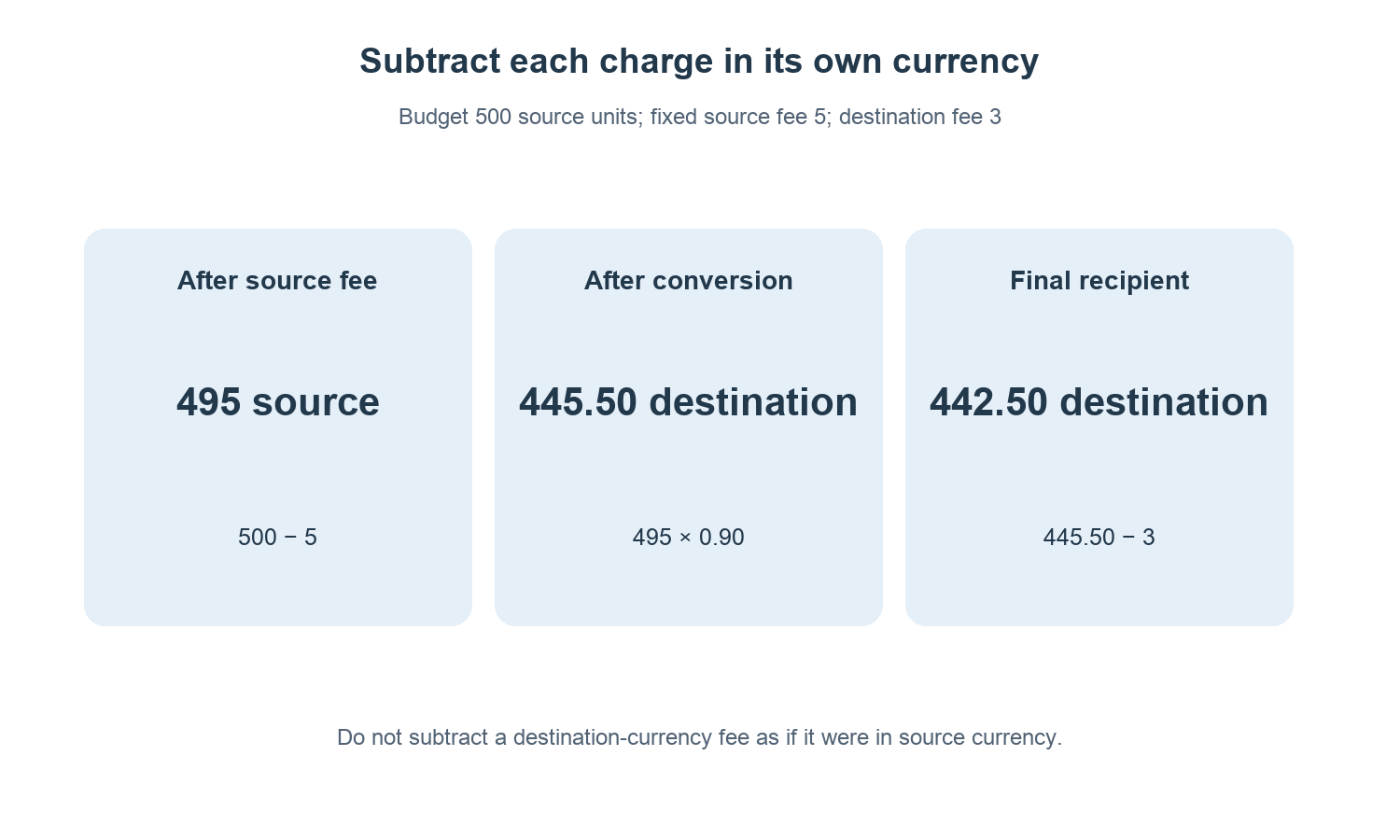
Suppose an offer removes 5 source units from a 500-unit budget, converts the remaining 495 at 0.90 and then deducts 3 destination units. Conversion produces 445.50, and the final amount is 445.50 − 3 = 442.50 destination units.
Do not subtract the destination charge as if it were 3 source units before conversion. That alternative would produce (500 − 5 − 3) × 0.90 = 442.80, a different result. Currency labels on fee lines are part of the calculation.
If a charge is only an estimate or is not known in advance, keep that uncertainty visible in the comparison. A precise-looking final amount cannot be more certain than its fee inputs.
Currency exchange fees: check the quote’s rate direction
The rate 0.90 destination units per source unit has an inverse of 1 ÷ 0.90 ≈ 1.111111 source units per destination unit. These describe the same hypothetical exchange relationship in opposite directions.
Multiplying a source amount by the inverse as though it were the original quote makes the result too large. Write the units beside the rate and cancel them: source units × destination/source leaves destination units.
When comparing quotes, align direction, timestamp, budget basis, payment method and receipt method first. The resulting recipient-amount comparison then has a clear meaning rather than combining incompatible labels.
Common questions
Is the break-even amount always 250?
No. It is 250 only for the fictional fixed fee of 5 versus 2%, with the equal-rate and equal-basis assumptions used above.
Can a reference-rate conversion tell me exactly what will arrive?
Only if the actual transaction uses that rate and all charges are included. A reference amount is a comparison input, not a provider commitment.
What if the fixed fee exceeds the budget?
The simple deducted-fee scenario cannot fund a positive transfer. Check the provider’s minimum amount rather than treating a negative calculated recipient amount as a valid quote.
Use the currency converter to check a written quote, with its fee basis and rate direction beside the inputs.