 Skip to content
Dynamic currency conversion, or DCC, is an offer to convert a card purchase or ATM withdrawal into your card’s home currency at the point of the transaction. The familiar currency can make a price easier to recognize, but the conversion quote may include an added markup.
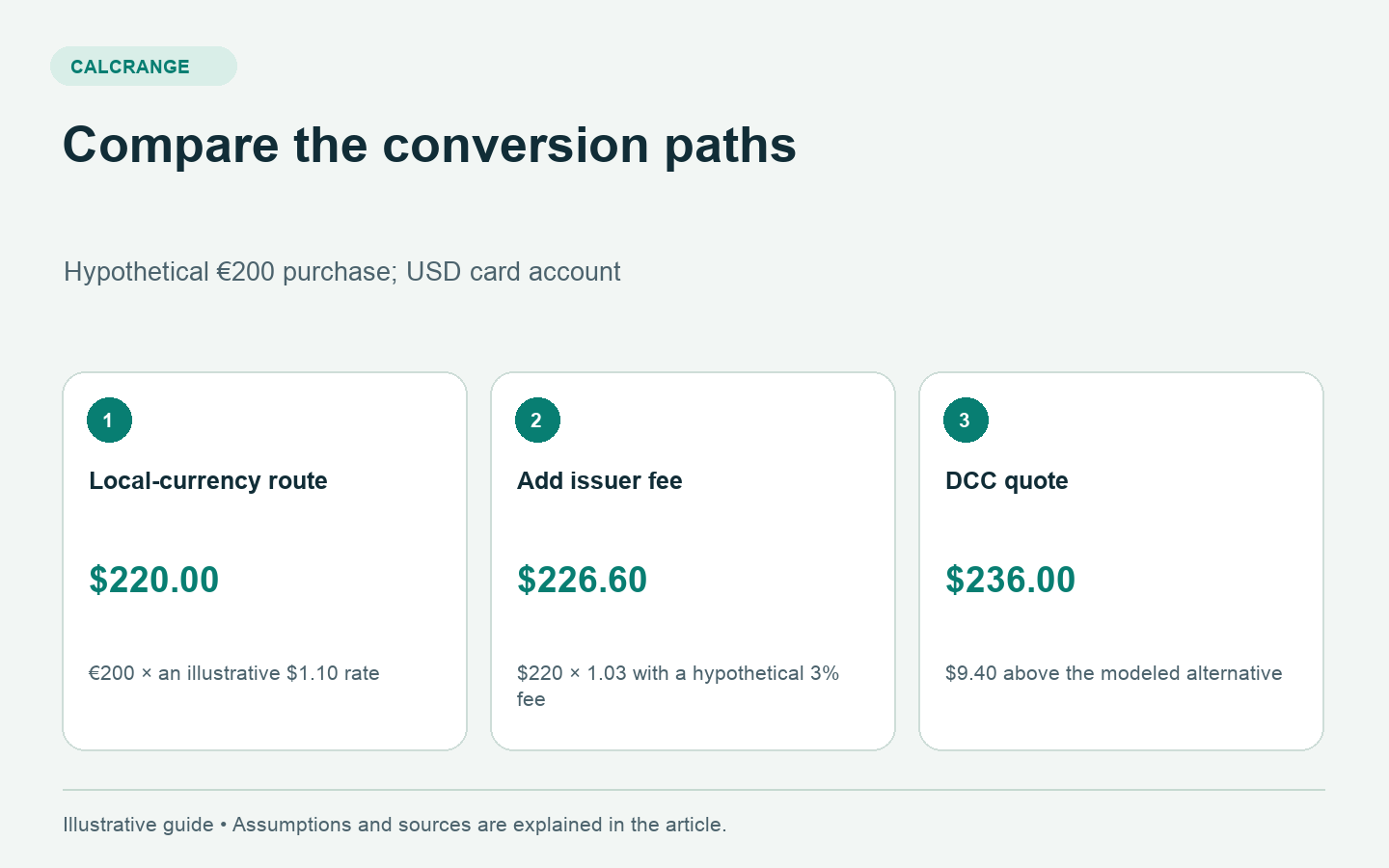
The useful comparison is the total cost of accepting that quote versus paying in the local currency and letting the card payment process handle conversion under your issuer’s terms. The Currency Converter can help compare explicit rates and fees; its reference rate is not a promise of the rate your card will receive.
What to look for on the screen
Visa’s DCC guidance says its merchants and ATMs should display the amounts in both currencies, the conversion rate and additional fees or markup. The customer should be able to accept or decline conversion. These are Visa’s stated requirements; consult your own card network and issuer for their terms.
Read the currency codes as well as the amount. A dollar symbol alone may be ambiguous. Before confirming, identify which option charges the local-currency amount and which option accepts the converted amount. Keep the receipt so you can compare the choice with the posted transaction.
A worked example with a card fee
Assume a €200 purchase and a USD card account. These figures are entirely hypothetical. The terminal offers a DCC total of $236. A reference comparison uses $1.10 per euro, and the hypothetical issuer charges a 3% fee on the converted amount.
- Convert the local price: €200 × $1.10 = $220.
- Add the modeled issuer fee: $220 × 3% = $6.60.
- The comparison total becomes $226.60.
- Subtract: $236 − $226.60 = $9.40.
On those assumptions, the DCC quote costs $9.40 more. If the issuer fee were zero, the difference would instead be $16. If another issuer charge applies under either choice, add it to the appropriate side. Never assume the home-currency option removes every foreign transaction charge.
How to measure the implied rate
Divide the home-currency quote by the local-currency amount: $236 ÷ €200 = $1.18 per euro. Relative to the assumed $1.10 reference rate, the difference is ($1.18 ÷ $1.10 − 1) × 100 = about 7.27%.
That 7.27% is a comparison with this chosen reference rate. It is not necessarily the provider’s disclosed markup methodology, and it is not the net extra cost after the alternative issuer fee. The two percentages answer different questions.
For a defensible comparison, write down when the reference rate was obtained and whether it was a card-network indication, a provider quote or a general market rate. Visa describes its exchange-rate calculator as an indication of a rate you may receive.
ATMs add another layer
An ATM transaction may involve a machine fee, issuer withdrawal fee, conversion and other account-specific charges. Build a row for each quoted charge. A fixed $5 fee on a small withdrawal can have a different percentage effect from the same fee on a larger withdrawal, but that arithmetic alone does not establish the right withdrawal amount for you.
If the machine offers an account-currency conversion, compare that decision separately from whether to accept the ATM’s own service fee. Read the exact wording: a button that declines conversion is not necessarily a button that cancels the entire withdrawal.
Use the converter without overclaiming accuracy
Enter the local amount, a clearly labeled comparison rate and any known fee. Run a second scenario using the DCC quote. If the calculator uses a percentage spread and a fixed fee, check their order and avoid adding the same markup twice when it is already included in the offered rate.
Visa’s travel guidance recommends local-currency payment to avoid the DCC markup. Your own comparison should still retain the issuer’s charges and recognize that final processing rates can differ from a reference estimate. An unexplained posted amount is a reason to ask the issuer for the rate and fee breakdown, using the receipt as evidence.
Sources and method
Source links checked September 18, 2026. Examples are original educational calculations using the assumptions stated above.