 Skip to content
Cows are commonly pregnant for about 283 days, or a little over nine months. The useful answer for herd planning is a date range tied to the breeding record, rather than a promise that every cow will calve on day 283.
The Cow Gestation Calculator can help organize those dates. Before using it, identify whether the input is a witnessed service, an insemination or simply the first day a bull was present.
Why published gestation ranges differ
Nebraska Extension describes 283 days as common for most breeds, with a 279–287-day range, and notes variation with breed and calf sex. The Mississippi State producer guide gives the same average with a broader 273–290-day range.
Those references are not identical prediction intervals for your herd. They describe variation at different levels of generality. Neither supplies a probability that an individual cow will calve on a particular day. Use your veterinarian’s advice and herd records when deciding how much observation coverage is needed.
Worked example: January 1 breeding
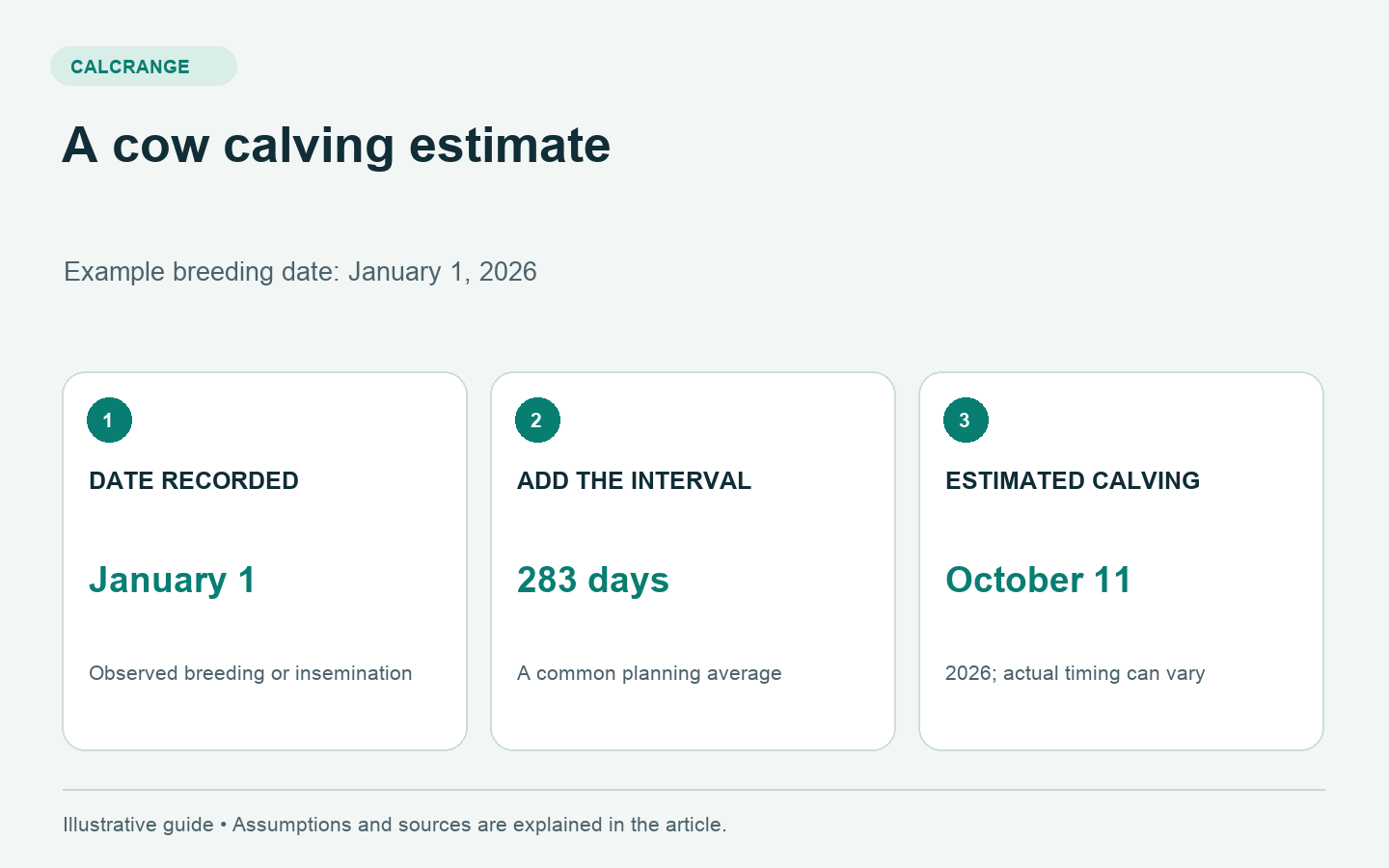
For a recorded breeding on January 1, 2026, adding 283 days gives October 11, 2026. To illustrate the broader Mississippi State reference, adding 273 days gives October 1 and adding 290 gives October 18.
| Calculation | Result | Meaning |
|---|---|---|
| January 1 + 273 days | October 1 | Lower reference used in this example |
| January 1 + 283 days | October 11 | Central planning estimate |
| January 1 + 290 days | October 18 | Upper reference used in this example |
This example uses elapsed days, so January 2 is one day after January 1. Do not substitute nine calendar months: January 1 plus nine months is October 1, which differs from the 283-day estimate by ten days. Month lengths make the two methods unequal.
Handle repeat services explicitly
Suppose the same cow was served on January 1 and again on January 22. The second date is 21 days later, so its 283-day estimate is also 21 days later: November 1 rather than October 11. Averaging the two service dates would conceal that there are two different possible starting points.
Keep both services in the record and add the pregnancy examination result. Ask the veterinarian which date best matches the examination findings. A calculator cannot determine which service resulted in conception merely because both dates were entered correctly.
When the bull was with the herd for weeks
If all you know is an exposure period, calculate an estimate from its start and another from its end. This shows the uncertainty created by the records before allowing for biological variation. For example, a 30-day exposure interval cannot justify a one-day calving prediction without additional evidence.
Useful fields include cow identification, service date, bull or semen identification, pregnancy check date, recorded gestational estimate, expected calving window and actual calving date. Keep the raw dates even after the expected date is revised, so a later review can distinguish incorrect records from ordinary variation.
Pregnancy confirmation is a separate step
Nebraska Extension’s pregnancy-detection guidance describes ultrasound and blood testing from around 30 days and palpation commonly at 35–50 days, depending on the examiner. A veterinarian should choose the method and timing for the herd; a due-date calculation is not a positive pregnancy test.
Arrange an observation and emergency-contact plan before the expected window. Do not use a date estimate to delay assessment of a cow that is ill, distressed or having difficulty calving. The calculator answers when to plan; examination answers questions about the individual animal.
Sources and method
Sources checked September 18, 2026. Numerical examples are illustrative calculations, not patient or animal records.