 Skip to content
To find how many days are left until your birthday, compare today’s calendar date with the next occurrence of your birthday. If this year’s date has already passed, use next year. For a live countdown, choose a specific time as well as the date.
The CalcRange Countdown Timer can count toward your selected date and time. Deciding whether the target is the start of your birthday or the start of a party makes the result much more useful.
A simple 50-day birthday example
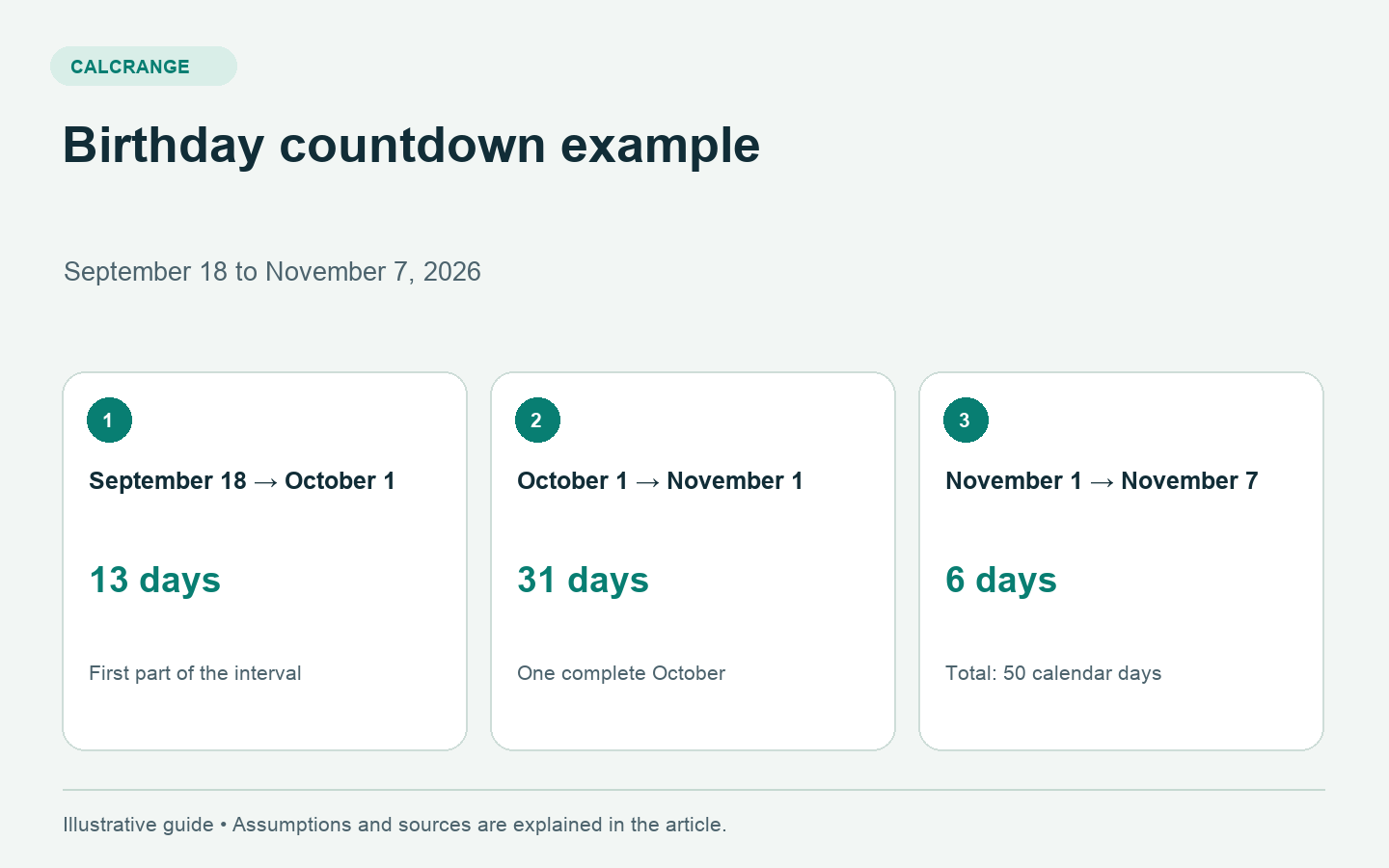
Imagine today is September 18, 2026, and your birthday is November 7. The elapsed calendar-date difference is 50 days. One way to check it is to divide the interval at the start of each month:
- September 18 to October 1: 13 days.
- October 1 to November 1: 31 days.
- November 1 to November 7: 6 days.
Add 13 + 31 + 6 to get 50 days. This is a fixed example, not a claim about your birthday or today’s date when you read this article.
Set the target before starting the timer
Write down the birthday’s month and day, then select the next applicable year. For a countdown to the birthday itself, midnight at the beginning of that date is a clear convention. For an event, enter its actual start time: a party beginning at 6 p.m. has 18 more hours to run than a timer ending at midnight that morning.
Check the target shown after you enter it. A 12-hour clock can make 12 a.m. and 12 p.m. easy to confuse: 12 a.m. is midnight and 12 p.m. is noon. If the interface uses a 24-hour clock, 00:00 is midnight and 18:00 is 6 p.m.
Why the timer can show one fewer day
A calendar question and a live countdown measure slightly different things. At noon on September 18, the date November 7 is still 50 calendar dates away. But midnight on November 7 is only 49 full 24-hour periods plus 12 hours away, assuming no clock change in that interval.
A timer displaying whole days, hours and minutes will normally put the completed 24-hour blocks in its days field. Seeing 49 days and 12 hours therefore does not mean the calendar subtraction was wrong. Read the remaining hours before comparing the two displays.
What if the birthday is in another time zone?
Choose whose local birthday you mean. A friend in another country may reach midnight several hours before or after you. If you are planning a call, convert their local birthday date and time into your own time zone before setting a device-local timer.
NIST’s local time guidance explains that daylight saving changes the offset used by participating locations. A date interval crossing a clock change may contain an extra or missing hour even though its number of calendar dates has not changed.
February 29 birthdays and year changes
A February 29 birthday needs an explicit choice in a non-leap year: count toward the celebration date you actually plan to use, or toward the next February 29. The U.S. Naval Observatory documents the leap-year rule; the timer cannot choose a family’s celebration custom for them.
Similarly, after a birthday has passed, update the target year. Leaving last year’s date in the form cannot produce a meaningful countdown to the next birthday.
Use a reminder for an action you must remember
A visible browser timer is useful for checking the remaining time, but an open page is not the same as a scheduled notification. Device sleep, a closed tab or browser restrictions may prevent an alarm from being heard. Put the call, gift-order deadline or party in a calendar reminder if it needs to alert you later.
Once the date, time and time zone are clear, enter the target in the Countdown Timer and check that the displayed destination matches your plan.