 Skip to content
The weight of a cubic yard of concrete depends on its density. With an assumed density of 150 pounds per cubic foot, one cubic yard weighs 27 × 150 = 4,050 pounds. That is a worked estimating assumption, not an exact weight for every mix.
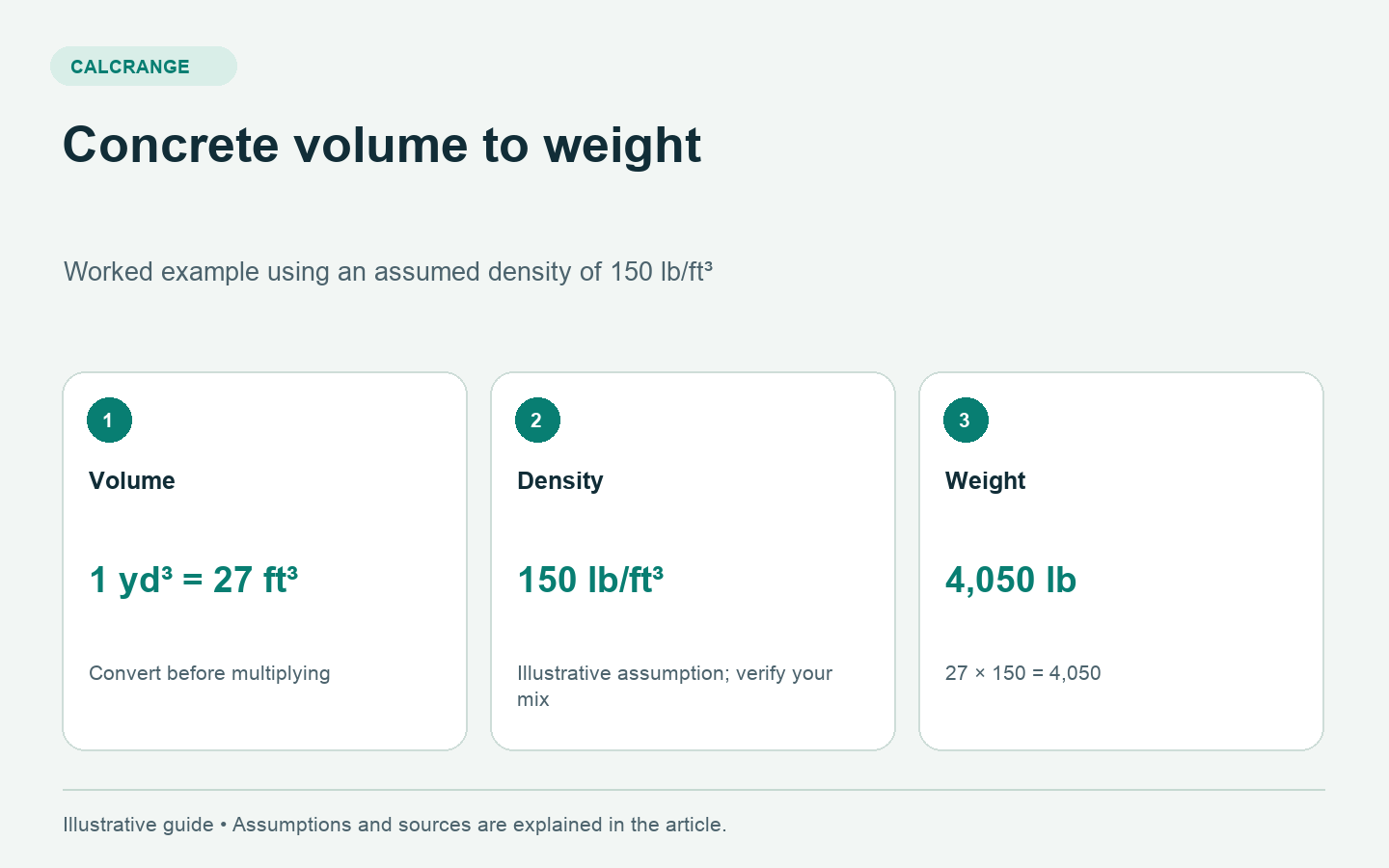
Use the Concrete Calculator to estimate project volume, then obtain the density of the actual material before converting that volume to weight. This extra step matters when comparing delivery quantities, bag handling and material records.
The formula and the units
Weight = volume × density. The volume unit in the density must match the volume you measured. A density in pounds per cubic foot cannot be multiplied directly by a quantity in cubic yards.
| Starting volume | Conversion | At an assumed 150 lb/ft³ |
|---|---|---|
| 1 cubic foot | No conversion | 150 lb |
| 0.5 cubic yard | 13.5 cubic feet | 2,025 lb |
| 1 cubic yard | 27 cubic feet | 4,050 lb |
| 2 cubic yards | 54 cubic feet | 8,100 lb |
In metric units, an assumed 2,400 kg/m³ density and a 0.75 m³ volume produce 1,800 kg. Keep the original density specification with your calculation so another person can reproduce it instead of assuming the result came from a universal conversion factor.
Why there is no single exact weight
Concrete contains different aggregates and can have different air content and moisture conditions. The Concrete Society describes normal-weight concrete using an oven-dry density range of 2,000–2,600 kg/m³. That definition is not a delivery-ticket measurement of fresh concrete.
The American Concrete Institute also distinguishes low-density and high-density aggregate applications. A lightweight mix should not inherit a conventional concrete assumption simply because both products are called concrete.
Record whether the supplier figure describes fresh, oven-dry or another specified condition. Reinforcement, embedded components and packaging are separate items if you are estimating the total weight of an assembly or shipment.
A small slab example
Imagine a rectangular volume measuring 8 feet by 6 feet by 4 inches. Convert thickness first: 4 ÷ 12 = one-third of a foot. The theoretical concrete volume is 8 × 6 × one-third = 16 cubic feet, or about 0.593 cubic yard.
At the illustrative 150 lb/ft³ density, the material weighs 16 × 150 = 2,400 pounds. If a confirmed density were instead 145 lb/ft³, the same geometry would give 2,320 pounds. Neither result verifies whether that thickness or construction method is suitable for a real slab.
If an ordering allowance increases the volume, weight increases in the same proportion. Keep the measured volume and the additional allowance in separate rows so they are not counted twice. The site’s concrete waste factor guide addresses ordering allowances separately.
Why bag weight and placed concrete weight differ
The weight printed on a dry-mix bag is not the final weight of its placed yield. Water is added, and the product has a specified yield. For example, the QUIKRETE No. 1101 technical sheet lists an approximate 0.60 cubic foot yield for an 80-pound bag. Use the current sheet for the product actually purchased.
At that yield, 27 ÷ 0.60 = 45 bags theoretically provide a cubic yard, before any project allowance. Their dry contents weigh 45 × 80 = 3,600 pounds. This is dry material arithmetic; it is not proof that a cubic yard of fresh concrete weighs 3,600 pounds. Do not force these two different measurements to match.
A practical record to keep
Save the measured dimensions, calculated volume, density source and condition, allowance, rounding method and resulting estimate. Ask the supplier to confirm delivery weight or product yield when it affects the order. For transport, use the vehicle and trailer manufacturer’s actual limits and the supplier’s measured loading information; this educational estimate cannot establish a safe payload.
A useful calculation is traceable: a later change to density or volume should be easy to update without rebuilding the whole estimate.
Sources and method
Source links checked September 18, 2026. Examples are original educational calculations using the assumptions stated above.