 Skip to content
Short answer: There is no single concrete waste percentage that fits every pour. First calculate the measured volume, then agree an allowance with your supplier or project professional. The 5%, 7% and 10% figures below are illustrative calculation scenarios—not sourced recommendations for particular project types.
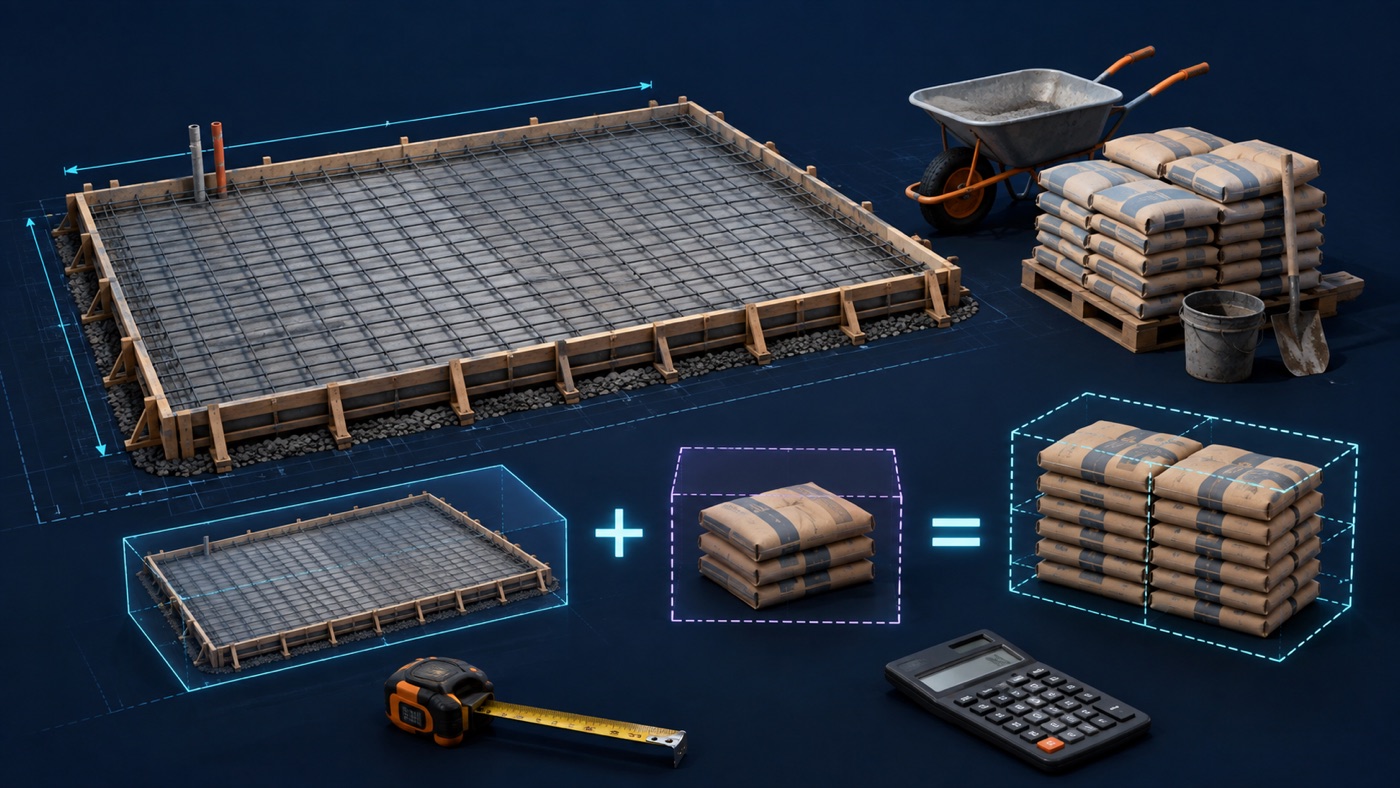
Running short during a continuous pour can create a cold joint, extra delivery fee, crew delay, or poor finish. Ordering far too much wastes money and creates a disposal problem. A waste factor is a deliberate buffer—not permission to skip careful measurement.
Choose an allowance from the actual site conditions
Check depth variation, form dimensions, thickened edges, delivery method and supplier order increments before choosing an allowance. A percentage cannot correct an inaccurate quantity takeoff. Structural drawings, specifications and the project professional’s measured quantities take priority.
QUIKRETE’s quantity calculator explicitly says that its approximate bag yields do not include uneven substrate or waste. That supports checking field conditions separately; it does not establish a universal 5%, 7% or 10% allowance. The arithmetic table below simply shows the effect of each assumed percentage.
Concrete volume formula
Volume = length × width × thickness
Keep every measurement in the same unit. In U.S. customary units, calculate cubic feet and divide by 27 to get cubic yards.
Cubic yards = length (ft) × width (ft) × thickness (ft) ÷ 27
For a 20 ft × 12 ft slab that is 4 inches thick:
- Convert thickness: 4 inches ÷ 12 = 0.333 ft.
- 20 × 12 × 0.333 = about 80 cubic feet.
- 80 ÷ 27 = about 2.96 cubic yards.
- Add 5%: 2.96 × 1.05 = 3.11 cubic yards.
- Add 10%: 2.96 × 1.10 = 3.26 cubic yards.
The ready-mix supplier may sell in specific increments and apply a minimum load or short-load fee. Confirm the final order with the supplier.
Waste-factor formula
Order quantity = calculated volume × (1 + waste percentage ÷ 100)
| Calculated volume | With 5% extra | With 7% extra | With 10% extra |
|---|---|---|---|
| 2 yd³ | 2.10 yd³ | 2.14 yd³ | 2.20 yd³ |
| 5 yd³ | 5.25 yd³ | 5.35 yd³ | 5.50 yd³ |
| 10 yd³ | 10.50 yd³ | 10.70 yd³ | 11.00 yd³ |
| 20 yd³ | 21.00 yd³ | 21.40 yd³ | 22.00 yd³ |
Use the concrete calculator to estimate slabs, walls, or footings before applying an allowance.
What causes concrete quantity overruns?
- Thickness variation: a poorly graded base can make a nominal four-inch slab much deeper in places.
- Form movement: bulging or displaced forms increase the space being filled.
- Irregular shapes: curves, slopes, thickened edges, piers, and trenches are easy to underestimate.
- Spillage and pump loss: hoses, priming, cleanup, and handling can consume material.
- Measurement and conversion errors: confusing inches with feet or cubic feet with cubic yards causes large mistakes.
- Embedded objects: large blockouts reduce volume, while grade beams and haunches increase it.
Before placing the order
- Measure in several places rather than assuming uniform depth.
- Separate the project into simple shapes and total their volumes.
- Confirm whether dimensions are inside or outside the forms.
- Check the mix design, strength, slump, exposure class, and reinforcement with the project professional.
- Ask the supplier about truck capacity, rounding, minimum orders, access, washout, and returns.
- Plan a safe use for a small surplus, but never dump concrete into drains or soil.
Bagged concrete versus ready mix
Bag yield varies by product and bag size. Use the manufacturer’s published yield on the current bag, not a generic conversion. QUIKRETE, for example, provides a product calculator tied to slab dimensions and package sizes. Moisture, consolidation, and field conditions still affect actual use.
Source
Frequently asked questions
Is 10% extra concrete always necessary?
No. It may be excessive for a precisely formed, well-verified placement and insufficient for a highly irregular excavation. Base the allowance on measured uncertainty.
How many cubic feet are in a cubic yard?
There are 27 cubic feet in one cubic yard.
Should I round up my ready-mix order?
Suppliers sell in specific increments and may set minimums. Calculate first, apply the chosen allowance, then confirm the deliverable quantity with the supplier.
Does the calculator include thickened edges?
Only if those sections are entered separately or the calculator explicitly supports them. A uniform slab input can underestimate beams, haunches, and footings.
Can leftover concrete be returned?
Supplier policies differ, and returned material may involve charges. Arrange an approved washout or secondary use before the pour.
This guide estimates material quantity only. Concrete design, placement, safety, and code compliance require qualified project professionals.
Pingback: Concrete Weight per Cubic Yard: Estimate From Volume and Density