 Skip to content
Daily compound interest produces a slightly larger balance than monthly compound interest when the starting balance, nominal annual rate and time are identical. The word nominal matters: if two accounts advertise the same annual percentage yield, you should not add a separate daily-compounding bonus to one of them.
This guide isolates compounding frequency with a reproducible example. It does not compare current bank offers or predict investment returns. Use the Compound Interest Calculator to repeat the calculation with your own assumptions.
What changes when interest compounds daily?
Compounding adds earned interest to the balance that can earn future interest. A daily model does this 365 times in a standard year; a monthly model does it 12 times. Each daily addition is smaller, but it becomes part of the interest-earning balance sooner. The CFPB explanation of compound interest describes this interest-on-interest effect.
Do not confuse compounding with the date a deposit appears on your statement. An account can calculate interest using daily balances and show an interest credit less frequently. The account disclosure tells you the calculation method, compounding schedule and crediting policy. Regulation DD commentary recognizes different compounding and crediting arrangements.
A $10,000 worked comparison
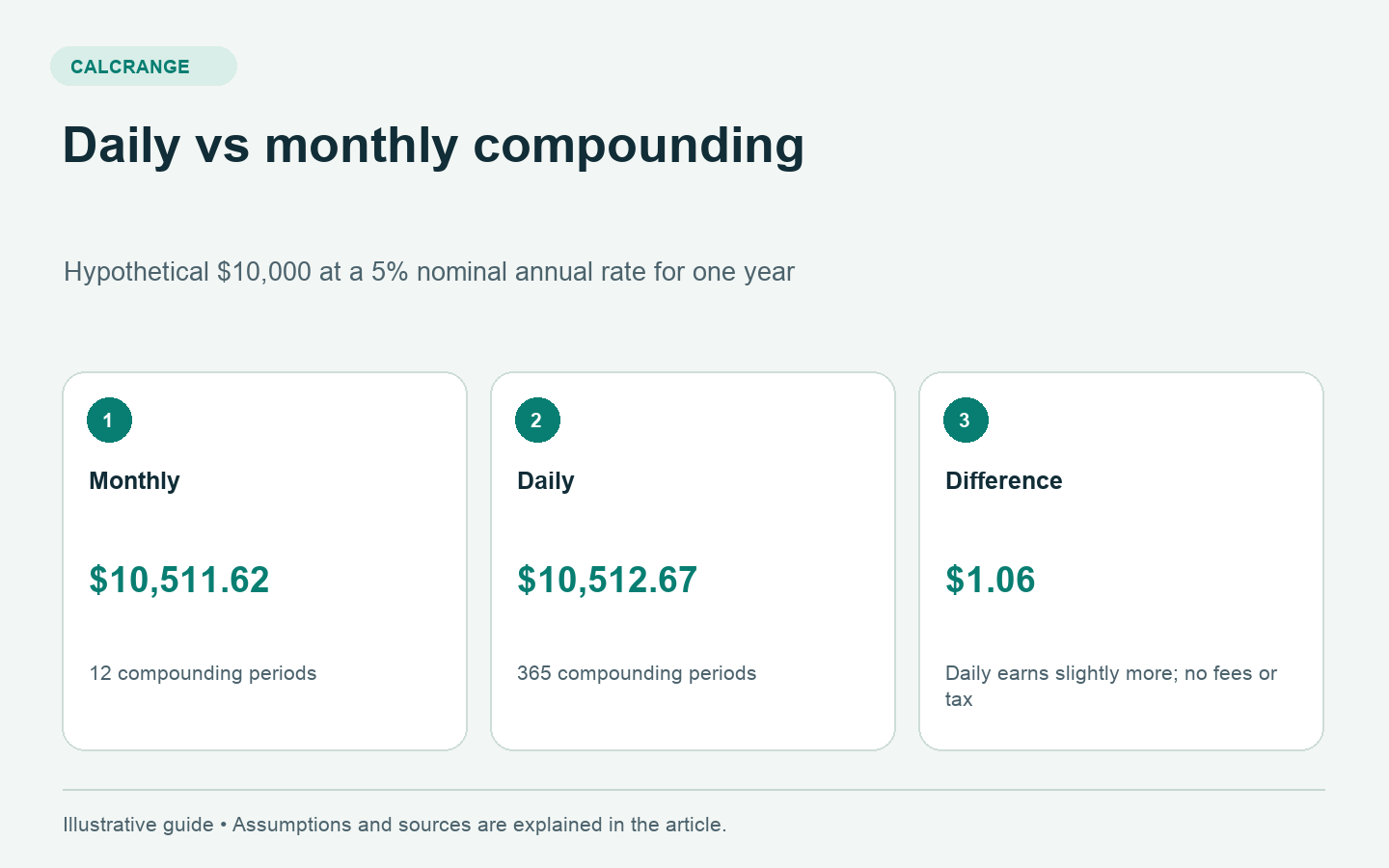
Assume a $10,000 opening balance, a fixed 5% nominal annual rate, one year, and no transactions, fees or tax. Use the formula ending balance = principal × (1 + annual rate ÷ periods)periods × years. Write 5% as 0.05.
| Frequency | Calculation | Ending balance |
|---|---|---|
| Annual | 10,000 × 1.05 | $10,500.00 |
| Monthly | 10,000 × (1 + 0.05/12)12 | $10,511.62 |
| Daily | 10,000 × (1 + 0.05/365)365 | $10,512.67 |
The daily model earns about $1.06 more than the monthly model. That difference comes from subtracting the unrounded results and then rounding. Subtracting the already rounded balances gives $1.05; this one-cent discrepancy is a rounding effect, not a different formula.
Because the formula is proportional to principal, the same assumptions on $1,000 produce a difference of about 11 cents. On $100,000, the difference is about $10.56. These examples show why frequency deserves attention without making it the only comparison.
Compare the same kind of rate
A nominal rate describes the annualized rate before the effect of repeated compounding. APY expresses an annual yield that already incorporates compounding under the stated conditions. For a broader rate comparison, see APR vs APY.
If both hypothetical accounts instead have exactly 5% APY, leave $10,000 untouched for the matching annual period and the modeled result is $10,500 in each. Using 5% as a nominal rate in one calculator and as APY in another creates an artificial difference. Check the field label before entering the percentage.
What to enter in the calculator
- Enter the starting balance and set regular contributions to zero for the first comparison.
- Use the same nominal annual rate and duration for both runs.
- Run monthly compounding, record the result, then change only the frequency to daily.
- Add actual contribution assumptions only after the controlled comparison makes sense.
Monthly deposits introduce another timing question: does money arrive at the beginning or end of the month? A deposit cannot earn interest before it exists in the account. Match the calculator convention to your model and label the difference if the real account uses a different schedule.
Checks before choosing an account
Write down the advertised APY, any rate tiers, minimum balance, monthly fee, introductory-rate end date and access restrictions. In the worked example, even a $1 monthly fee would exceed the extra interest from daily rather than monthly compounding over the year. That is arithmetic about this example, not a statement about any current account.
Actual balances may differ because rates change, transactions occur during the period, institutions use specific day-count conventions, or interest is rounded as it is credited. The model is an educational comparison, not a bank statement or a guaranteed return.
Sources and method
Source links checked September 18, 2026. Examples are original educational calculations using the assumptions stated above.