 Skip to content
Maintenance calories after weight loss should be treated as a new estimate, not assumed to equal either your old maintenance intake or your recent weight-loss intake. Body size, activity and individual physiology all matter.
Start with current inputs in the Calorie Calculator. Keep the result as a planning reference rather than a precise measurement. If you are managing a health condition or need an individualized nutrition plan, a registered dietitian or clinician can help interpret it.
Why the old number may not fit
NIDDK explains that energy needs can decrease after weight loss and that maintaining the loss involves ongoing eating and activity habits. A static formula cannot capture every adaptation, but re-entering current weight is more transparent than continuing to use an old input.
It is also possible for activity to change during the same period. A smaller body with a more active routine does not necessarily have a lower total expenditure than before. That is why changing weight and activity simultaneously can make the source of a calculator difference hard to identify.
Worked example: change weight only
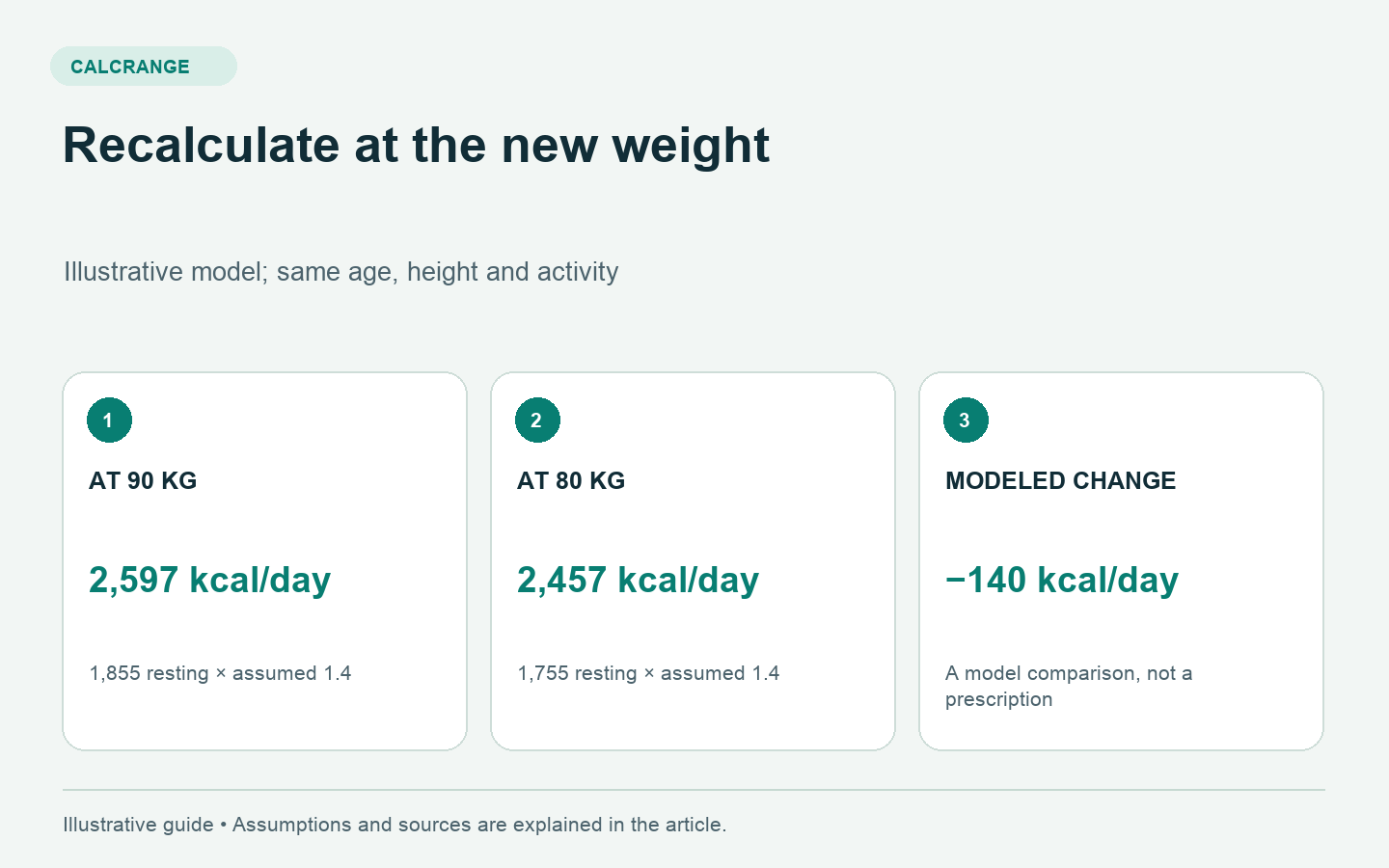
Consider an illustrative 35-year-old man, 180 cm tall. Using the simplified Mifflin–St Jeor equation, the resting estimate at 90 kg is 900 + 1,125 − 175 + 5 = 1,855 kcal/day. At 80 kg, it is 800 + 1,125 − 175 + 5 = 1,755.
If an assumed activity multiplier of 1.4 is held constant, the corresponding total estimates are 2,597 and 2,457 kcal/day. The modeled difference is 140 kcal/day. This is a demonstration of how the inputs affect one model; it is not a prediction that every 10 kg loss lowers expenditure by 140 calories.
| Input or output | Earlier example | Later example |
|---|---|---|
| Weight | 90 kg | 80 kg |
| Resting estimate | 1,855 kcal/day | 1,755 kcal/day |
| Assumed activity factor | 1.4 | 1.4 |
| Modeled total | 2,597 kcal/day | 2,457 kcal/day |
Then review activity separately
Using the later resting estimate, a factor of 1.3 gives about 2,282 kcal/day, while 1.5 gives about 2,633. The 351-calorie spread comes entirely from the illustrative activity assumption. It shows why vague labels such as “moderately active” deserve attention.
Describe the real routine beside the selection: work pattern, usual movement and exercise schedule. Do not select a higher category solely to reach a preferred calorie number. When the routine changes, note the change so that future comparisons remain interpretable.
Keep a comparison record
- Record the date, current measurements and formula used.
- Save the selected activity level and the routine it represents.
- Distinguish a maintenance estimate from any displayed weight-loss target.
- Compare weight trends over time rather than interpreting one reading as proof.
- Note substantial changes in intake, activity, medication or health for a clinical discussion.
The record helps explain discrepancies. For example, a lower calculator estimate after changing both weight and activity does not show how much each factor contributed. Re-running one change at a time makes the arithmetic reviewable.
A dynamic tool can ask a different question
The NIH Body Weight Planner models reaching a goal and maintaining it afterward. Its stated population is adults, excluding pregnancy and breastfeeding. That differs from a simple snapshot estimate based on today’s measurements.
Neither tool proves the exact food intake that will maintain a particular person’s weight indefinitely. Avoid turning a single output into an inflexible limit. If weight is changing unexpectedly or monitoring food and weight is causing distress, seek individual guidance instead of repeatedly adjusting the calculator to explain every daily fluctuation.
Sources and method
Sources checked September 18, 2026. Numerical examples are illustrative calculations, not patient or animal records.