 Skip to content
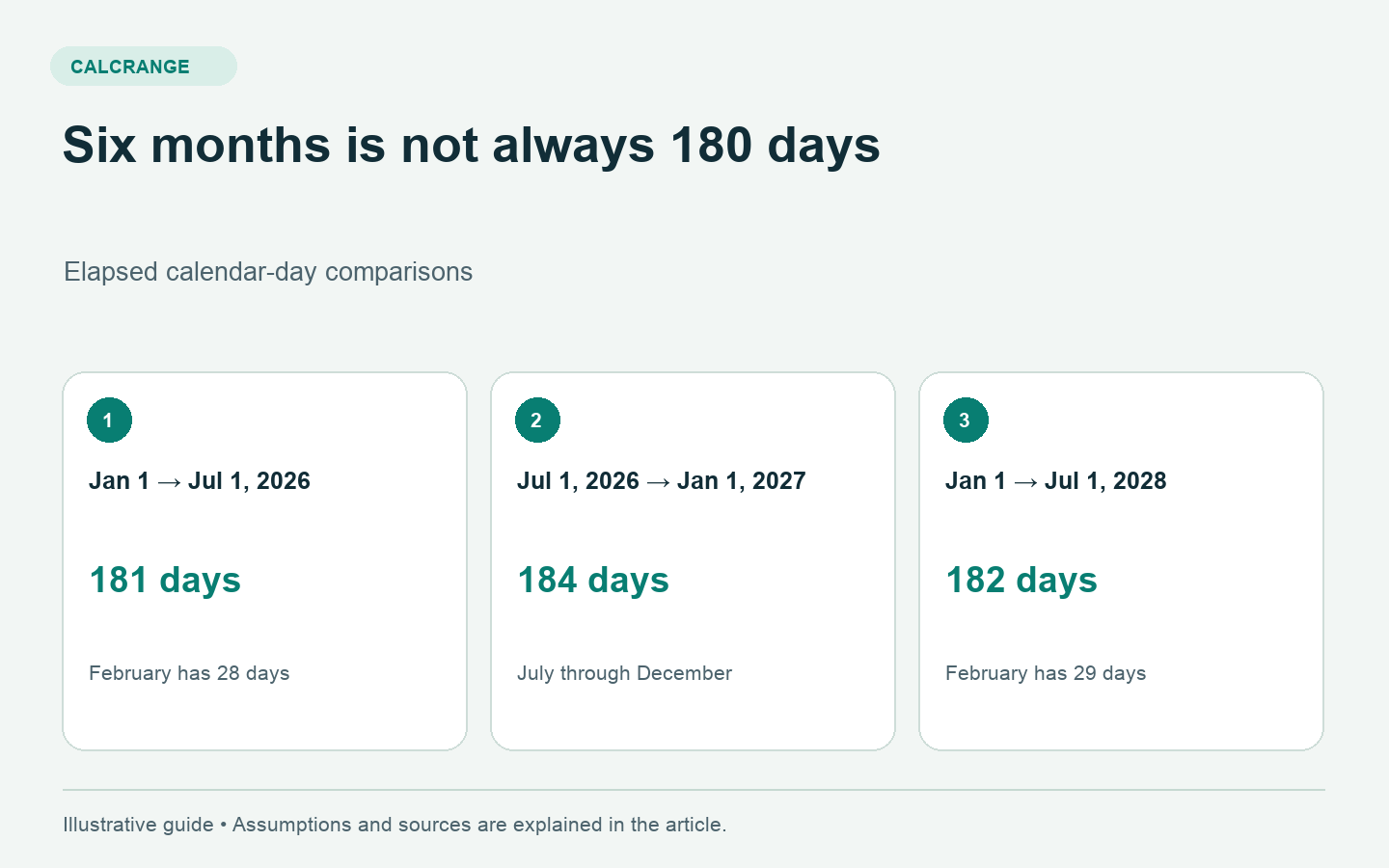
Six months does not have one fixed number of days. The exact total depends on the start date, the end date and whether February includes a leap day. For example, January 1 to July 1, 2026, is 181 elapsed days; July 1, 2026, to January 1, 2027, is 184.
Use the Date Difference Calculator to check a specific pair of dates. If a schedule says “six months,” first establish the calendar end date, then count the days between the dates.
Why six months is not simply 6 × 30
Multiplying 6 by 30 gives 180 days. That is a useful rough estimate when you deliberately treat every month as 30 days, but the calendar does not work that way. January has 31 days, April has 30 and February has 28 or 29.
January through June 2026 contain 31 + 28 + 31 + 30 + 31 + 30 = 181 days. In 2028, February has an extra day, so the corresponding interval contains 182 days. The U.S. Naval Observatory’s leap-year rule explains which Gregorian years include February 29.
Three exact examples
| Start date | Six-month end date | Elapsed days |
|---|---|---|
| January 1, 2026 | July 1, 2026 | 181 |
| July 1, 2026 | January 1, 2027 | 184 |
| January 1, 2028 | July 1, 2028 | 182 |
These examples count the interval between the dates rather than counting both named dates as whole days. A timetable that counts the first date as day one can produce a different displayed total. Keep the counting convention visible when you compare results.
Adding months and adding days answer different questions
Starting from January 1, 2026, adding six calendar months reaches July 1. Adding 180 days reaches June 30. Neither calculation is inherently incorrect; they apply different instructions.
For a recurring personal schedule such as “every six months on the first,” calendar-month arithmetic preserves the day of the month. For an interval explicitly stated as 180 days, add exactly 180 days. Do not silently replace one with the other just because their results are close.
What happens at the end of a month?
Consider adding six months to August 31, 2026. February 2027 has no 31st day. A system therefore needs a rule for the missing date. Some systems use February 28; others may roll the extra days forward or apply a rule written into a schedule.
The same issue appears when adding one month repeatedly. A schedule that moves January 31 to February 28 and then adds another month to that adjusted date can drift to March 28. A schedule anchored to the original month-end can instead use March 31. Record the intended rule before relying on a sequence of results.
A practical checking method
- Write the full starting date, including the year.
- Read whether the instruction specifies calendar months, a number of days or an explicit end date.
- Determine how unavailable month-end dates should be handled.
- Find the end date, then calculate the elapsed days between the two dates.
- Keep the original wording beside the result so the convention can be checked later.
For a contract, visa, filing requirement or other formal deadline, the issuing authority’s definition controls. A general date calculator can check arithmetic, but it cannot decide the governing rule or whether a holiday extends a deadline.
Are six months exactly half a year?
Six months is half of the twelve named months in a year. It does not necessarily contain half the year’s days. In 2026, the first six months contain 181 days and the last six contain 184, which together make 365.
For an exact answer, enter your dates in the Date Difference Calculator. Keep the result labelled “elapsed days” or “calendar months” so it retains its meaning.