 Skip to content
To compare two discounted products, divide each final price by its quantity in the same unit. The resulting unit price tells you the cost per ounce, kilogram, liter or item. A bigger discount percentage can still leave you paying more for the same amount of product.
Use the Discount Calculator to find each sale price, then compare that price with the quantity you will receive. The calculation is especially useful when package sizes differ.
The unit price formula
Unit price = final purchase price ÷ quantity. For a percentage discount, first calculate final price = original price × (1 − discount/100). Keep full precision until the comparison is finished, then round the displayed answer sensibly.
NIST’s Unit Pricing Guide emphasizes consistent units for comparable products. Comparing price per ounce with price per pound without converting one of them hides a 16-fold difference in the denominator.
Example: 25% off versus 10% off
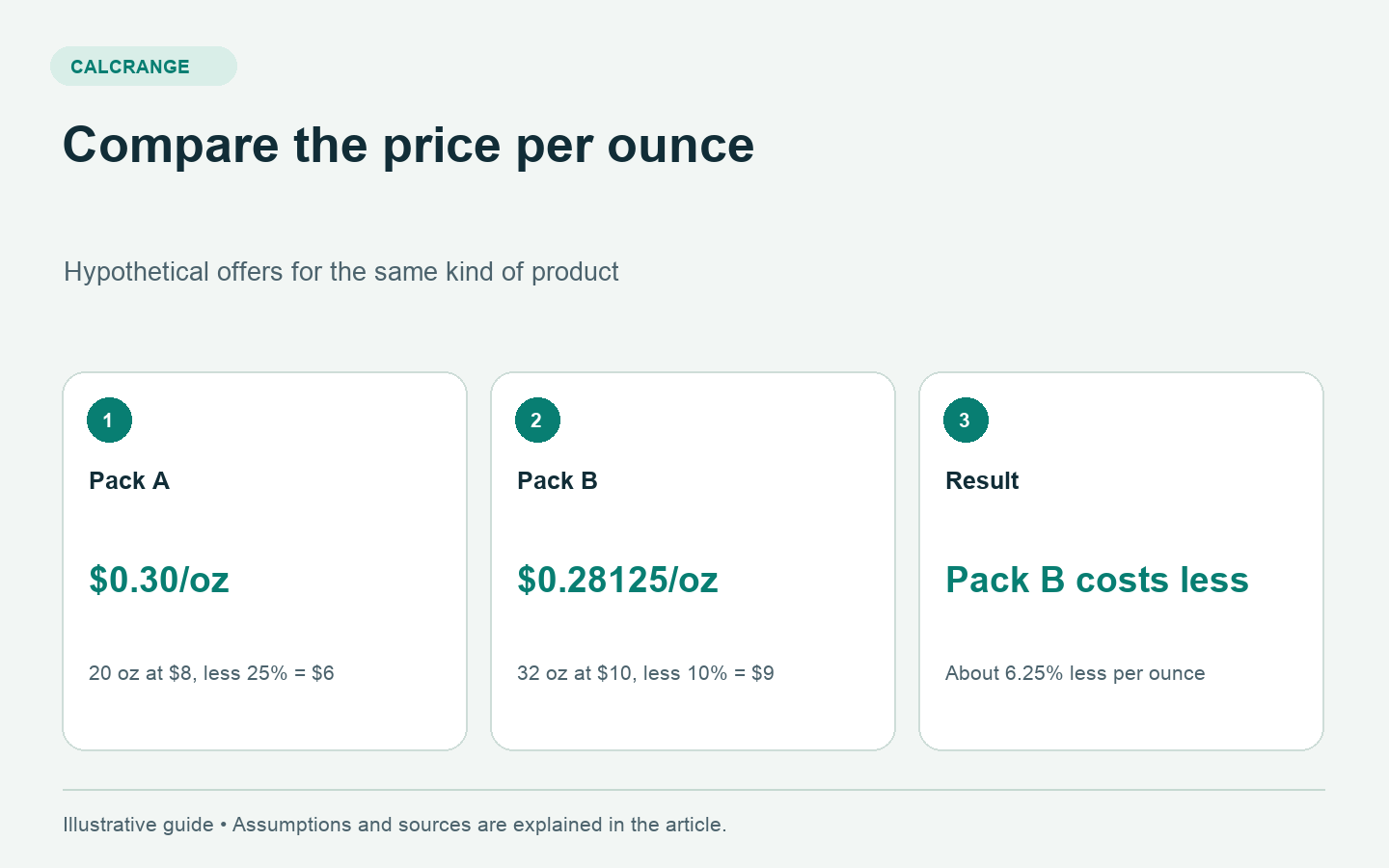
Imagine two packages of the same type and quality of cereal. Pack A contains 20 ounces and normally costs $8. Pack B contains 32 ounces and normally costs $10. The first is 25% off and the second is 10% off.
| Offer | Sale price | Quantity | Unit price |
|---|---|---|---|
| Pack A: 25% off | $8 × 0.75 = $6 | 20 oz | $0.30/oz |
| Pack B: 10% off | $10 × 0.90 = $9 | 32 oz | $0.28125/oz |
Pack B has the smaller discount but the lower unit price. Its unit cost is (0.30 − 0.28125) ÷ 0.30 × 100 = 6.25% lower. However, it requires spending $3 more now. The unit-price result does not decide whether that extra spending fits the shopper’s budget.
Buy-one-get-one offers need a quantity check
Suppose a 500-gram pack costs $6 and the offer is buy one, get one free, with identical eligible packs. The total is $6 for 1,000 grams, or $0.60 per 100 grams. A separate 750-gram pack for $4.20 costs $0.56 per 100 grams, so it remains cheaper per unit.
“Buy one, get one 50% off” is different. Two identical $6 packs cost $9 in total, giving $0.90 per 100 grams. Read whether the discount applies to the cheaper item, whether both items must be bought and whether a membership is required. Those conditions determine the numbers to enter.
Allow for the amount you can actually use
Lowest cost per purchased unit and lowest cost per used unit are different comparisons. If Pack B’s $9 purchase leaves 8 of its 32 ounces unused, the effective cost of the 24 ounces consumed is $9 ÷ 24 = $0.375 per used ounce. Pack A costs $0.30 per used ounce if all 20 ounces are consumed.
This does not require predicting waste precisely. Try a no-waste scenario and a realistic unused-quantity scenario. The break-even quantity for Pack B against a $0.30 alternative is $9 ÷ $0.30 = 30 ounces. You must use at least 30 ounces to match or beat that alternative on this basis.
Coupons, delivery and mixed products
Allocate a basket coupon consistently. A coupon restricted to one product can be subtracted from that product’s price. A whole-order coupon needs a stated allocation rule if you want per-product comparisons. An order-level delivery charge likewise belongs somewhere in the total; omitting it can reverse the apparent winner.
Keep unlike products separate unless you have a meaningful common unit. A price per bottle is unhelpful when bottles differ in volume. Price per tablet can be misleading when strengths or formulations differ. Unit price measures quantity cost, not suitability or quality.
A quick shopping worksheet
For each offer, record product, quantity, final price, comparison unit and any condition. Calculate the discount, convert the quantity, divide and then check whether the amount is usable. NIST identifies unit pricing as a tool for comparing value when package sizes change. The original examples here show how to apply that idea without assuming that bulk packaging or the largest sale label must win.
Sources and method
Source links checked September 18, 2026. Examples are original educational calculations using the assumptions stated above.