
A calving date from bull exposure starts with an interval, not a known conception day. If a bull was present from October 1 through October 21, entering October 1 as though it were a confirmed service hides 20 days of record uncertainty.
An artificial insemination record can provide a precise service date, but even that does not prove pregnancy resulted from that service. Keep the event record, calendar estimate and veterinary finding separate. This worksheet shows how to organize them without turning an uncertain starting point into a falsely precise due date.
The Cow Gestation Calculator accepts one breeding or AI date at a time. For an exposure interval, calculate both endpoints and retain both outputs; it does not automatically infer conception within the interval.
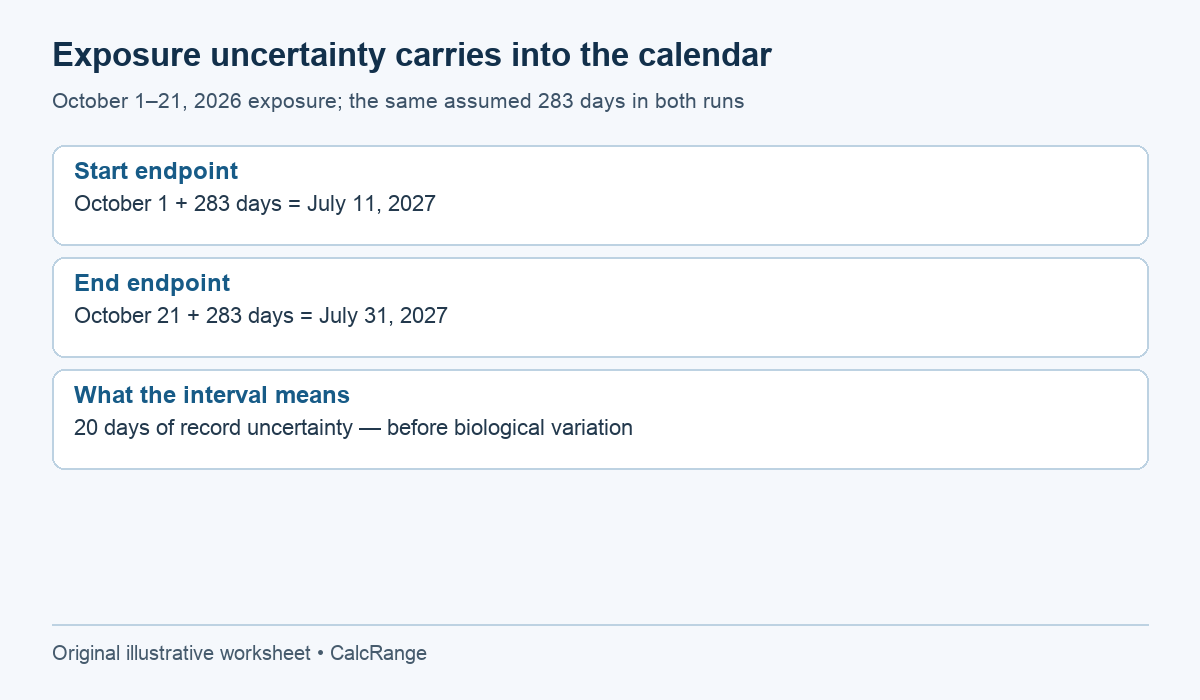
Table of Contents
Classify the calving date record before entering a date
Use a short event label: recorded AI service, witnessed natural service, bull introduced, bull removed or veterinary examination. These labels describe different evidence. A date without its event type is incomplete.
University of Wisconsin–Madison Extension’s calving calculator covers AI and natural-service planning and emphasizes the accuracy of entered information. The arithmetic cannot compensate for an exposure record mislabeled as an observed service.
| What you know | Store this | Do not silently assume |
|---|---|---|
| AI performed on October 1 | Service date and AI details | That conception is confirmed |
| Bull present October 1–21 | Exposure start and end | That the first day was conception |
| Two services recorded | Both dated events | That their midpoint is meaningful |
| Veterinarian provides findings | Examination date, method and reported interpretation | That the examination date replaces breeding |
Example A: calving date from an October 1 AI service
Using the calculator’s current 283-day central setting, October 1, 2026 + 283 elapsed days gives July 11, 2027. Write the result as “central calendar estimate from October 1 AI record,” not “confirmed calving on July 11.”
Elapsed-day addition counts October 2 as one day after October 1. The result crosses a year boundary, so include the year on exported calendars and printed notes. “July 11” alone can be ambiguous in records covering multiple breeding seasons.
The current tool also displays a planning window. Preserve its label and the interval used. Its progress display advances with the calendar; it does not observe fetal development. A changing percentage is not new evidence about this cow.
Example B: calving date estimates from both exposure endpoints
Now suppose the only record is bull exposure from October 1 to October 21, 2026. Run the calculator first with October 1 and then with October 21, retaining the same 283-day setting for this comparison.
| Starting record | Calculation | Central calendar estimate |
|---|---|---|
| Exposure begins | October 1, 2026 + 283 days | July 11, 2027 |
| Exposure ends | October 21, 2026 + 283 days | July 31, 2027 |
| Difference between endpoints | 20 elapsed days | 20 days in the output interval |
The interval July 11–31 comes from the dates of exposure alone. It does not include every biological uncertainty. Nor does it say that all dates within it are equally likely. A probability distribution would require evidence that this simple worksheet does not have.
Do not enter October 11 merely because it is halfway through the exposure period. That would create a single date without evidence of a service on that day. A midpoint may be labeled as a rough scheduling convenience, but it should never replace the original start and end.
Keep gestation variation separate from record uncertainty
To illustrate how two uncertainties combine, use the tool’s current 279–287-day planning offsets. Applying the lower offset to the exposure start gives October 1 + 279 = July 7, 2027. Applying the upper offset to the exposure end gives October 21 + 287 = August 4, 2027.
That produces a wider illustrative planning envelope of July 7–August 4. It combines the chosen offsets with the exposure interval; it is not a clinical guarantee, a statistical confidence interval or permission to delay veterinary assessment until its final day.
Our cow gestation reference guide explains why published biological ranges differ. Do not select a narrower reference simply because a broad staffing interval is inconvenient. Ask the herd veterinarian how the animal’s records and examination findings should affect preparation.
Update the calving date estimate without erasing the evidence
Suppose a veterinary examination later supports a different expected period. Add a dated entry with the findings as reported and the revised plan. Keep the original exposure record and earlier calculator outputs, marking them superseded rather than overwriting them.
A short version history can distinguish “the bull-removal date was corrected” from “the veterinarian supplied new dating information.” Those changes have different meanings. An unexplained edited due date makes it difficult for another person to know whether anything was actually examined.
For repeat services, use separate event rows with animal ID, date and service details. Do not automatically delete the earlier service when a later one appears, or assume the most recent entry is the conception event. Let the reproductive evidence guide that interpretation.
Three calving date checks before sharing the estimate
Check 1: retain two service events instead of selecting the convenient date
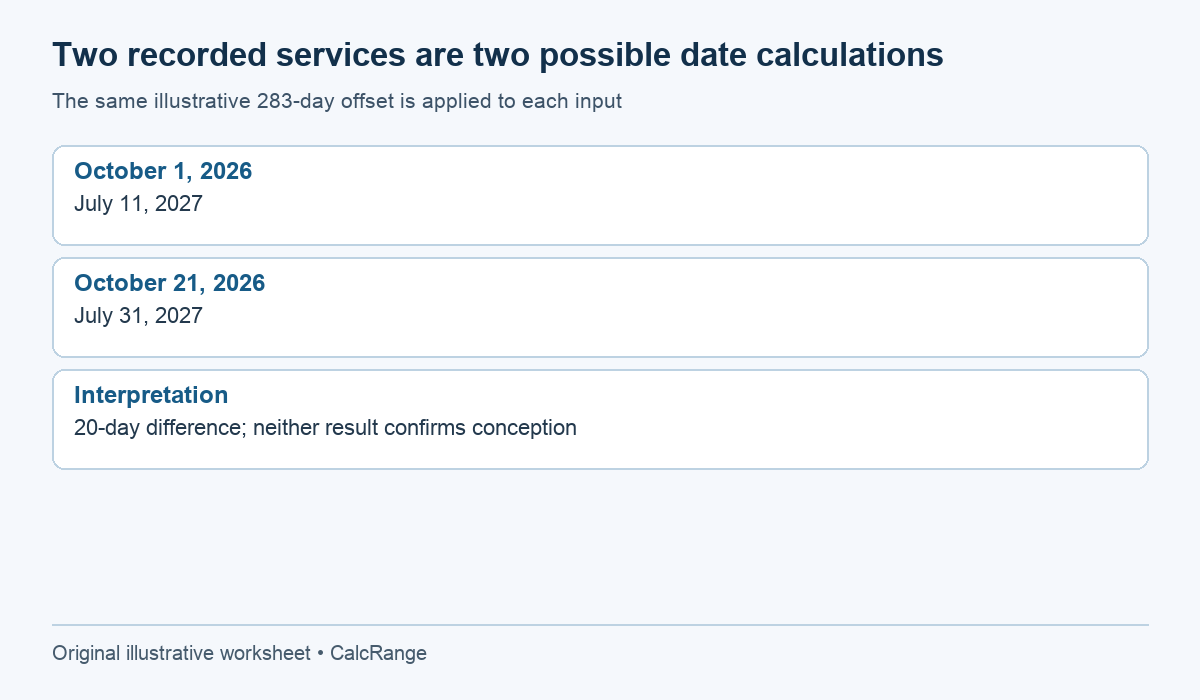
Suppose the record contains an insemination on October 1 and another service entry on October 21. Applying the same illustrative 283-day offset gives July 11 and July 31, 2027. The two calculations differ by 20 days because the inputs differ by 20 days. Arithmetic alone does not establish which event, if either, resulted in pregnancy.
Give the entries separate lines with their actual event types. A later service should not silently overwrite the earlier one. If a veterinary assessment subsequently identifies the most appropriate dating basis, record that assessment and its reference alongside the selected planning estimate. Keep the original history available for the person reviewing the herd records.
This is different from averaging the dates. An invented midpoint of October 11 produces July 21 with the same offset, but it introduces a date that was never recorded as a service. It may look tidy on a calendar while concealing the unresolved evidence. Label an assumption as an assumption whenever a planning exercise needs one.
Check 2: distinguish elapsed days from inclusive calendar labels
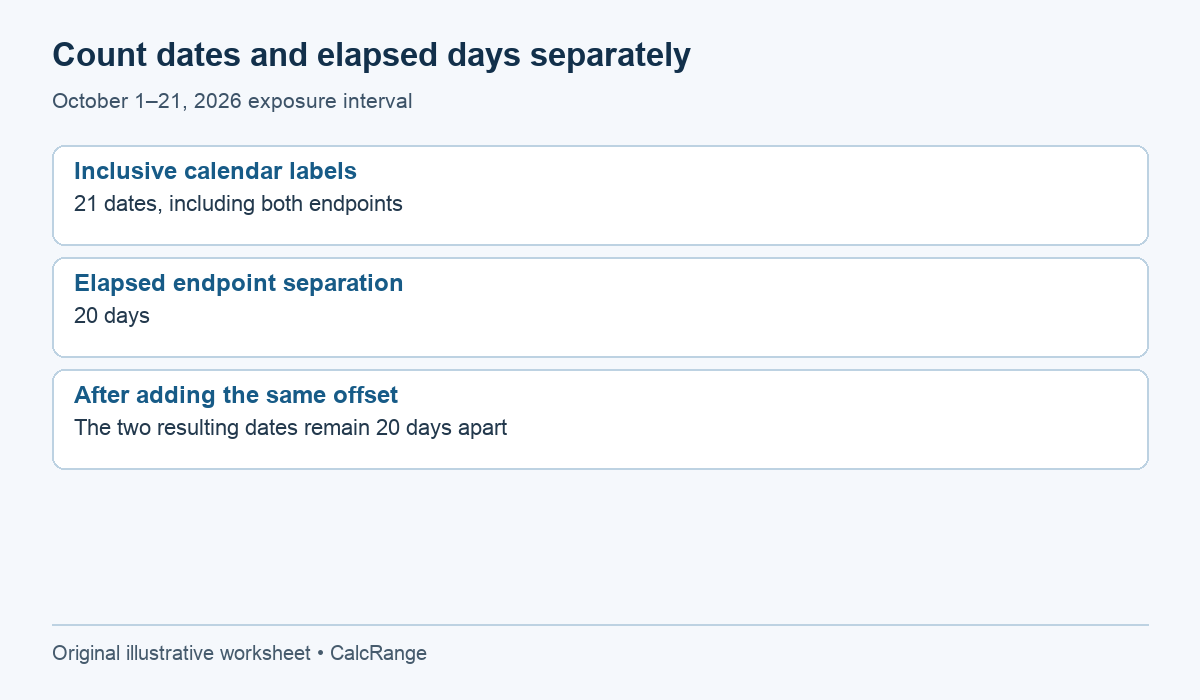
An exposure interval written October 1–21 contains 21 named calendar dates when both endpoints are included. The elapsed separation between its endpoints is 20 days. Adding the same 283-day offset to each endpoint therefore creates central-date estimates 20 days apart, not 21.
The distinction matters when a spreadsheet subtracts dates. Do not add one automatically simply because a person describes the exposure as “21 days including both dates.” Keep the recorded start and end dates, calculate each endpoint directly, and label whether a displayed duration is elapsed time or an inclusive count.
For the earlier illustrative envelope, October 1 plus 279 days is July 7, and October 21 plus 287 days is August 4. The elapsed span is 28 days; there are 29 calendar dates when both limits are counted. Neither number is a pregnancy probability or an assurance that calving cannot occur outside the displayed range.
Check 3: record a correction without erasing the audit trail
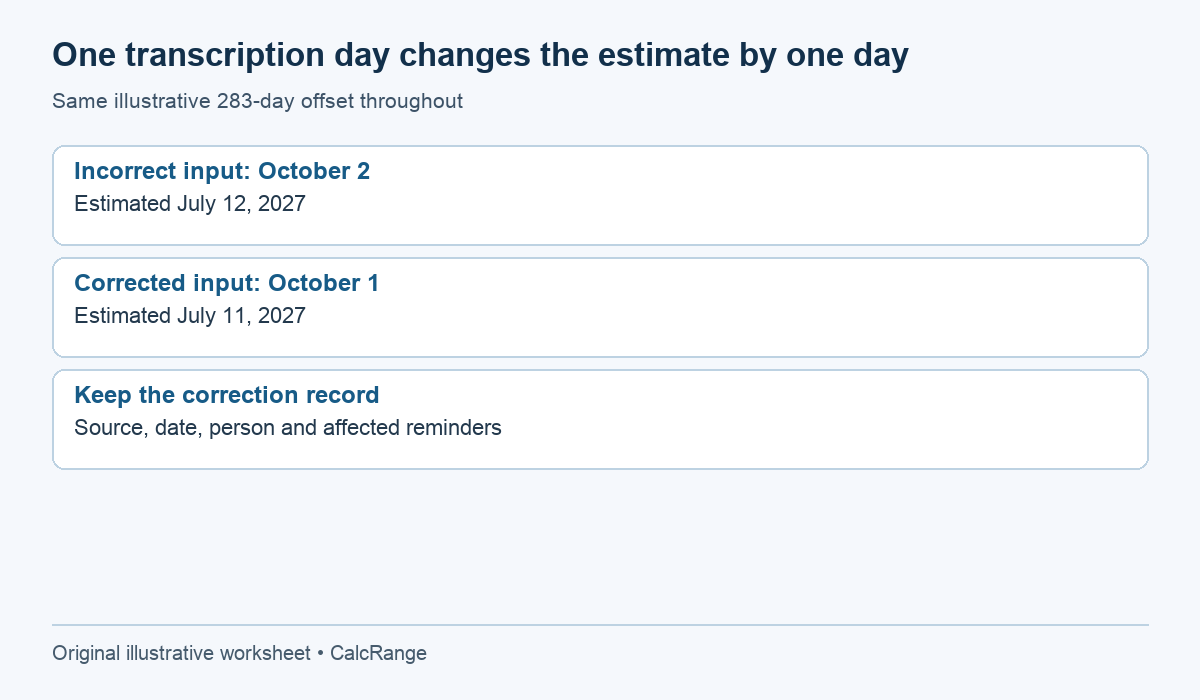
Imagine that an October 1 service was transcribed as October 2. With the same 283-day assumption, the incorrect entry produces July 12 instead of July 11. Correcting this one-day data-entry error is different from changing the biological assumption or receiving a new examination finding.
Write a short correction note: old entry, corrected entry, source document, date corrected and person making the change. Recalculate the affected reminder, then check any exported calendar or paper list that still carries the old date. Updating one spreadsheet does not automatically update a printout already used by another person.
A final handover should identify the animal, the chosen evidence basis, the offset used, the calculation date and the person responsible for follow-up. If the basis remains unresolved, say so directly. This lets a colleague reproduce the number without mistaking it for a confirmed conception date or a clinical assessment.
Use an actual calving date to close the record when available, while retaining the earlier estimates. Comparing a finished record with its assumptions can expose transcription and process problems. It does not prove that the same cow, breed or herd will repeat that exact interval in a future pregnancy.
Turn the date range into an operational handover
A useful handover has an owner for each task: maintain the animal record, arrange observation cover, confirm the veterinary contact and keep any animal-specific instructions accessible. The calendar should support that plan rather than become the whole plan.
For each cow, retain its identifier, event type, starting date or interval, calculation assumption, examination reference, current planning window and actual calving date when known. Do not copy a herd-wide central date into every individual record.
The calculator’s copy, calendar and print features can help transfer the output, but inspect the exported wording. If it contains only one run, add a note that an exposure-end run also exists. A neat single calendar event can otherwise lose the uncertainty you carefully recorded.
For a mixed-species record format, see the animal breeding-record worksheet. Pregnancy confirmation and assessment of an unwell animal remain veterinary tasks; a calving calendar should never be used to decide that a concerning observation can wait.