
A Pakistan salary tax calculation after a midyear raise should begin with the salary expected across the whole tax year, not simply the new monthly salary multiplied by twelve. If the higher rate applies for only six months, annualizing it for all twelve months models a different income.
This worked example uses tax year 2027, covering the ordinary July 2026–June 2027 tax year, and the salaried-person rates published by FBR following the Finance Act 2026. It assumes salary is the only taxable income, no exemptions, deductions or credits, and no other adjustments. It is an educational projection, not a payroll instruction for every employee.
The Income Tax Calculator is a custom-bracket arithmetic tool. It has no automatic Pakistan preset; replace its fictional teaching brackets with the applicable official bands before using it.
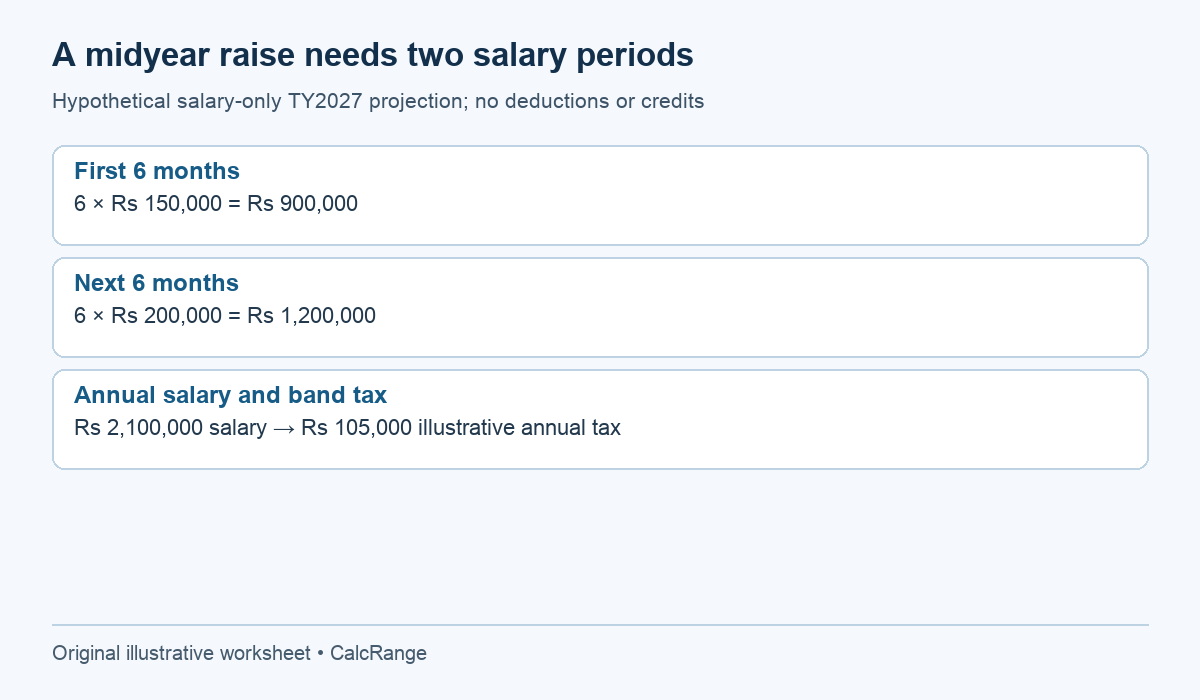
Table of Contents
1. Build the annual earnings basis for Pakistan salary tax
Suppose monthly taxable salary is Rs 150,000 from July through December 2026, then rises to Rs 200,000 from January through June 2027. This is a hypothetical salary record; the raise takes effect at the start of January with no retroactive payment.
| Period | Months | Monthly taxable salary | Period total |
|---|---|---|---|
| July–December 2026 | 6 | Rs 150,000 | Rs 900,000 |
| January–June 2027 | 6 | Rs 200,000 | Rs 1,200,000 |
| Full tax year | 12 | Mixed rates | Rs 2,100,000 |
The projected annual income is Rs 2.1 million. Multiplying the new Rs 200,000 salary by twelve would give Rs 2.4 million and invent Rs 300,000 that was not earned during the first half of this example year.
If the raise begins halfway through a payroll period, use the actual taxable earnings expected for that period rather than rounding it to a full month at either rate. Include any applicable bonus or arrears in the appropriate annual projection according to its tax treatment. Keep the pay-period record as the evidence for the total.
2. Calculate Pakistan salary tax on the annual projection
FBR’s 2027 rate card places annual taxable salary above Rs 1,200,000 and up to Rs 2,200,000 in the band with Rs 6,000 plus 11% of the amount above Rs 1,200,000. The salaried table applies under its statutory salary-income condition; the example assumes only salary income.
For Rs 2,100,000, the calculation is Rs 6,000 + 11% × Rs 900,000 = Rs 105,000. The Rs 6,000 represents tax accumulated through the lower bands. Do not add it again after independently calculating every lower slice.
| Taxable-income slice | Rate | Tax |
|---|---|---|
| First Rs 600,000 | 0% | Rs 0 |
| Next Rs 600,000 | 1% | Rs 6,000 |
| Remaining Rs 900,000 | 11% | Rs 99,000 |
| Total | Effective annual rate 5% | Rs 105,000 |
The effective rate is 105,000 ÷ 2,100,000 = 5%. That is different from the 11% marginal rate on the last slice. Applying 11% to the entire income would produce Rs 231,000 and would not reproduce the progressive bands. See marginal versus effective tax rates for that distinction.
3. Reconcile Pakistan salary tax already withheld
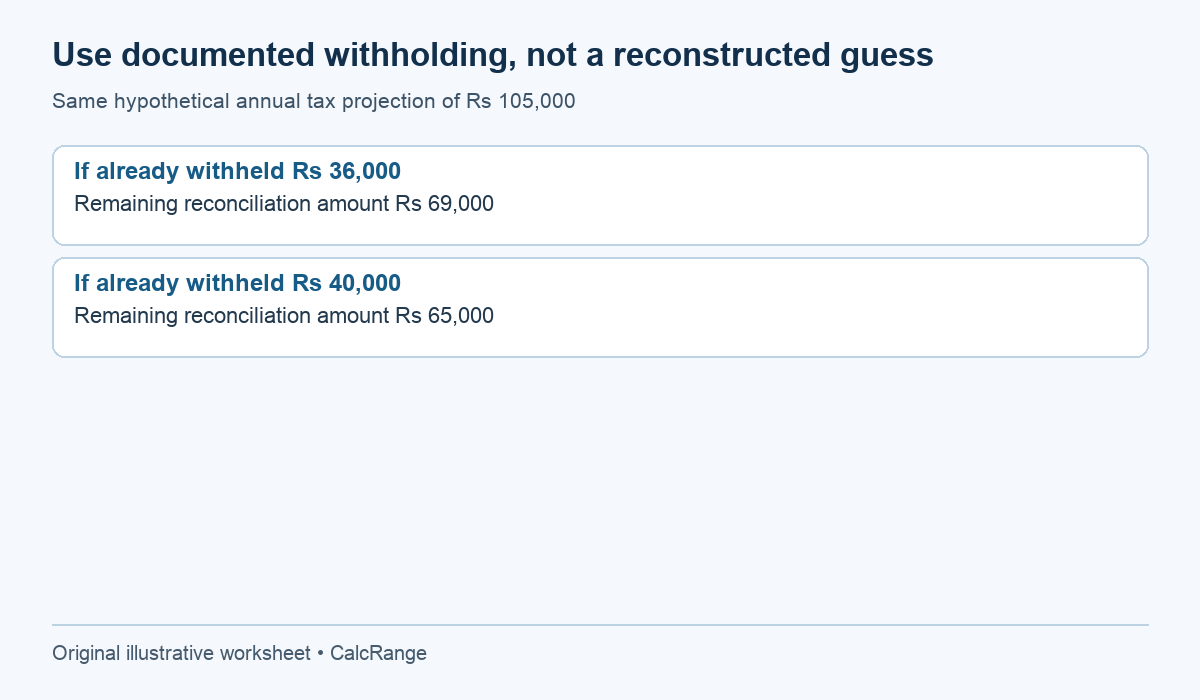
Before the raise, a full year at Rs 150,000 monthly would have projected Rs 1.8 million of salary and Rs 72,000 of tax: Rs 6,000 + 11% of Rs 600,000. Suppose payroll had withheld Rs 6,000 per month for the first six months, totaling Rs 36,000.
The revised projection is Rs 105,000, so the remaining amount to reconcile is Rs 105,000 − Rs 36,000 = Rs 69,000. Spreading that illustrative remaining balance equally over six payments gives Rs 11,500 per payment.
This equal-spread worksheet is a reconciliation example, not a claim that every employer must use precisely Rs 11,500 in every remaining month. Section 149 concerns deduction using an average rate on estimated annual salary, with applicable adjustments. Actual payroll must use the employee’s records and the governing rules.
A second common error is to calculate Rs 105,000 ÷ 12 = Rs 8,750 and use that for only the last six months without accounting for the earlier lower deductions. Six payments of Rs 6,000 plus six of Rs 8,750 total Rs 88,500, leaving Rs 16,500 below this simplified annual projection.
Enter the current bands in the custom-bracket tool
For a salary-only TY2027 scenario within this stated scope, enter annual income 2100000, deductions 0 and credits 0. Replace the tool’s example text with cumulative upper limits and marginal percentages:
600000:0
1200000:1
2200000:11
3200000:20
4100000:25
5600000:29
7000000:32
Infinity:35
These lines tell the calculator where each slice ends. They are not monthly thresholds. The tool should return Rs 105,000 in arithmetic tax for the supplied scenario, although its currency-neutral result may not print the rupee label. It does not calculate prior withholding or tell payroll how to allocate the remaining amount.
Do not enter Rs 600,000 as an additional deduction: the zero-rate slice already includes that portion. Doing both would remove the same amount twice. Similarly, do not enter a credit without establishing that it applies to the employee and year.
Update Pakistan salary tax when the underlying facts change
If a later bonus adds Rs 100,000 of taxable salary, the example annual projection rises to Rs 2.2 million and band tax becomes Rs 116,000. If the raise starts one month later, recompute the salary-period totals first. Do not patch the tax by applying a guessed percentage to the difference.
For a change of employer, retain the previous employer’s earnings and tax-withholding evidence. A second employer’s monthly salary alone may not describe the year’s total. Keep taxable salary, other income and tax already withheld in separate columns.
Cash salary is also not always identical to taxable salary. Exemptions, benefits and other components require the applicable legal treatment. This guide deliberately does not invent deductions for medical allowances or assume that every payslip line has the same tax status.
Three changes to test in the Pakistan salary tax projection
Pakistan salary tax when the raise starts one month later
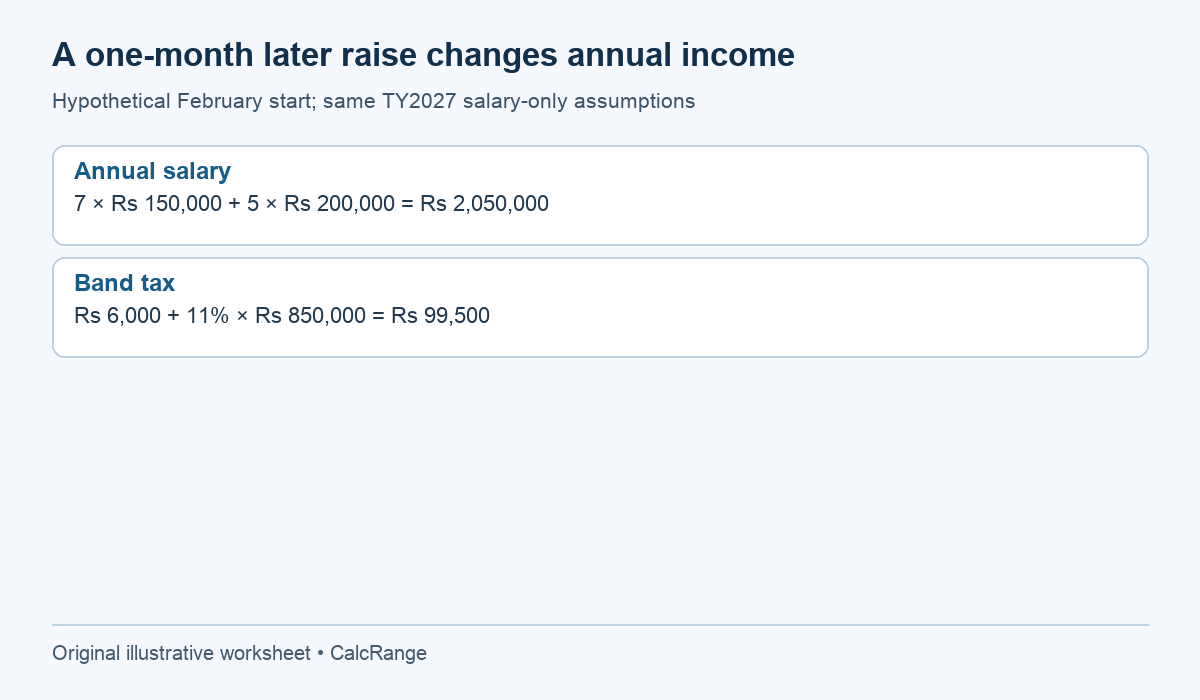
Keep the same monthly rates but assume the increase starts in February rather than January. There are now seven months at Rs 150,000 and five at Rs 200,000. The annual projection is Rs 1,050,000 + Rs 1,000,000 = Rs 2,050,000.
Using the same stated TY2027 band, tax is Rs 6,000 + 11% × Rs 850,000 = Rs 99,500. That is Rs 5,500 below the original Rs 105,000 projection. The income difference is Rs 50,000, all within the same 11% marginal slice, so Rs 50,000 × 11% gives the same Rs 5,500 check.
This does not mean every one-month delay always has an 11% tax effect. A different salary or a threshold crossing can involve another slice. Rebuild annual earnings and run the progressive calculation rather than borrowing the percentage from this example.
A larger taxable bonus crosses a band boundary
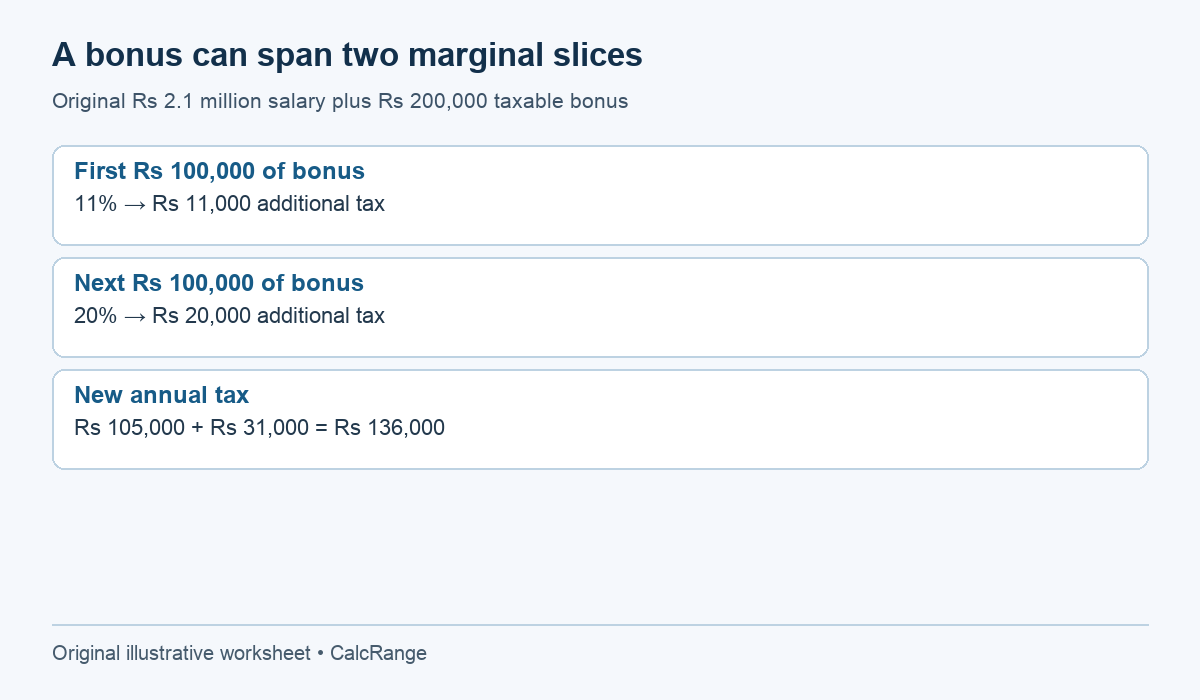
Start again with the original Rs 2.1 million annual salary, then assume a Rs 200,000 taxable bonus. The total becomes Rs 2.3 million. The first Rs 100,000 of the bonus reaches Rs 2.2 million and falls in the 11% slice. The next Rs 100,000 falls in the 20% slice.
The additional tax is therefore Rs 11,000 + Rs 20,000 = Rs 31,000, making the total Rs 136,000. The band formula checks this: Rs 116,000 + 20% × (Rs 2,300,000 − Rs 2,200,000) = Rs 136,000.
Applying the new 20% marginal rate to all Rs 2.3 million would be incorrect. Applying 11% to the entire bonus would also miss the part that crosses the threshold. Keep the two taxable slices visible when explaining the change to a colleague or checking a custom-bracket output.
Actual withholding differs from the assumed first-half amount
The original reconciliation assumed Rs 36,000 already withheld. If payroll records instead show Rs 40,000, the remaining difference against the same Rs 105,000 projection is Rs 65,000. An illustrative equal allocation over six remaining payments is approximately Rs 10,833.33, with currency rounding reconciled over the payments.
Use the actual cumulative withholding evidence rather than recreating it from the previous monthly salary. A correction, credit or earlier adjustment may explain why the real figure differs from a simple six-times-monthly estimate. Do not erase the actual record to make it fit the teaching example.
Keep three columns: projected annual tax, documented tax already withheld and the remaining amount to reconcile. If the annual projection later changes, revise the first column and recalculate the third. The withheld amount is historical evidence, not an adjustable planning assumption.
For a real employee, other income, benefits, exemptions, credits and statutory conditions may change the calculation. Present the worksheet to payroll with those facts rather than treating a neat remaining-balance schedule as an instruction to deduct that amount. The examples here isolate arithmetic so differences can be investigated clearly.
Sources and scope
Rates and the salary-withholding framework were checked against FBR’s Income Tax Ordinance amended through June 30, 2026 and Withholding Tax Rates Card 2027 on October 30, 2026. The statute prevails over a summary card.
For the full table context, read Pakistan’s 2026–27 salary tax bands. For the difference between amounts deducted during the year and final tax, see withholding versus liability. Confirm individual treatment with payroll or a qualified tax professional before relying on a projection for a filing or payment.