 Skip to content
Tax withholding is money paid toward tax during the year, often through a paycheck. Tax liability is the tax calculated under the applicable rules for the year. Reducing withholding can increase a paycheck without reducing the final liability when income, deductions, credits and other relevant facts remain unchanged.
The Take-Home Pay Estimate models pay after its stated income-tax assumptions. It does not recreate every payroll withholding rule or every deduction on a real payslip. Keep that scope in mind when comparing an estimate with a bank deposit.
Three separate numbers
Write the figures in three rows: tax calculated, tax already paid and remaining difference. This prevents “I paid more tax this payday” from being confused with “my final annual tax increased.”
The IRS explains that federal income-tax withholding from regular employee pay depends on earnings and information supplied on Form W-4. Its employee guidance describes federal income tax as paid during the year and recommends checking withholding when circumstances change.
A refund and balance-due example
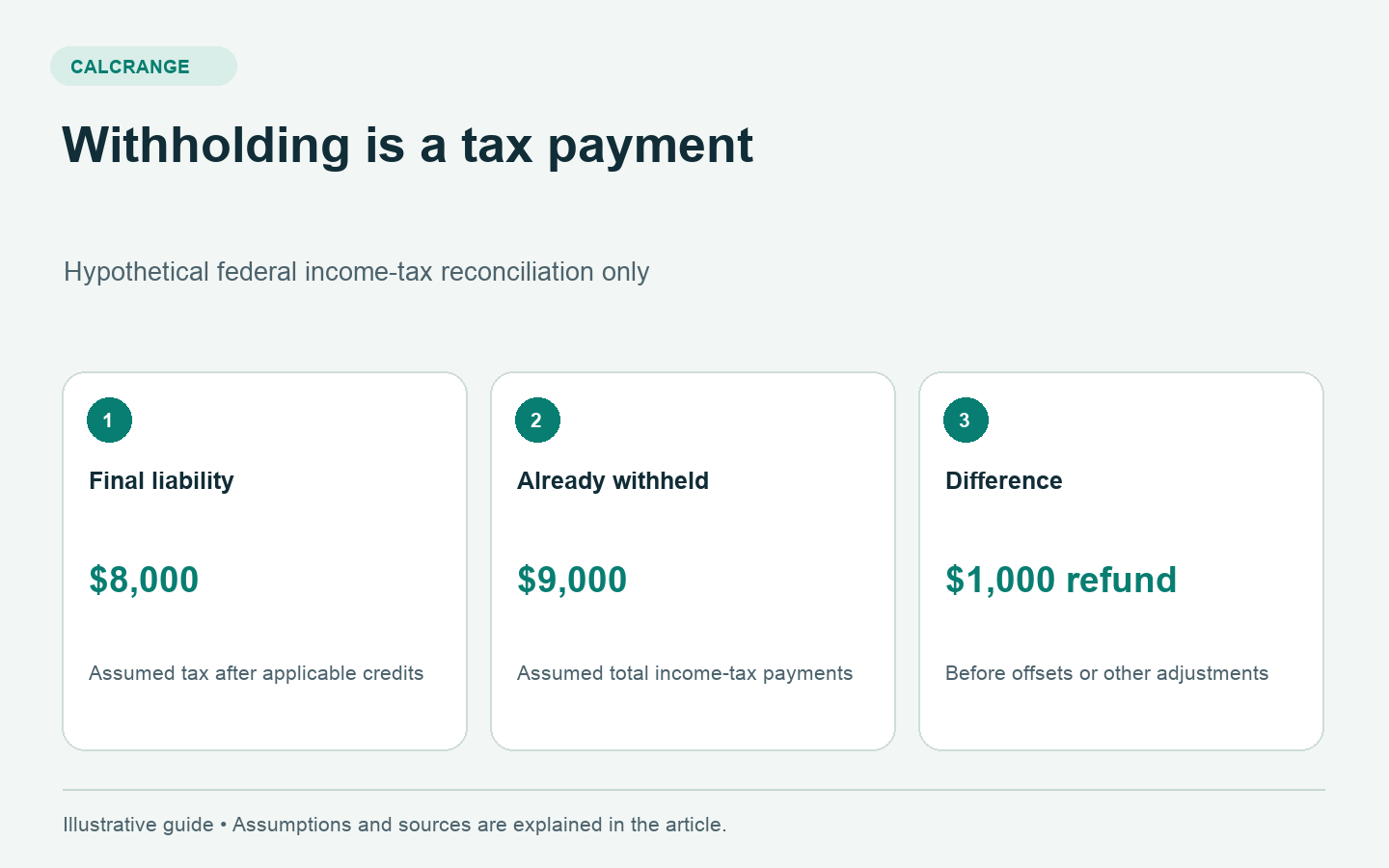
Assume a fictional taxpayer’s final federal income-tax liability, after relevant credits, is $8,000. Ignore all other taxes, payments, refundable credits, penalties and offsets so the reconciliation is visible.
| Scenario | Assumed withholding | Liability | Simple difference |
|---|---|---|---|
| A | $9,000 | $8,000 | $1,000 overpayment |
| B | $8,000 | $8,000 | $0 |
| C | $7,000 | $8,000 | $1,000 still due |
The liability is identical in all three rows. Scenario A sent more money ahead of time; Scenario C sent less. A refund is therefore not, by itself, evidence of a lower tax liability than a person who owes money when filing.
If two otherwise identical hypothetical paychecks differ only by $50 of federal withholding, their net deposits differ by $50. The larger deposit is a cash-flow change. It should not automatically be counted as an annual tax saving.
How a midyear check works
Suppose an independently prepared annual estimate shows $5,500 of liability, $3,000 has already been withheld and eight equal paychecks remain. The arithmetic gap is $2,500. Spreading it evenly gives $2,500 ÷ 8 = $312.50 per remaining paycheck.
If the current hypothetical withholding were $250 per check, eight more checks would add $2,000 and leave a $500 gap. Dividing that gap by eight gives $62.50 more per check in this simplified model. These invented figures explain reconciliation; they are not instructions for any reader’s W-4 or assurance about payment deadlines.
Use the right paystub line
A paystub may contain federal income tax, Social Security, Medicare, state or local tax, retirement contributions and insurance. Adding all those lines together and calling them federal income-tax withholding corrupts the comparison.
The IRS estimator’s income-and-payments instructions distinguish the current-check federal amount from year-to-date federal withholding and exclude state, local, Social Security and Medicare amounts from that entry. Match the field label before copying a figure.
Where Form W-4 fits
Form W-4 supplies information used for federal income-tax withholding. It does not independently set the final annual liability. The IRS W-4 guidance directs employees to the official estimator for help completing the form.
A second job, a spouse’s earnings, uneven pay or a midyear start can make a simple annual-salary division inadequate. Use current paystubs and the official workflow for a real check rather than guessing a withholding percentage from another person’s paycheck.
Compare estimates without promising an exact deposit
First compare gross earnings for the same period. Then identify which tax the calculator modeled and which deductions it omitted. Finally reconcile each actual paystub line. This turns an unexplained difference into a list of specific inputs to verify.
For filing and payroll changes, rely on current official instructions or a qualified tax professional where the situation requires it. A transparent estimate helps explain the numbers; it cannot validate every employer calculation or guarantee a refund.
Sources and method
Source links checked September 18, 2026. Examples are original educational calculations using the assumptions stated above.