 Skip to content
To convert hours and minutes to decimal hours, divide the minutes by 60 and add the whole hours. 7 hours 30 minutes = 7 + 30 ÷ 60 = 7.50 hours. It does not equal 7.30 hours.
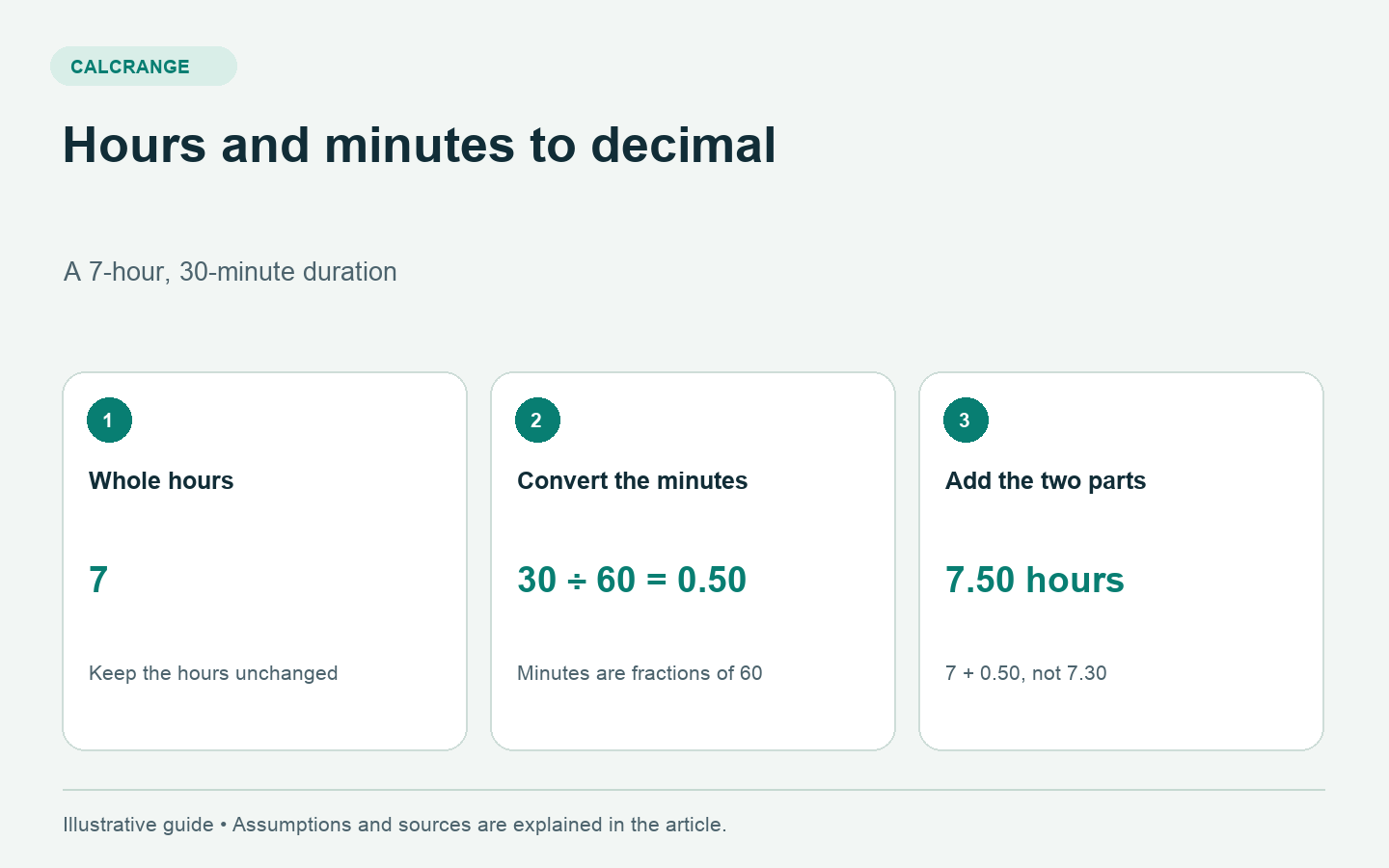
This conversion is useful when checking a time card, recording project time or multiplying a duration by an hourly rate. The Time Card Calculator can help total shifts and breaks; understanding the conversion makes its decimal results easier to verify.
Why 7:30 and 7.30 mean different things
The colon form, 7:30, commonly means 7 hours and 30 minutes when used for a duration. Decimal 7.30 means 7 whole hours plus 0.30 of an hour. Because an hour contains 60 minutes, 0.30 × 60 = 18 minutes.
Writing 7.30 for a 7-hour-30-minute shift loses 12 minutes in the conversion. At an illustrative rate of $20 per hour, 7.50 hours corresponds to $150, while 7.30 hours corresponds to $146 before any other pay rules. The difference comes entirely from the notation error.
A quick minutes-to-decimal table
| Minutes | Fraction of an hour | Decimal hours |
|---|---|---|
| 5 | 5 ÷ 60 | 0.08333… |
| 10 | 10 ÷ 60 | 0.16667… |
| 15 | 15 ÷ 60 | 0.25 |
| 20 | 20 ÷ 60 | 0.33333… |
| 30 | 30 ÷ 60 | 0.50 |
| 45 | 45 ÷ 60 | 0.75 |
For 8 hours and 45 minutes, add 8 to 0.75 to get 8.75. NIST’s time-unit reference defines the hour as 60 minutes; the table is direct arithmetic from that relationship.
Calculate a shift with a break
Suppose a shift starts at 9:10 a.m. and ends at 5:25 p.m. on the same day. The elapsed time is 8 hours 15 minutes, or 495 minutes. If the record includes a 35-minute unpaid break, subtract it before converting the total:
- Elapsed time: 495 minutes.
- Recorded work time after the example break: 495 − 35 = 460 minutes.
- Decimal duration: 460 ÷ 60 = 7.66666… hours, displayed as 7.67 when rounded to two decimals.
The unrounded duration is 7 hours 40 minutes. The example assumes that the 35 minutes is properly classified as unpaid; the arithmetic does not decide whether a particular break is compensable.
Convert decimals back to hours and minutes
Keep the whole number as hours and multiply the decimal remainder by 60. For 6.80 hours, the whole part is 6 and 0.80 × 60 = 48, so the duration is 6 hours 48 minutes.
A value already rounded to two decimals may not return a whole number of minutes. For instance, 7.67 hours becomes 7 hours and 40.2 minutes. That small difference is expected if the original 7 hours 40 minutes was rounded for display.
Conversion is separate from rounding policy
Dividing minutes by 60 changes the representation of the same duration. Rounding clock entries to five-minute, six-minute or fifteen-minute blocks can change the duration being counted. Keep these operations separate when reviewing a result.
The U.S. Department of Labor’s wage-and-hour resources explain that employers must maintain time and pay records. This article supplies conversion arithmetic, not a determination of overtime eligibility, paid-break rules or which rounding policy is permissible for a particular worker.
For the clearest check, retain actual times and full minutes, total the period, and round the display only when required. Enter the shifts in the Time Card Calculator and review its break and rounding settings alongside the result.