 Skip to content
EST is Eastern Standard Time, UTC−5. EDT is Eastern Daylight Time, UTC−4. They are one hour apart. “Eastern Time,” abbreviated ET, can refer to the local Eastern clock using whichever of those two offsets applies on the selected date.
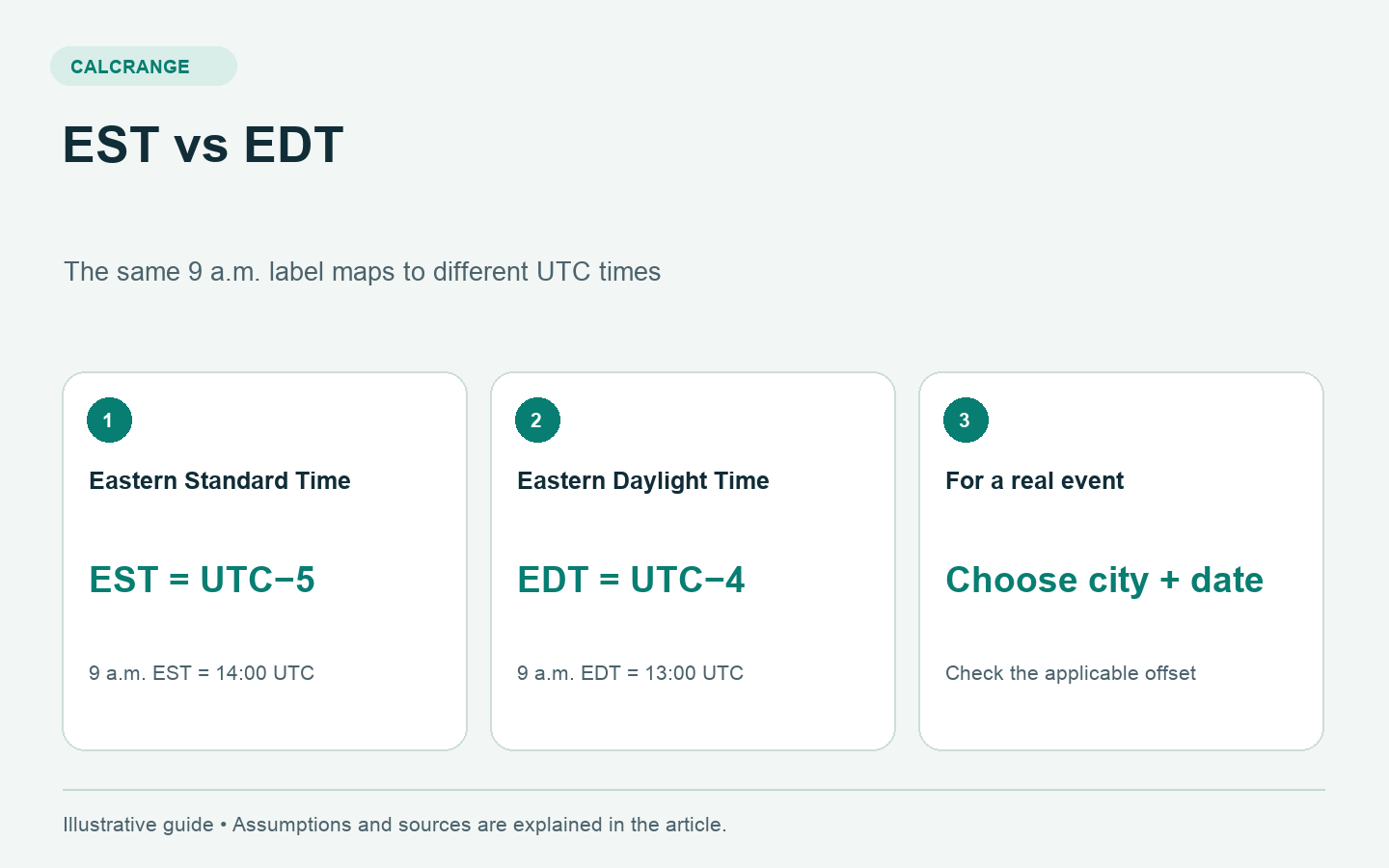
For a real event, use the city and the date in the Time Zone Converter. The label “9 a.m. Eastern” is easier to interpret correctly when you also know where and when the event happens.
Compare the abbreviations
| Label | Meaning | UTC offset |
|---|---|---|
| EST | Eastern Standard Time | UTC−5 |
| EDT | Eastern Daylight Time | UTC−4 |
| ET | Eastern local time for the date | Depends on the location and date |
NIST’s local time reference documents these offsets and explains why a general label such as Eastern Time is useful for year-round hours. A business can operate at 9 a.m. local Eastern time all year even though that opening time corresponds to a different UTC time during daylight saving.
Convert 9 a.m. EST and EDT to UTC
UTC−5 means the local clock is five hours behind UTC. To convert 9 a.m. EST to UTC, add five hours: 09:00 + 05:00 = 14:00 UTC.
For 9 a.m. EDT, add four hours instead: 09:00 + 04:00 = 13:00 UTC. An invitation that says EST when its organizer intends EDT can therefore lead someone to join an hour late.
This calculation is about the meaning of the labels. To decide which label applies to New York on a particular date, choose that city and date rather than assuming that the abbreviation is always EST.
Why a fixed UTC meeting can move on the local clock
Suppose a meeting is fixed at 14:00 UTC. Under EST, it appears at 9 a.m. because 14 − 5 = 9. Under EDT, it appears at 10 a.m. because 14 − 4 = 10.
Now reverse the scenario: a team fixes its meeting at 9 a.m. New York local time. That meeting moves between 14:00 UTC and 13:00 UTC when the local offset changes. Decide whether the recurring commitment follows a location’s wall clock or a fixed UTC moment before creating the calendar series.
Do not use a season as the complete rule
“Summer time” is a convenient description, but the applicable offset is determined by the date and the location’s rules. Other countries can change clocks on different dates or follow no daylight saving arrangement. The difference between two cities can therefore change during only part of a year.
For example, if a destination remains at UTC+5, it is ten hours ahead of EST and nine hours ahead of EDT. The arithmetic follows directly from comparing +5 with −5 or −4. It does not require both locations to change their clocks together.
How to write a clear invitation
- Include the full date and an identifiable city.
- Use “Eastern Time” for local hours that follow that city’s clock through the year.
- Include the verified UTC offset when a precise one-time event needs extra clarity.
- Send a calendar event with a location-aware time zone so recipients see the corresponding local time.
If an invitation says EST during a period when the organizer’s city uses EDT, ask which local start time they intend before relying on the abbreviation alone. The sender may be using EST casually to mean all Eastern Time.
Check dates near midnight and clock changes
A conversion can move an event onto the previous or next calendar date. In addition, clock-change transitions can produce a local time that is skipped or repeated. For those cases, keep the date, city and UTC offset with the result.
Use the Time Zone Converter to compare the same moment across your chosen cities, then confirm the date as carefully as the hour.