 Skip to content
Biweekly pay arrives every two weeks. Semimonthly pay arrives twice each month, often on two specified dates. Those schedules typically produce 26 and 24 paychecks per year, respectively. They are not interchangeable descriptions of the same calendar.
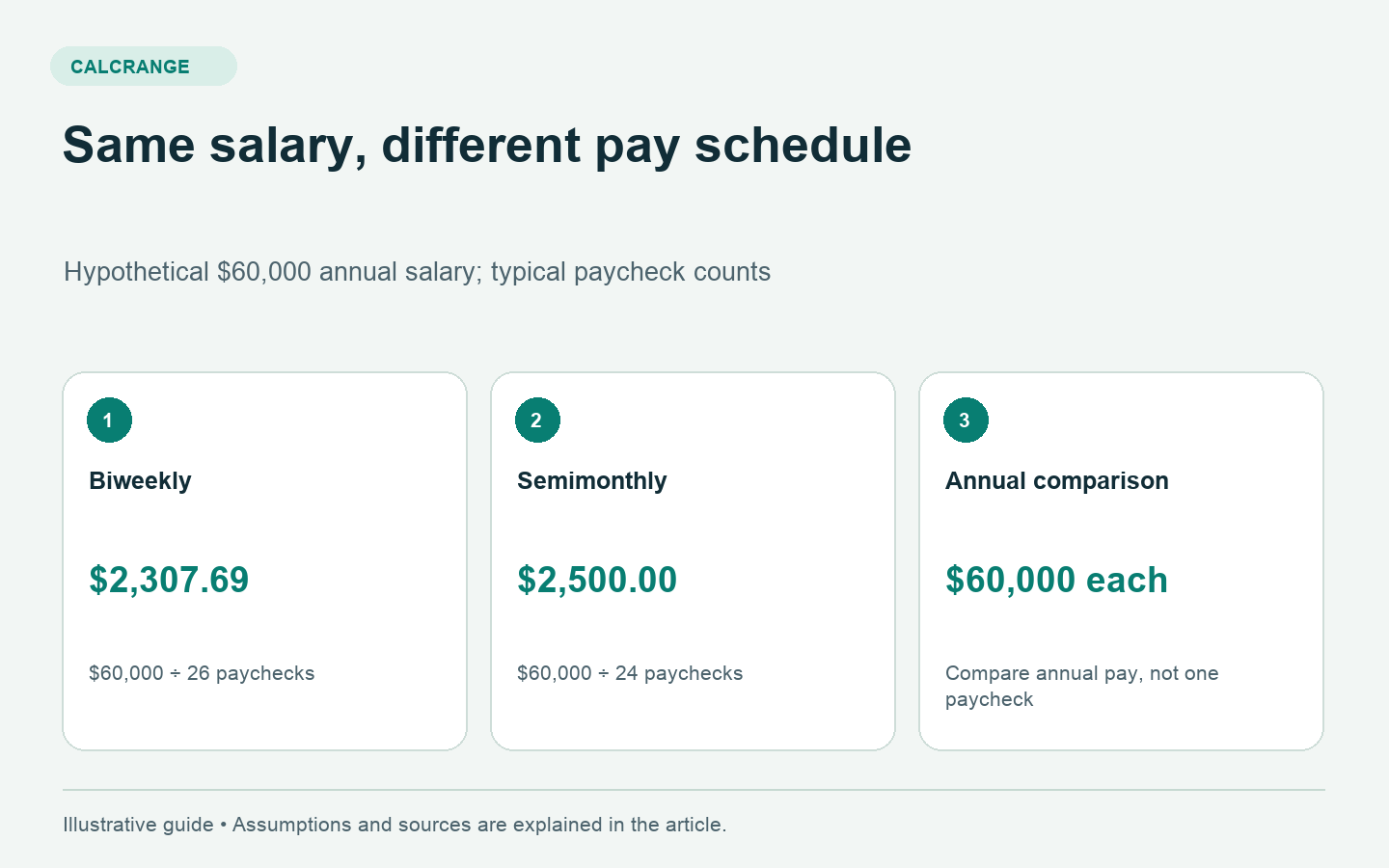
A larger semimonthly paycheck does not necessarily mean a larger salary. Use the Salary Calculator to compare pay on a consistent annual basis, then check the employer’s actual payroll calendar.
The basic difference
The Bureau of Labor Statistics describes typical pay schedules as 52 weekly, 26 biweekly, 24 semimonthly and 12 monthly paydays per year. Here the BLS source supports the schedule definitions, not a claim about the current proportion of employers using each schedule.
| Feature | Biweekly | Semimonthly |
|---|---|---|
| Timing | Every 14 days | Two dates each month |
| Typical annual checks | 26 | 24 |
| Common monthly pattern | Two checks, with some three-check months | Two checks |
| Period length | Two weeks | Varies with the calendar |
A $60,000 salary example
Assume a full-year fixed gross salary of $60,000, no bonus, no unpaid time and conventional paycheck counts. Dividing by 26 gives approximately $2,307.69 per biweekly check. Dividing by 24 gives $2,500 per semimonthly check.
The semimonthly amount is about $192.31 higher each payday, but there are two fewer paydays in the model. Comparing those individual checks would mistake a timing difference for an annual earnings difference.
For biweekly pay, two checks total approximately $4,615.38 and three total approximately $6,923.07. The annual monthly average remains $60,000 ÷ 12 = $5,000. That average is useful for annual planning, but it is not the cash received in every calendar month.
Plan bills using dates as well as averages
Suppose a household allocates $4,500 per month to recurring expenses, using gross figures only to illustrate the schedule. A two-check biweekly month in this example leaves $115.38 before everything excluded from this simplified model. A monthly average of $5,000 would suggest a much larger margin.
In a real budget, replace these gross figures with expected net deposits and include all expenses. Map the actual deposit dates against rent, utilities and other due dates. A three-check month can fund expenses in other months; it should not automatically be treated as income beyond the agreed annual salary.
Check the payroll calendar for exceptions
Dividing a year into 14-day intervals leaves a calendar remainder. Depending on the first payday and date shifts, a calendar year can contain an extra biweekly payday. Do not label every biweekly worker as having 27 checks in a particular year without counting that employer’s scheduled dates.
Ask payroll how annual salary, benefit deductions and an unusual payday count are handled. A date moved because of a holiday can also affect the calendar year in which a deposit arrives. The employer’s calendar is more useful than a generic internet table for this question.
Hourly pay and overtime need separate calculations
For hourly work, actual payable hours may vary across periods. The annual-salary division above is not a promise that an hourly employee’s semimonthly checks will be identical.
The DOL federal overtime guidance uses a workweek for the usual covered, nonexempt weekly threshold. A two-week paycheck does not mean overtime can automatically be averaged across two workweeks. Keep pay frequency separate from the rule used to calculate earnings.
How to compare an offer or a changed schedule
Write down annual gross pay, pay frequency, actual pay dates and any partial starting period. Confirm whether a displayed amount is salary or expected take-home pay. If two offers use different periods, convert both to annual amounts before comparing benefits and deductions.
Small differences can arise from cent rounding: 26 payments of exactly $2,307.69 total $59,999.94. Payroll may adjust a payment to reconcile the annual figure. A six-cent rounding difference is different from a missing paycheck. Use the written salary and year-to-date record to make the comparison precise.
Sources and method
Source links checked September 18, 2026. Examples are original educational calculations using the assumptions stated above.