
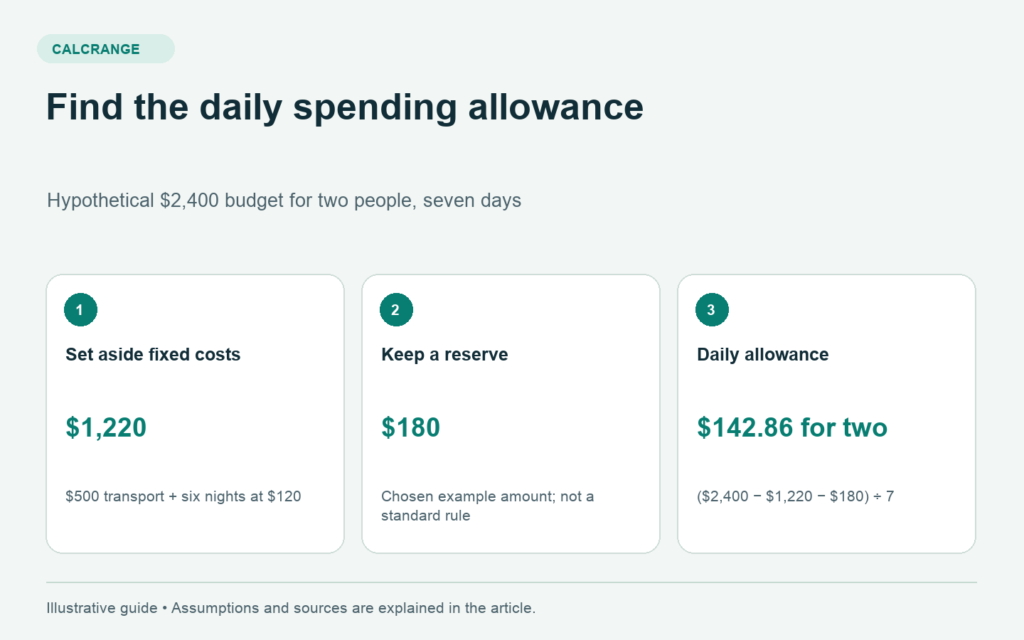
Vacation Budget per Day: Separate Total Cost From Spending Money
Dividing the entire budget by trip days can overstate what you can spend each day. Subtract committed costs and a chosen reserve first.
Compare the assumptions behind journey costs, fuel use, driving distances, and travel times. Try the fuel cost calculator, trip cost calculator, or distance calculator. Actual routes, traffic, prices, and fees can change your final cost.
Dividing the entire budget by trip days can overstate what you can spend each day. Subtract committed costs and a chosen reserve first.
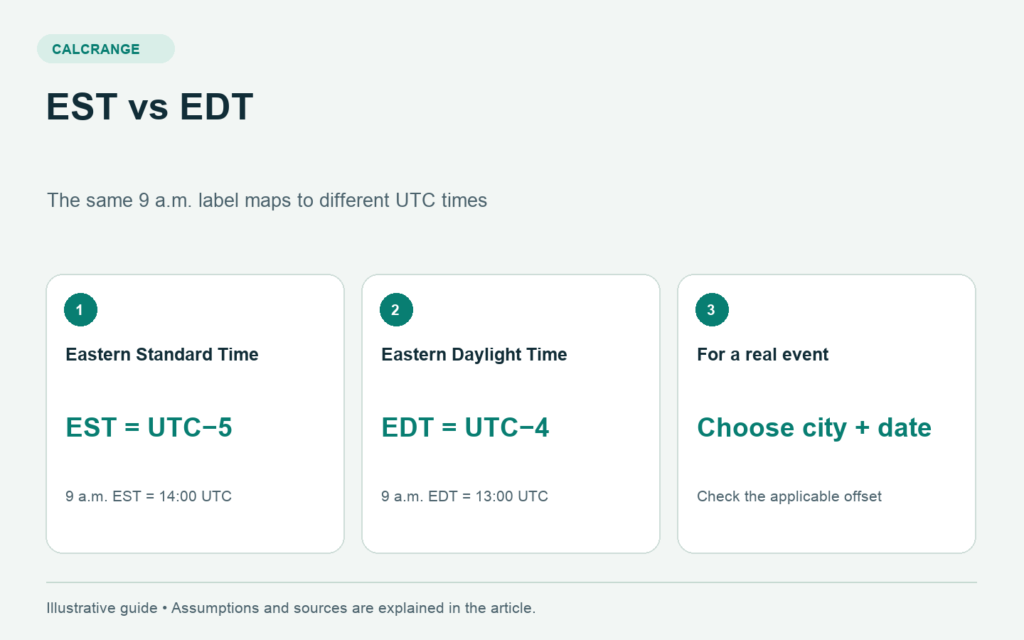
EST is Eastern Standard Time, UTC−5. EDT is Eastern Daylight Time, UTC−4. They are one hour apart. “Eastern Time,” abbreviated ET, can refer to the local Eastern clock using whichever of those two offsets applies on the selected date.
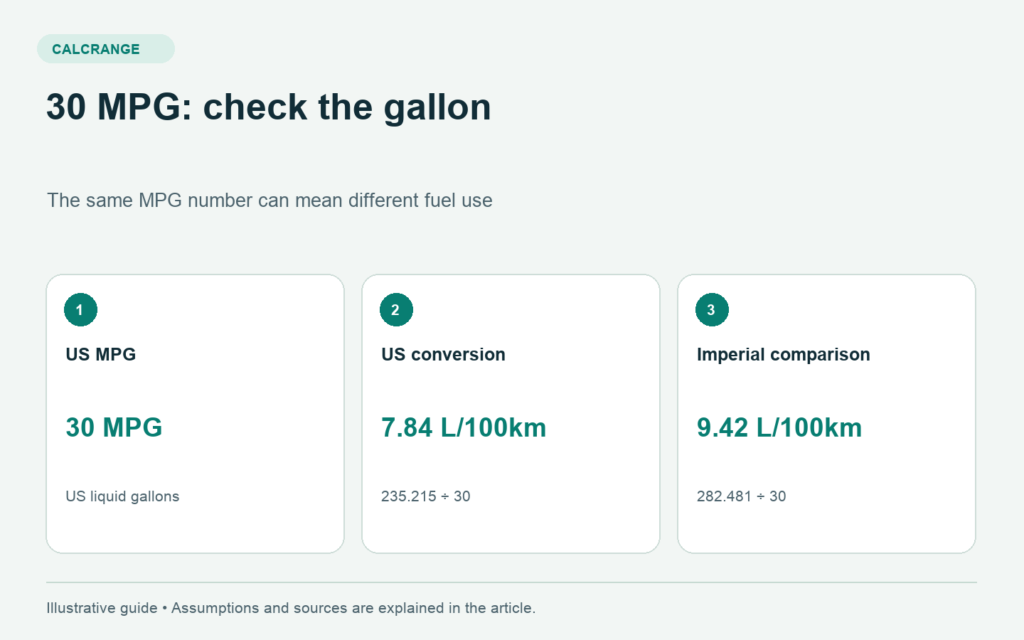
To convert US MPG to liters per 100 kilometers, divide 235.215 by MPG. For UK imperial MPG, divide 282.481 by MPG instead. The gallon systems are different, so you must identify which one the original figure uses.
You planned a route, Maps said one number, and your fitness watch logged something else entirely after the drive or walk was done. Neither is “wrong” – they’re answering different questions. Straight-…
The flight, the hotel, the big obvious line items – those get budgeted every time. It’s the smaller costs, scattered across a dozen categories, that quietly blow through a travel budget: a foreign tra…
Comparing an electric car to a petrol car by “tank versus charge” doesn’t really work – the containers are different sizes and the fuel is priced completely differently. The fair comparison is cost pe…

Compare direct and road distance with a coordinate example. Learn why a 1.3 multiplier is only an assumption and how to check the actual route.
Driving time is distance divided by your average speed, not the speed limit. How to estimate realistically with traffic, stops, and rest breaks, with examples.

Driving cost barely changes with more passengers; flying scales per person. How to compare the true cost of a road trip and flights, with break-even factors.
The driving habits that genuinely cut fuel use: easing off speed, smooth acceleration, correct tyre pressure, and less weight and drag, ranked by impact.