
Fill-to-fill fuel economy uses the distance travelled between two comparable full-tank readings and the fuel needed to refill the tank at the end. Divide distance by fuel for km/L or MPG; divide fuel by distance and multiply by 100 for L/100 km.
Once you have a measured efficiency, enter it in the fuel cost calculator to estimate a future trip. A receipt-based average is a record of past driving, not a promise that the next journey will use fuel at exactly the same rate.
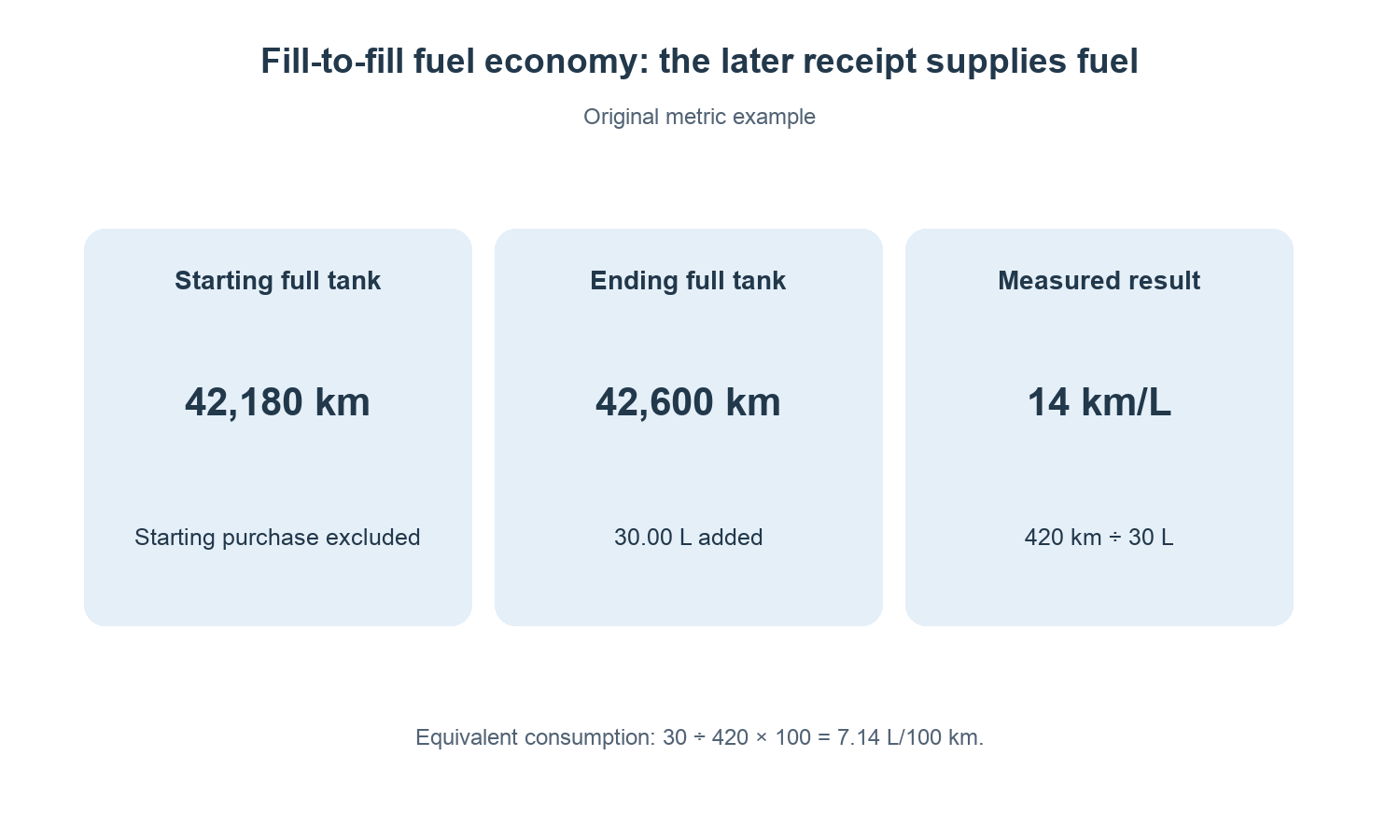
Table of Contents
Record the full fill-to-fill fuel economy interval
The U.S. DOE/EPA fuel-economy calculation page describes both odometer and trip-odometer methods. The important relationship is between the distance after the first full fill and the fuel added to restore a comparable level at the last fill.
- At the starting fill, record the odometer and establish a normal full-tank level using the vehicle’s refuelling instructions.
- Drive normally and retain receipts for any fuel added during the interval.
- At the ending fill, restore a comparable full level and record the new odometer and fuel volume.
- Subtract the odometer readings, then use the fuel added after the starting reading through the ending fill.
Do not include the fuel bought at the starting fill in the measured interval. That fuel establishes the starting level; its purchase does not represent fuel consumed after the starting odometer reading.
Do not deliberately run the tank empty or continue topping off beyond the vehicle’s normal refuelling procedure to make the test seem more exact. Consistency matters more than forcing an artificial “full” level.
Fill-to-fill fuel economy: 420 km and 30 litres
| Record | Odometer | Fuel relevant to the interval |
|---|---|---|
| Starting full fill | 42,180 km | Starting purchase excluded |
| Ending full fill | 42,600 km | 30.00 L added |
| Measured interval | 42,600 − 42,180 = 420 km | 30.00 L |
Efficiency in km/L = 420 ÷ 30 = 14 km/L
Consumption in L/100 km = 30 ÷ 420 × 100 = 7.142857… L/100 km
Rounded appropriately, these are 14.0 km/L and 7.14 L/100 km. They describe the same observation in reciprocal formats. A higher km/L figure means more distance per litre, whereas a lower L/100 km figure means less fuel for a fixed distance.
Do not enter 7.14 with the km/L selector; that changes the meaning. Check the selected efficiency unit before comparing a calculator estimate with your receipt.
Fill-to-fill fuel economy using U.S. gallons
Suppose an odometer rises from 18,240 to 18,555 miles, and the ending full fill takes 10.5 U.S. gallons. The distance is 315 miles, and 315 ÷ 10.5 = 30 MPG U.S.
The gallon definition matters. A U.S. liquid gallon is about 3.785 L; an imperial gallon is about 4.546 L. The same vehicle and physical fuel use therefore produce a larger numerical MPG figure when expressed per imperial gallon. Label the result rather than writing “30 MPG” without context.
The fuel calculator has separate MPG U.S. and MPG U.K. choices. Its fuel-price unit must also match the quoted litre or gallon basis. See U.S. vs U.K. gallons if your dashboard, receipt and price source use different conventions.
Partial fills: wait for the next comparable full fill
A partial refill does not establish a new full-tank endpoint. Keep its receipt and include it when you eventually return to a comparable full level.
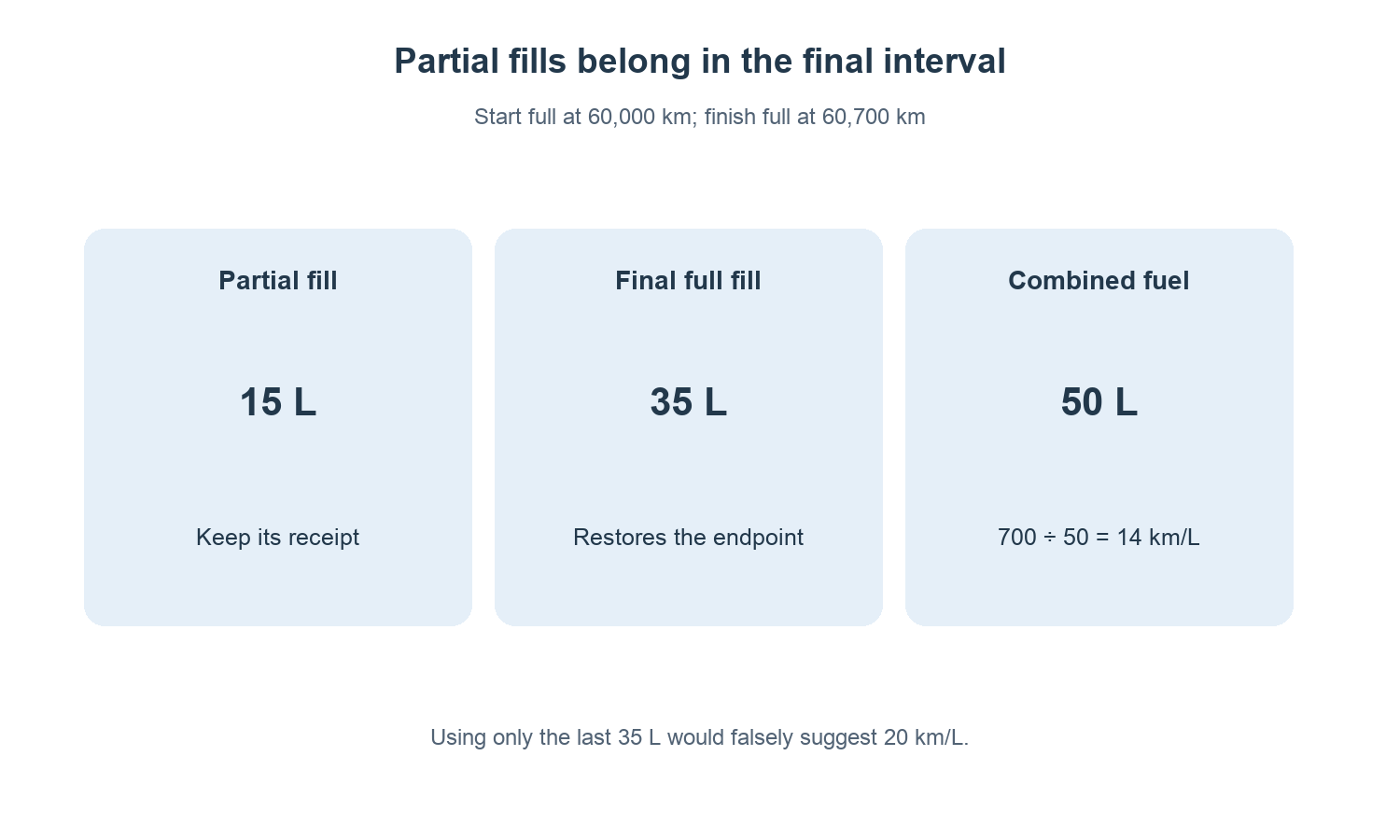
For example, start full at 60,000 km, add 15 L partway through, then finish full at 60,700 km after adding another 35 L. The interval is 700 km and the total added fuel is 50 L. Efficiency is 700 ÷ 50 = 14 km/L. Using only the final 35 L would incorrectly suggest 20 km/L.
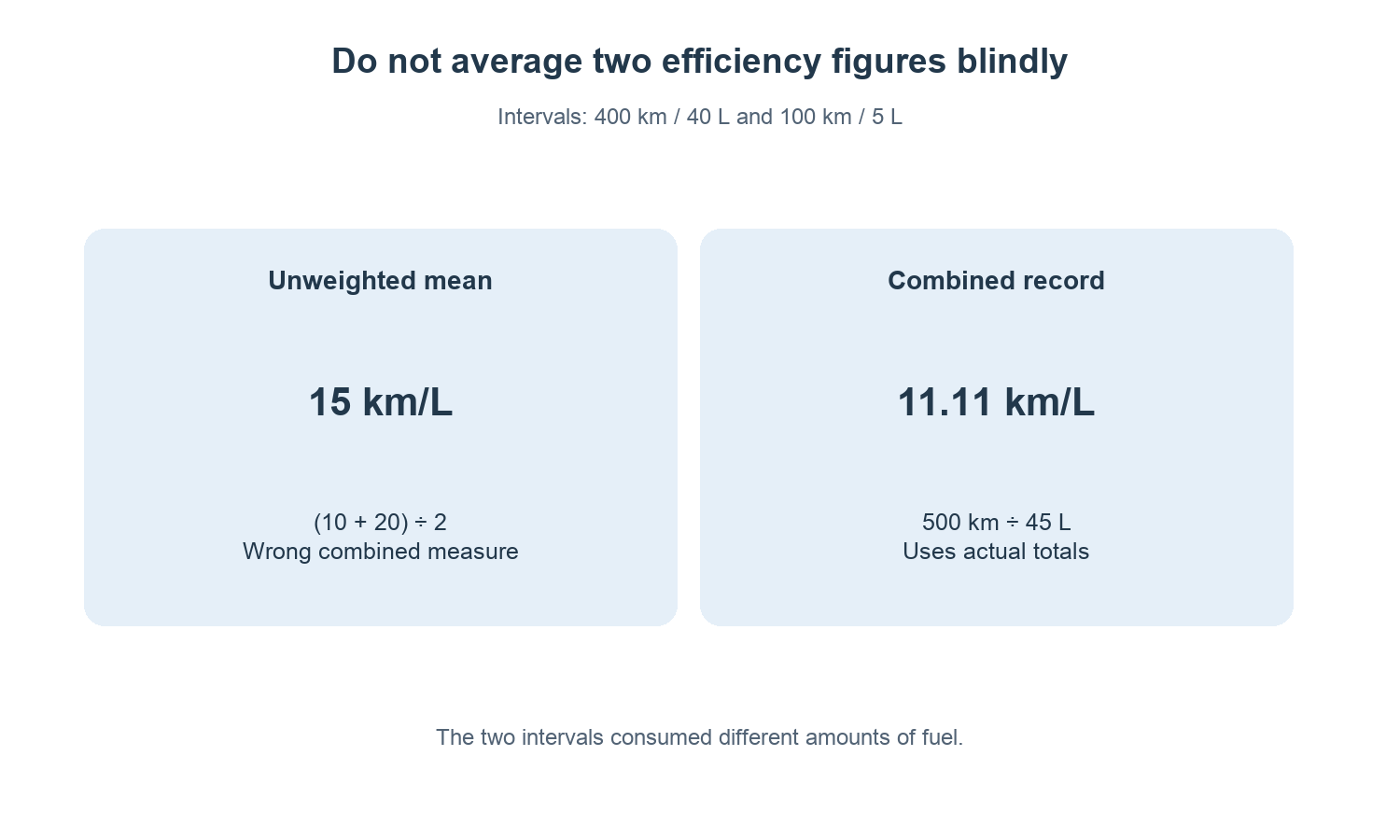
For multiple completed intervals, add distances and fuel volumes before dividing. Do not normally average their efficiency numbers without weighting.
| Interval | Distance | Fuel | Efficiency |
|---|---|---|---|
| First | 400 km | 40 L | 10 km/L |
| Second | 100 km | 5 L | 20 km/L |
| Combined | 500 km | 45 L | 11.11 km/L |
The unweighted average of 10 and 20 is 15 km/L, which overstates this combined record. The intervals consumed very different amounts of fuel. Preserve the underlying totals so a longer-term average remains reproducible.
Use the measurement in a trip estimate
Using the original 14 km/L observation, a future 280 km trip would require 280 ÷ 14 = 20 L if it achieved the same efficiency. At a fictional price of 1.60 currency units per litre, the estimated fuel cost is 32 units.
Enter 280 km, one-way, 14 km/L and 1.60 per litre in the fuel calculator. If 280 km already includes the return, keep the one-way multiplier; selecting round trip would count the return twice.
Use a range when the future conditions differ substantially. At 12 km/L, the same 280 km would need 23.33 L, costing about 37.33 units at the same price. This is a sensitivity check, not a prediction that one figure will occur.
Our trip fuel-cost guide covers the cost formula. FuelEconomy.gov’s driving guidance explains why driving conditions and vehicle use can affect consumption.
Fill-to-fill fuel economy is sensitive to the endpoint
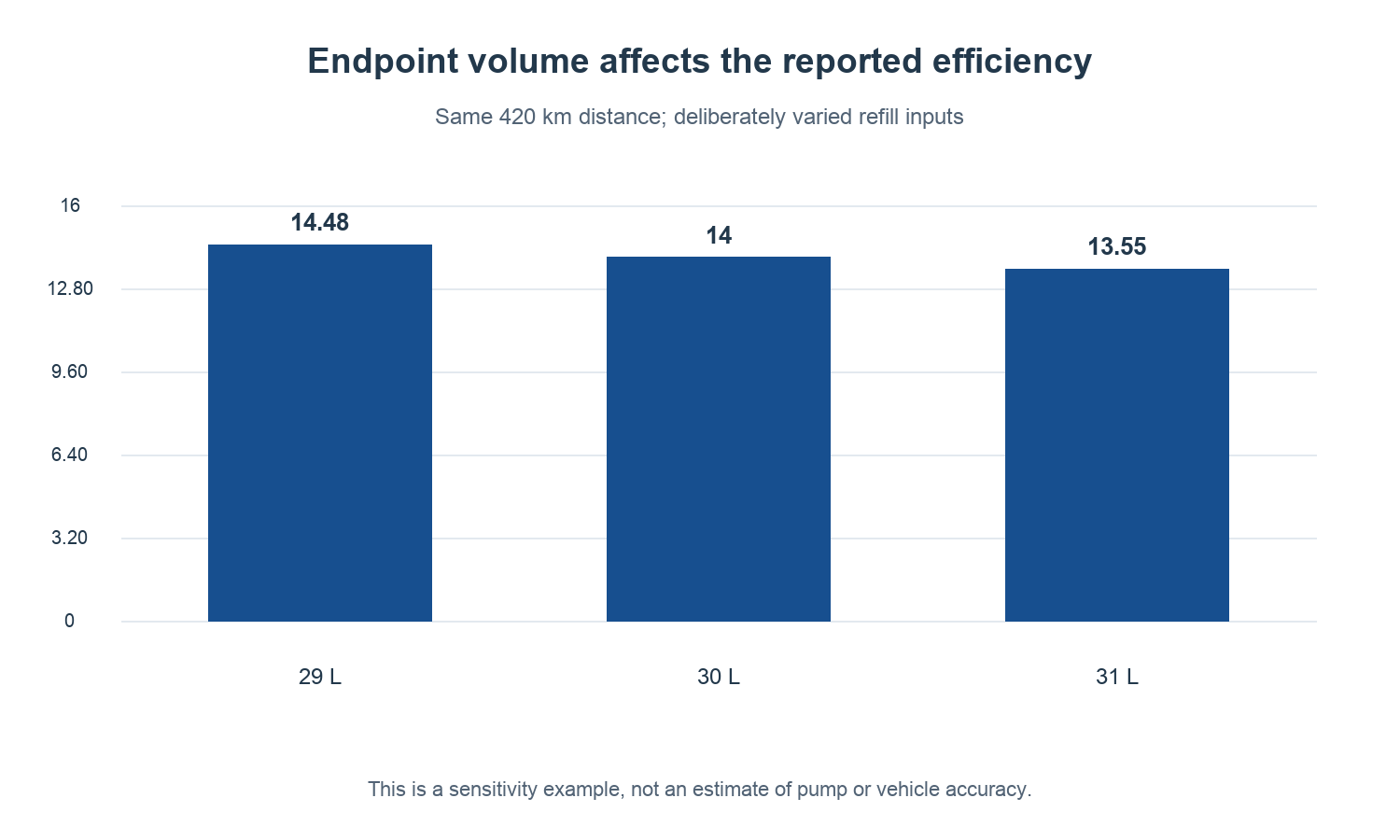
Using the original 420 km interval, suppose the recorded refill volume were 29 L instead of 30 L because the ending level differed. The calculated efficiency would be 420 ÷ 29 ≈ 14.48 km/L. At 31 L it would be 420 ÷ 31 ≈ 13.55 km/L.
| Distance | Recorded fuel | Calculated km/L | Calculated L/100 km |
|---|---|---|---|
| 420 km | 29 L | 14.48 | 6.90 |
| 420 km | 30 L | 14.00 | 7.14 |
| 420 km | 31 L | 13.55 | 7.38 |
These deliberately varied inputs are not a measurement of pump accuracy or a claim that every fill varies by one litre. They show why a small change in endpoint level can move the reported result without establishing a real change in the vehicle.
Several consistent intervals reduce the importance of one unusual endpoint. They do not eliminate odometer error or make different driving conditions identical. Preserve the raw readings so an implausible result can be investigated rather than simply discarded.
Calculate fuel cost per distance from the same log
If the 30 L ending fill costs 48 currency units, its average purchase price is 48 ÷ 30 = 1.60 per litre. Applying that price to the 420 km interval gives a fuel-cost estimate of 48 ÷ 420 ≈ 0.114286 units per kilometre, or about 11.43 per 100 km.
This uses the ending purchase price as a valuation assumption. It is not a complete cost-of-ownership figure and may not equal a detailed accounting of fuel bought at different prices during the interval. Maintenance, depreciation, tolls and other costs are outside this calculation.
To compare future routes, multiply the chosen cost-per-kilometre estimate by each route’s distance, keeping its price and efficiency assumptions visible. If prices change, update the price input without pretending that the vehicle’s measured km/L changed.
A missing receipt breaks the fuel total
If fuel was added but the volume is unknown, the interval’s consumed-fuel estimate is incomplete. The odometer difference alone cannot reconstruct the missing litres. A bank charge also needs the actual unit price and any non-fuel purchases separated before it can help recover volume.
Mark the interval incomplete and start a new well-documented full-to-full interval if necessary. Do not fill the missing row with an average and then present the result as entirely measured. If you use an estimate for planning, label it as such.
A fill-to-fill fuel economy log separates facts and assumptions
Record the date, main odometer, litres or labelled gallons added, whether the fill established a comparable full level, and any partial-fill receipts included. A notes column can identify unusual traffic, load, weather or a reset dashboard display without claiming to quantify their individual effects.
Keep the measured fill-to-fill fuel economy result separate from a future-trip assumption. For example, “last measured interval 14.0 km/L; planning scenario 12.0 km/L” makes the margin explicit. Writing only “fuel economy 12” loses both the unit and the reason for changing the input.
That labelled record is the useful output of a fill-to-fill calculation. It supports a reproducible cost estimate while leaving real-world variation visible.
Checks and common questions
- Use fuel volume, not the receipt’s monetary total.
- Use distance travelled, not the dashboard’s estimated remaining range.
- Include all partial fills after the start and before the final full endpoint.
- Check litres, U.S. gallons and imperial gallons before division.
- Use several comparable intervals to reduce the influence of small filling-level differences.
Can I use the fuel gauge’s half-tank mark?
Not for the same measurement precision. Gauge segments need not represent equal fuel volumes. Receipts and comparable full endpoints provide a better-defined calculation.
Does this work unchanged for a plug-in hybrid?
A fuel-only calculation can omit energy supplied by charging. Record electricity use separately; an unusually high fuel MPG value does not describe the vehicle’s total energy consumption or cost.
Keep the fuel log, then use the fuel cost calculator with the correct efficiency unit for your next estimate.