
An ovulation test and basal body temperature answer different timing questions. A urine LH test can indicate that ovulation may be approaching; a sustained temperature change is interpreted retrospectively. Neither should be confused with the date estimated by a calendar. The Ovulation Calculator uses entered cycle information for estimates; it does not measure hormones or temperature.
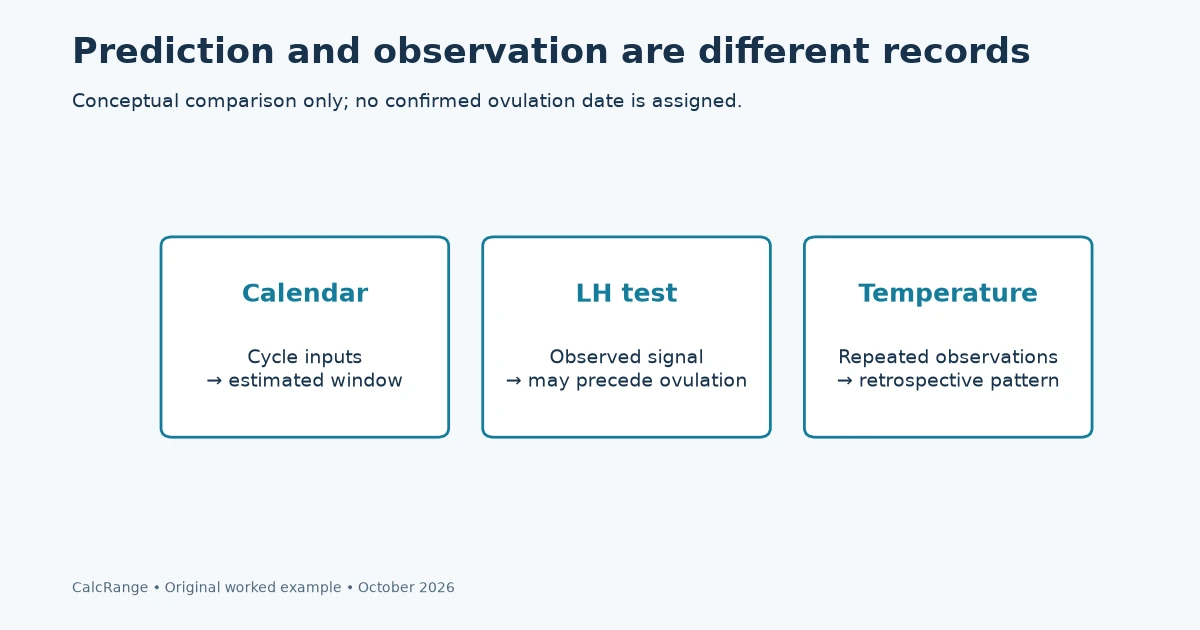
Table of Contents
Ovulation test vs basal body temperature: compare the evidence
The ASRM patient fact sheet distinguishes urine LH testing from temperature charting. The LH signal can precede ovulation, while the temperature pattern is assessed after the change has occurred.
| Method | Information used | What the record can say |
|---|---|---|
| Calendar estimate | Period dates and assumed cycle timing | Estimated date or window |
| Urine ovulation test | Test’s detection of an LH signal | Observed test result at a recorded time |
| Basal temperature log | Repeated temperature observations | A pattern to review retrospectively |
A positive LH result is not a photograph of an egg being released. A single warmer reading is not the same as an interpretable sustained pattern. If confirmation is needed, a healthcare professional can advise which assessment fits the situation.
The purpose of this comparison is to label the evidence accurately. It does not rank one method as universally best for everyone or supply a do-it-yourself diagnostic rule.
An original ovulation test and temperature timeline
This fictional log demonstrates how to keep records separate. It is not a typical cycle, a prediction of your ovulation day or a recommended testing schedule.
| Cycle day | Calendar record | LH test record | Temperature record |
|---|---|---|---|
| 12 | Predicted window saved | Negative, time recorded | Recorded as usual |
| 13 | Same original prediction | Positive, time recorded | Recorded as usual |
| 14 | Same original prediction | Result retained | First higher reading noted |
| 15 | Same original prediction | Result retained | Higher reading noted |
| 16 | Same original prediction | Result retained | Higher reading noted |
Keep the original calendar prediction rather than editing it afterward to match the observations. Otherwise, the record appears to show a prediction that was never actually made.
Likewise, write “positive test on day 13” rather than “ovulated on day 13.” The first sentence is an observation; the second adds an inference. Keeping that distinction makes the log more useful if results seem inconsistent.
No numerical temperature threshold is supplied here. Interpretation depends on the method and context, and the example intentionally does not diagnose ovulation from these rows.
Record enough detail to review an ovulation test
For an LH test, keep the product name, date, time and result according to its instructions. Different products can use different reading windows and displays. A photograph reviewed outside the stated time is not automatically equivalent to a correctly timed result.
For temperature, keep the date, time, measurement method and notes about relevant disruptions. Follow the thermometer or method instructions consistently. Do not mix measurements from different sites or devices without labeling the change.
The ASRM infertility overview discusses the limitations of temperature charting and factors that can complicate interpretation. A missing or disturbed reading should remain marked rather than being filled with an invented “expected” temperature.
A simple blank worksheet needs five columns: date, cycle day, observed test result, temperature if measured, and a note. Separate columns prevent a prediction from being accidentally copied into an observation field.
When ovulation test and temperature records disagree
A calendar can predict a day without detecting anything in the body. An LH signal and a temperature pattern also do not have identical timing. Disagreement is therefore a reason to review the evidence, not an automatic diagnosis.
The ASRM “Am I ovulating?” guidance notes that an LH surge can occasionally occur without ovulation. Do not use a positive strip as proof of pregnancy or assume that repeated negative strips establish infertility.
If cycles are irregular, tests repeatedly conflict or you have concerns, discuss the record with a healthcare professional. They can consider history, medications and appropriate investigations. Avoid changing fertility medication or choosing treatment based on this worksheet.
The related guides on ovulation observations and irregular-cycle estimates cover adjacent questions. This article’s narrower task is preserving the distinction between predicted and observed information.
Use the calculator as a dated estimate
Enter the actual first day of the recorded period and the requested cycle information. Save the inputs with the output, including any luteal-phase assumption. An output cannot be reproduced from a screenshot that shows only a highlighted date.
The current tool has regular- and irregular-cycle inputs, but an extra input field does not make the estimate a hormonal measurement. It also does not automatically import test-strip results or a thermometer log.
This comparison is not contraception guidance. Do not use a calculator window, a single negative LH test or an isolated temperature reading to declare a day “safe.” Anyone seeking pregnancy prevention needs an appropriate contraceptive method and guidance.
Use observation labels instead of inferred dates
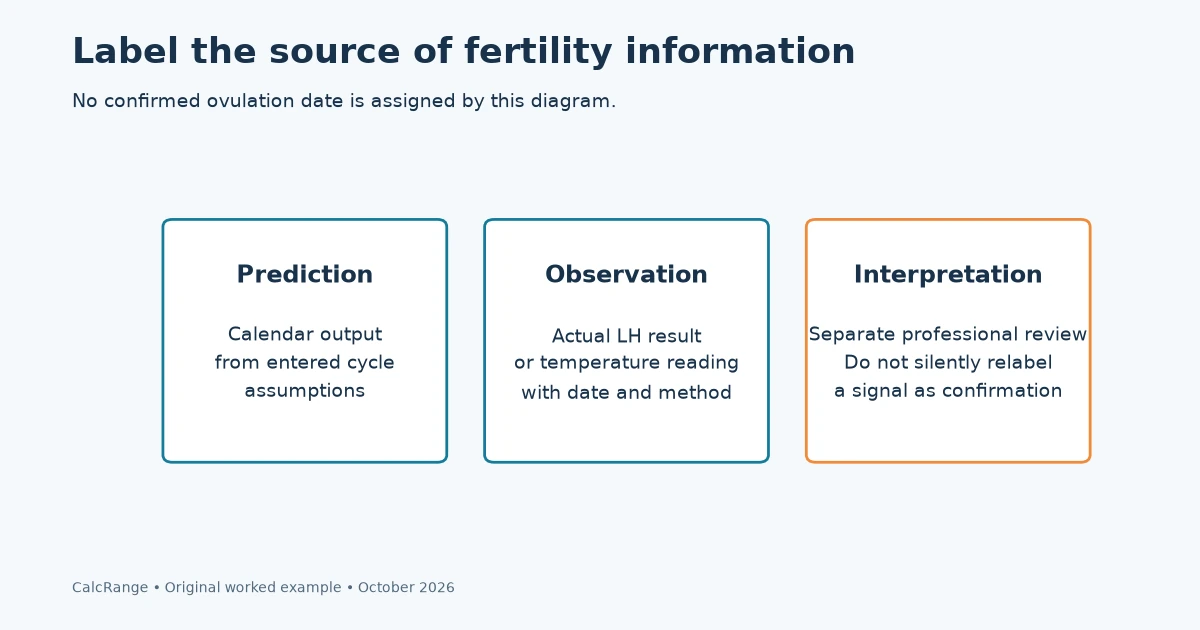
A log can become misleading when a software field asks for “ovulation day” but the available information is only a positive test. Keep the evidence in its original form instead: test product, date, time and result. If a clinician later interprets the record, add that interpretation as a separate note.
The same principle applies to a temperature chart. “Higher reading on Tuesday” is an observation. “Ovulation occurred Monday” adds an inference that may require a method-specific review and context.
| Entry | Type of information | Keep or revise |
|---|---|---|
| Positive LH test, date and time recorded | Observation | Keep the test’s actual wording |
| Calendar predicted day 14 | Model output | Keep the original prediction |
| Temperature reading with measurement method | Observation | Keep the actual value and unit |
| Confirmed ovulation on day 14 without clinical evidence | Unsupported conclusion | Do not label it confirmed |
This does not make every observation equally informative. It makes the record honest about its source. A clean separation is especially useful when the calendar, test and temperature pattern do not line up neatly.
Do not discard an inconvenient result just to make all three methods agree. Preserve it with relevant notes and discuss persistent uncertainty with a healthcare professional.
Keep date, time and temperature units consistent
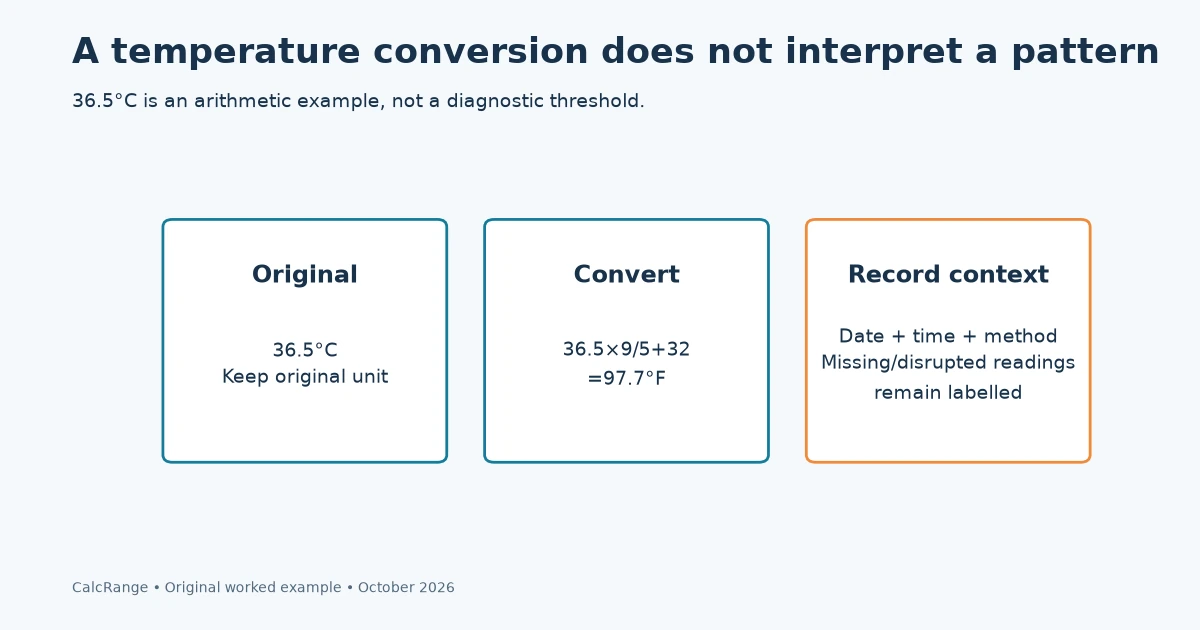
A record needs more than a cycle-day number. Include the calendar date and time so that entries can be ordered correctly, particularly around travel, an overnight work schedule or a changed routine.
If a thermometer displays Celsius, keep that unit in the log. A converted display should not overwrite the original reading. For arithmetic illustration only, 36.5°C converts to 97.7°F using F = C × 9/5 + 32. That conversion does not establish whether the reading belongs to a meaningful ovulatory pattern.
A missing reading is not the same as a normal reading. Leave it missing, and label disrupted measurements according to the method you are using. Filling gaps with the previous day’s value can create an artificial flat line.
If you change thermometer, measurement site or test product, note the date of change. Do not assume the new method has identical behavior merely because the displayed units or app colours look the same.
Follow the relevant product instructions for collection and reading. This comparison intentionally avoids a universal testing time or temperature threshold because those would go beyond the simple record-keeping task.
Create a short, useful summary for an appointment
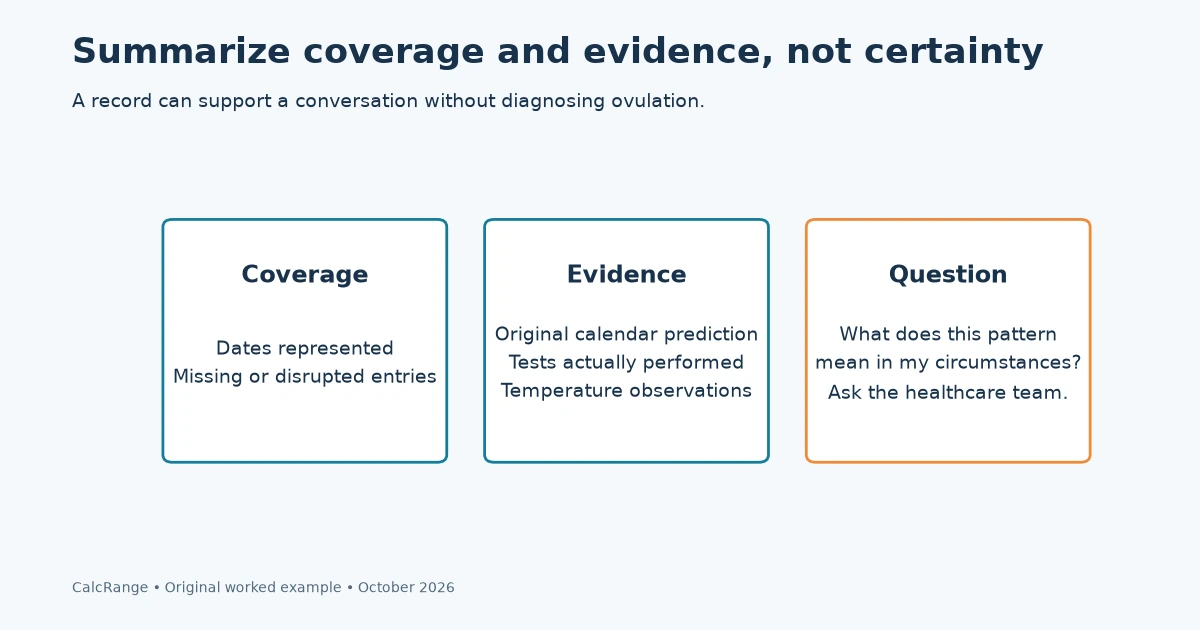
Rather than bringing only a predicted fertile date, summarize the date range covered, cycle information entered, tests actually performed and missing or disrupted observations. Keep the original rows available if the healthcare professional needs them.
A factual summary might say: “The app predicted a window from the entered cycle length; an LH test was positive on the recorded date; several later temperature readings were higher, with one missing day.” It should not say that all three independently confirmed an exact ovulation time.
If a tool offers reminders, distinguish a planned reminder from a completed observation. A reminder labelled “ovulation” does not prove that a biological event occurred on that date. Mark whether the underlying information came from a calendar estimate, test or clinical assessment.
The information needed for an individual fertility assessment can extend beyond these logs. A healthcare professional may consider history and appropriate testing; this article cannot determine the cause of irregular results or select a treatment.
Keep the goal of the record clear. It can support a conversation about trying to conceive, but it is not a contraceptive method and does not identify a guaranteed fertile or infertile day. Avoid turning uncertainty into a false promise simply because an app can display a precise date.
Ovulation test and temperature questions
Does a positive ovulation test prove ovulation happened?
No. It records an LH signal according to the test. That signal can precede ovulation and does not independently prove egg release.
Can basal temperature predict tomorrow’s ovulation?
Temperature charting is mainly retrospective. A later pattern should not be presented as a precise advance prediction of tomorrow’s ovulation.
Should I change the calendar estimate to match my test?
Keep the original prediction and observed result separately. You can discuss their difference without rewriting the historical record.
Sources and calculation notes
The timeline is fictional and intentionally assigns no confirmed ovulation date. It is an observation-recording aid, not a fertility treatment or contraception protocol. Sources checked October 30, 2026.