
To split accommodation by person-nights, multiply each person by the number of nights they occupy the shared booking. Divide the agreed lodging cost by the total person-nights, then multiply that rate by each traveller’s nights. This is one possible agreement, not a rule that every group must use.
The method differs from simply dividing the total by the headcount. It also differs from splitting each individual night among the people present that night. The example below shows why these two reasonable approaches can produce different payments.
Use the Trip Cost Calculator for the overall trip budget. Its per-person total is an equal split; use this separate worksheet for unequal lodging stays rather than expecting the tool to allocate person-nights automatically.
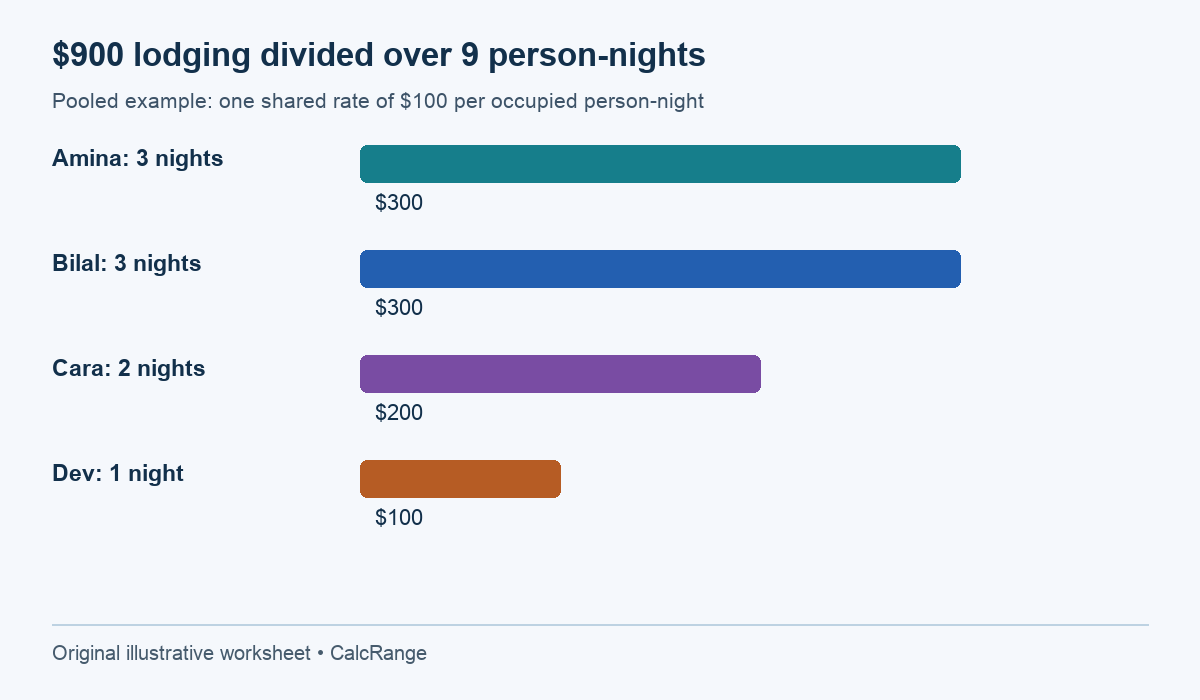
Table of Contents
Define the booking and count occupied nights
Four friends share one accommodation booking costing $900 for three nights. Amina and Bilal stay all three nights; Cara stays the first two; Dev stays only the first night. Assume the $900 is the final agreed lodging cost, with any shared mandatory booking fees already included.
Use check-in and check-out dates to count nights. Arriving Friday and checking out Monday normally covers Friday, Saturday and Sunday nights: three, not four. Someone arriving for a day visit but sleeping elsewhere has zero accommodation nights unless the group separately agrees to charge for another service.
| Traveller | Night 1 | Night 2 | Night 3 | Total nights |
|---|---|---|---|---|
| Amina | Yes | Yes | Yes | 3 |
| Bilal | Yes | Yes | Yes | 3 |
| Cara | Yes | Yes | No | 2 |
| Dev | Yes | No | No | 1 |
| Occupants each night | 4 | 3 | 2 | 9 person-nights |
Check the total both ways: 3 + 3 + 2 + 1 = 9, and 4 + 3 + 2 = 9. This catches a missing night or accidentally duplicated traveller before money is assigned.
Method 1: pool the cost across all person-nights
The pooled rate is $900 ÷ 9 = $100 per person-night. Amina and Bilal each owe 3 × $100 = $300. Cara owes $200, and Dev owes $100. The shares add back to $900.
| Traveller | Person-nights | Rate | Accommodation share |
|---|---|---|---|
| Amina | 3 | $100 | $300 |
| Bilal | 3 | $100 | $300 |
| Cara | 2 | $100 | $200 |
| Dev | 1 | $100 | $100 |
| Total | 9 | — | $900 |
This method gives every occupied person-night the same price. It pools the cost of the quieter final night with the busier first night. That can suit a group that deliberately booked one shared property together, but it should be agreed before people rely on the quoted share.
The formula can be written as individual share = total shared lodging cost × individual nights ÷ total person-nights. A negative night count is invalid, and a zero total person-night count cannot be used as a denominator.
Method 2: split each night among its occupants
Now suppose the booking’s price is $300 for each of the three nights. Divide the first night by four occupants: $75 each. Divide the second by three: $100 each. Divide the third by two: $150 each.
Amina and Bilal each pay $75 + $100 + $150 = $325. Cara pays $175, and Dev pays $75. Again, the total is $900. Compared with pooling, the people staying on the sparsely occupied final night pay more.
| Traveller | Pooled person-nights | Split each night | Difference |
|---|---|---|---|
| Amina | $300 | $325 | +$25 |
| Bilal | $300 | $325 | +$25 |
| Cara | $200 | $175 | −$25 |
| Dev | $100 | $75 | −$25 |
Neither method is mathematically wrong. They answer different allocation questions. If nightly prices vary, use the actual nightly charges for the second method. If the group chooses pooling, it deliberately averages those variations. Do not label one result “fair” without explaining the agreement.
Keep cleaning fees, private rooms and other costs visible
A flat cleaning fee might be included in the pooled lodging cost, divided equally by all travellers, or allocated another agreed way. These choices are not equivalent. For a separate $120 fee, equal headcount shares are $30 each; person-night shares are $40, $40, about $26.67 and about $13.33.
A larger private room, an extra bed or a pet fee can justify a separately agreed charge. Avoid quietly multiplying someone’s person-nights by an unexplained “premium.” Record the amount and agreement so the final ledger can be checked.
Food purchased by individuals, admission tickets and different transport journeys should not automatically inherit the lodging split. A visitor may share dinner without staying overnight. Our road-trip fuel split guide treats shared travel segments separately.
Reconcile deposits and round only at settlement
Suppose Amina paid the entire $900 booking in advance and the group chose pooled person-nights. Her $300 share is already paid; Bilal owes her $300, Cara $200 and Dev $100. The $600 she receives plus her own $300 contribution equals the booking cost.
If Bilal previously sent Amina a $50 deposit, his remaining transfer is $250. Do not subtract that $50 from the group’s $900 expense and then subtract it again from his personal balance. Deposits are payments toward shares, not a second discount on the supplier’s invoice.
For a $901 booking with the same nine person-nights, unrounded shares are $300.333…, $300.333…, $200.222… and $100.111…. Rounding each to cents gives $900.99 in total. Assign the remaining cent using an agreed rule, such as the largest fractional remainder with a stable tie-break: $300.34, $300.33, $200.22 and $100.11 add to exactly $901.
Three further allocation checks
Check 1: different prices on different nights
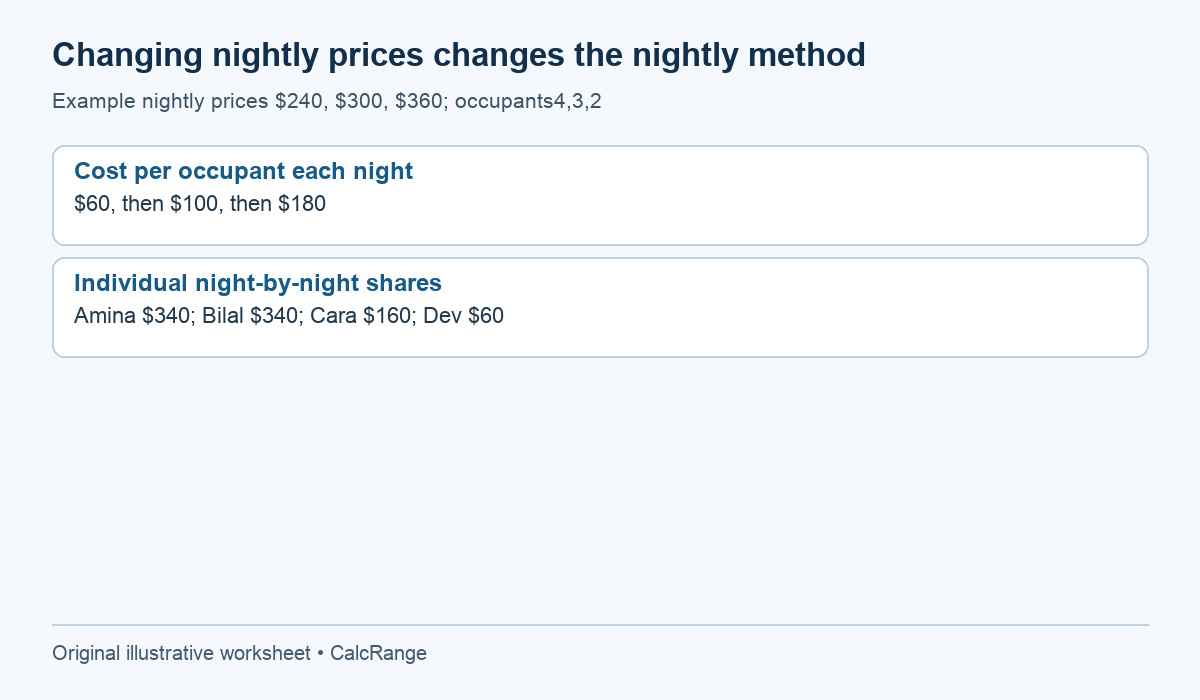
Suppose the same three-night booking costs $240, $300 and $360 rather than $300 each. The total is still $900. Under pooled person-nights, the nine occupied person-nights still receive the same $100 rate and the original $300, $300, $200, $100 shares.
Under a night-by-night agreement, the first night costs $240÷4=$60 per occupant, the second $300÷3=$100 and the last $360÷2=$180. Amina and Bilal each owe $340, Cara owes $160 and Dev owes $60. The shares total $900, but they differ more sharply because the least occupied night is also the most expensive.
This comparison is useful before booking. Ask whether travellers are agreeing to a pooled property cost or to the actual nights they use. Do not announce one rate beforehand and silently switch methods after someone has committed to the trip. Keep the chosen method in the shared booking note.
Check 2: a shared fixed fee uses a different allocation rule
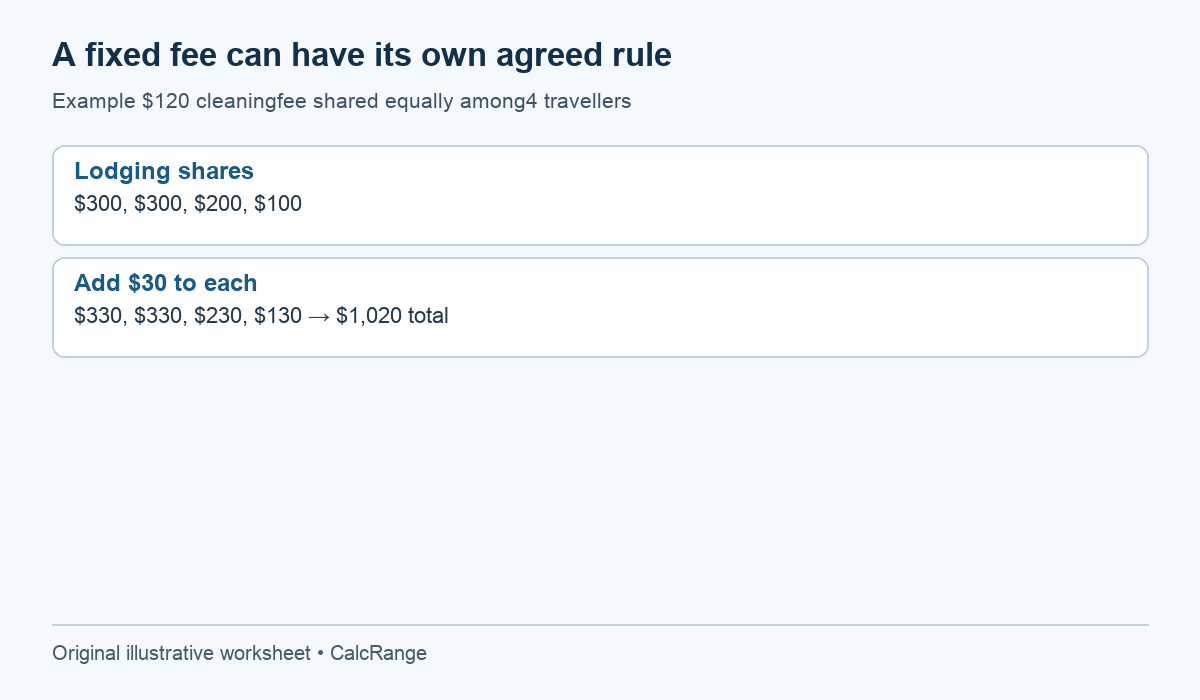
Imagine a separate $120 cleaning fee that the group agrees to split equally among all four travellers, regardless of nights. Start with the original pooled lodging shares of $300, $300, $200 and $100, then add $30 to each. The final shares are $330, $330, $230 and $130, totaling $1,020.
If you instead include the cleaning fee in the person-night pool, the rate becomes $1,020÷9=$113.333… per night. The longer-stay travellers would each owe $340, while the two-night and one-night travellers would owe approximately $226.67 and $113.33. Both sets reconcile, but their allocation rules differ.
A worksheet can support mixed rules if each line names its rule. Use separate rows for lodging, cleaning, a private-room supplement and individual extras. Avoid calling the whole sheet “person-nights” if some costs are actually split by headcount. Clear labels matter more than forcing every expense through one formula.
Check 3: settle several advance payments
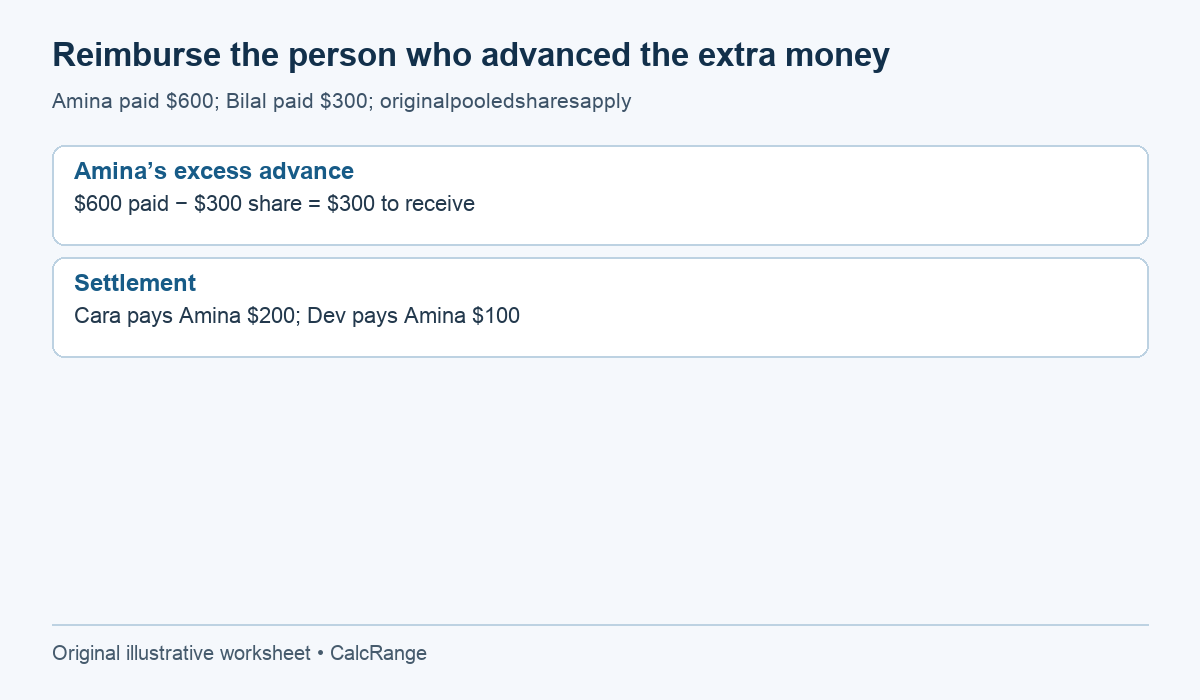
Return to the original $900 pooled example. Suppose Amina paid $600 toward the supplier and Bilal paid $300. Their allocated lodging shares remain $300 each. Cara’s share is $200 and Dev’s $100. Amina has advanced $300 more than her share; Bilal has paid exactly his share.
The simplest settlement for this example is Cara paying Amina $200 and Dev paying Amina $100. No transfer from Bilal is required. Check each person’s final net contribution: Amina $600−$300 received=$300; Bilal $300; Cara $200; Dev $100. These again sum to $900.
If a booking platform later refunds $90, record who actually receives it and agree how to allocate it under the original cost-sharing method. Do not merely reduce everyone’s unpaid balance if some people have already settled. A ledger with supplier payments, reimbursements and refunds can show both the final expense and who currently holds the group’s money.
These settlement examples assume no transfer fees or currency differences. If either exists, add a named line and an agreed allocation rather than hiding it in an exchange-rate estimate. The goal is a complete explanation of balances, not only a final number next to each name.
Handle cancellations and changed stays explicitly
If Dev cancels after a non-refundable booking, the person-night formula alone cannot decide who absorbs the cost. The supplier’s cancellation terms and the group’s prior agreement matter. Recalculate a new scenario, but do not treat the new arithmetic as proof that someone’s original obligation disappeared.
Keep four columns in the final record: allocated share, payments already made, reimbursements received and balance remaining. Record one currency and one exchange-rate convention if payments cross currencies. A booking deposit still held by the property should remain separate from a confirmed non-refundable cost.
Accommodation is only one part of a trip budget. MoneyHelper’s holiday-budget guide separates costs arranged before travel from day-to-day spending such as food and activities. Use that wider checklist after agreeing the accommodation allocation; a low lodging share alone does not establish that the whole trip is affordable.
Once lodging shares are agreed, place each person’s amount into their own budget. Our daily vacation budget worksheet separates prepaid accommodation from money available for meals and activities. The examples here are original allocation arithmetic, not current accommodation prices or advice about what anyone should spend.