 Skip to content
A daily vacation budget can mean two different things: total trip cost divided by days, or the money left to spend each day after committed costs. Label the number clearly. Otherwise, a daily average that includes flights and hotels may be mistaken for restaurant and activity money.
Use the Trip Cost Calculator to organize transportation, accommodation, food and other expenses. Then divide the appropriate subtotal by days and travelers.
Start with the money available
Write a total budget that is available for this trip, separate from money needed for expenses at home. Use actual booking quotes where available and label uncertain costs as estimates. A destination-wide “average daily cost” may use a different travel style, season or treatment of airfare.
MoneyHelper’s holiday budgeting guide separates pre-trip items from day-to-day expenses. The worksheet below builds on that distinction with original hypothetical numbers rather than current travel prices.
A two-person, seven-day example
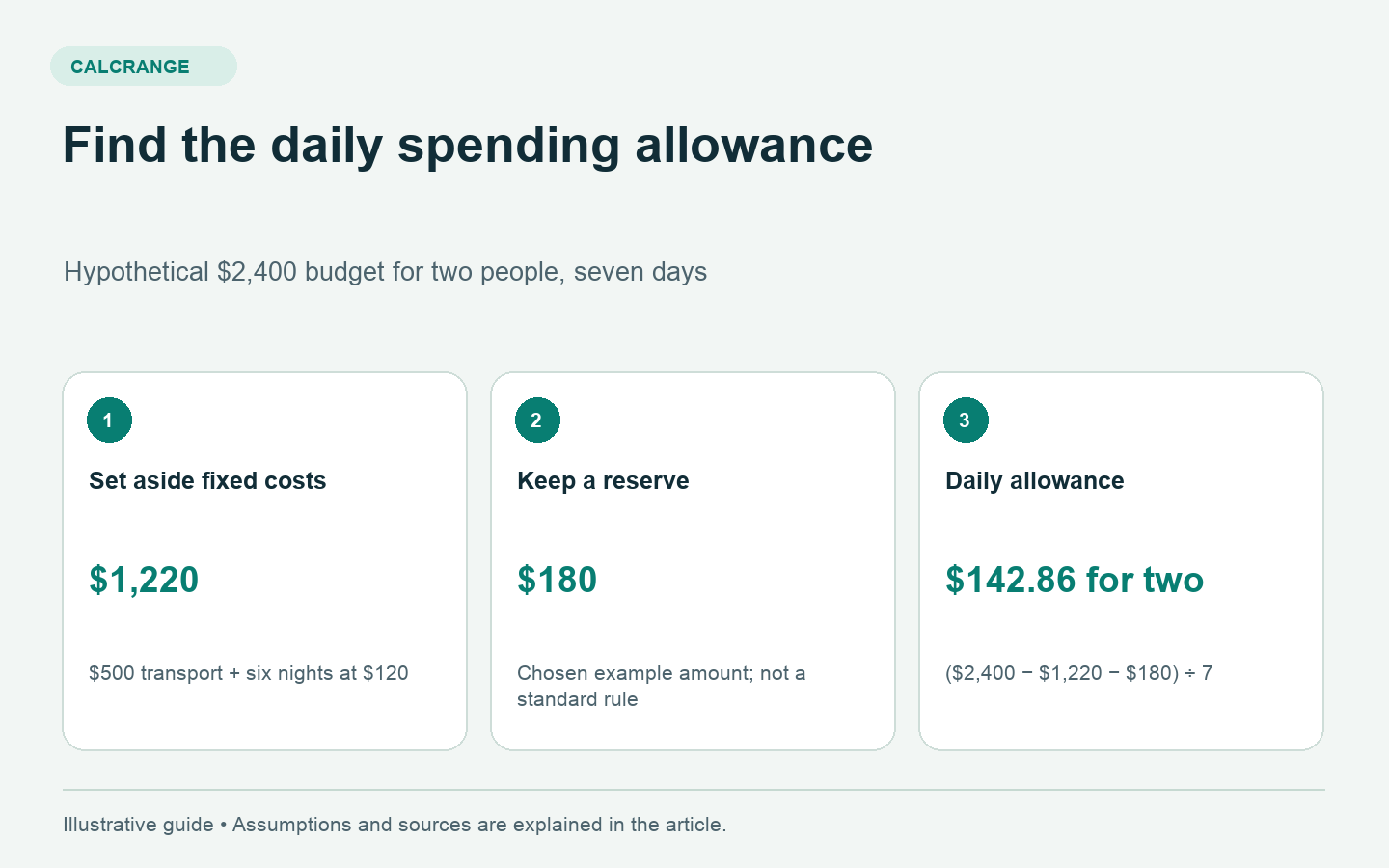
Assume two people have allocated $2,400 for seven travel days and six accommodation nights. Their transport costs $500 in total. A room costs $120 per night for six nights, or $720. They also choose a $180 reserve. That reserve is a planning choice in this example, not a universal recommended percentage.
| Budget item | Calculation | Amount |
|---|---|---|
| Total available | Chosen budget | $2,400 |
| Transport | Total quote | −$500 |
| Accommodation | 6 nights × $120 | −$720 |
| Reserve | Chosen allocation | −$180 |
| Daily spending pool | Remaining balance | $1,000 |
The daily spending allowance is $1,000 ÷ 7 = approximately $142.86 for both people together, or $71.43 per person if divided equally. The $2,400 all-in budget divided by seven days and two people is about $171.43 per person-day. Both calculations are valid, but they describe different amounts.
Days and nights are different units
A seven-day itinerary often has six lodging nights, but overnight transport or unusual departure times can change that. Count the actual bookings. Multiplying seven days by a nightly room rate would add a night that may not exist in the itinerary.
Similarly, a quoted room price may cover the room rather than each person. Two people sharing one $120 room do not automatically owe $240 a night. Record whether every quote is per person, per room, per vehicle or per booking.
Turn the allowance into usable categories
For the $142.86 daily pool, an illustrative allocation could be $70 for meals, $20 for local transport, $35 for activities and approximately $17.86 for small purchases. The allocation should come from the itinerary; it is not evidence that those amounts will buy the desired services at any destination.
A daily allowance is an average, not a rule that every day must cost the same. If a planned excursion costs $210 for the pair, reserve that amount in advance and spread the remaining money across the rest of the schedule. Do not count the excursion once as a prepaid item and again in a daily activity allowance.
Recalculate during the trip
Suppose the travelers spend $330 from the $1,000 spending pool in the first two days. They have $670 for five days, or $134 per day. This remaining-balance method is more informative than continuing to repeat the original $142.86 allowance.
Track pending charges and prepaid expenses separately from unspent cash. Money held as a reserve is still part of the budget, but it is not an actual expense until used. At the end, compare actual spending with the original plan rather than reporting every allocated dollar as a cost.
Build a plan you can update
MoneyHelper’s general budgeting guidance recommends tracking income and spending. For a trip, a simple note with date, category, amount and currency is often enough to update the remaining pool.
Convert foreign-currency estimates consistently and retain a date for the assumed rate. Use current provider quotes to replace invented inputs before booking. This worksheet helps allocate a chosen budget; it does not establish a destination’s current prices or decide what travel spending is affordable for you.
Sources and method
Source links checked September 18, 2026. Examples are original educational calculations using the assumptions stated above.