 Skip to content
Fluid ounces measure volume; ordinary ounces measure mass. A label reading 8 fl oz describes how much space the contents occupy. A label reading 8 oz usually describes their mass in everyday packaging. The two measurements are not automatically interchangeable.
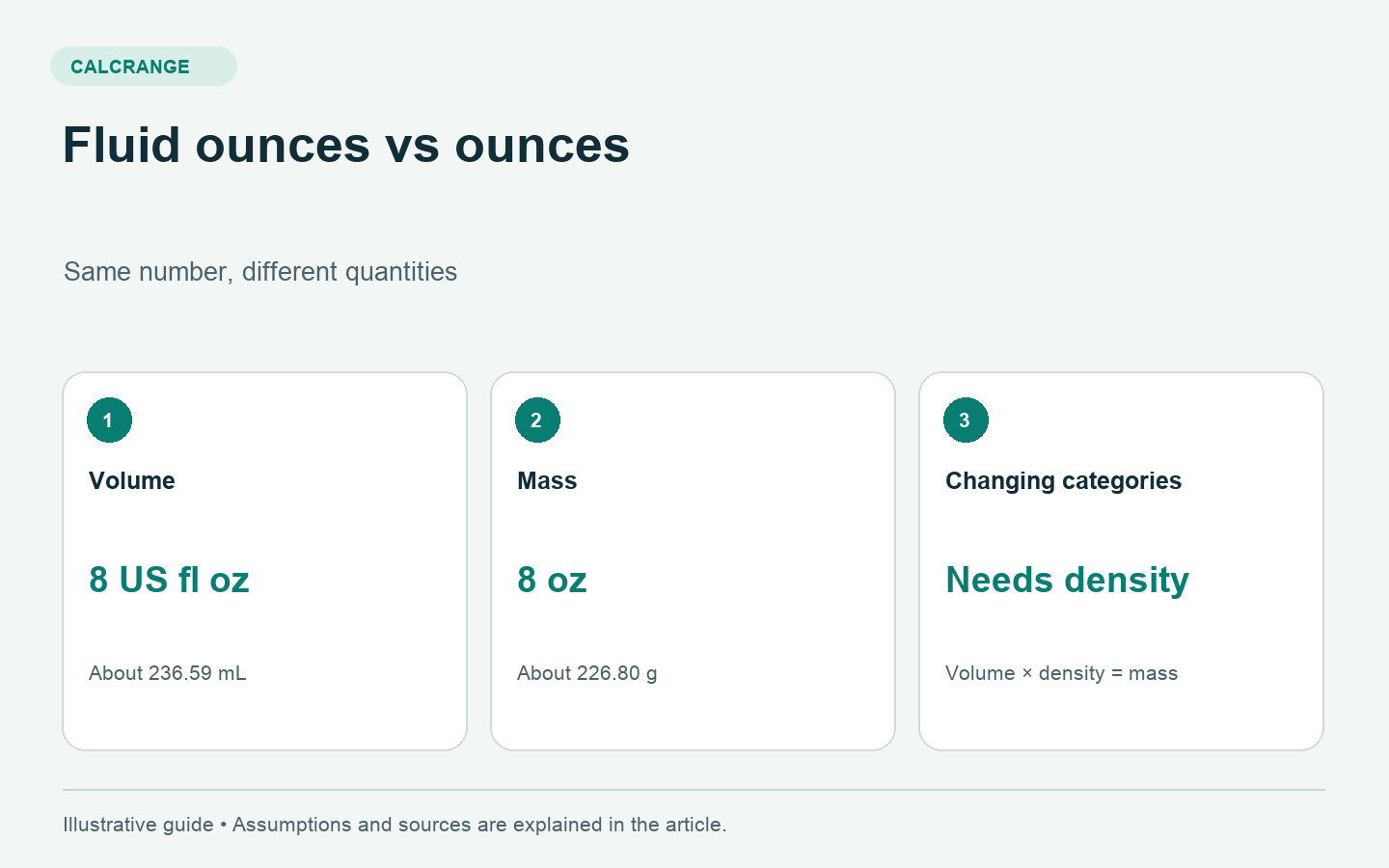
Use the Unit Converter within the correct category: volume for fluid ounces and milliliters, mass for ounces and grams. Changing between volume and mass also requires information about the material’s density.
The basic conversions
| Measurement | What it measures | Metric equivalent |
|---|---|---|
| 1 US fluid ounce | Volume | 29.5735295625 mL |
| 1 imperial fluid ounce | Volume | 28.4130625 mL |
| 1 ordinary avoirdupois ounce | Mass | 28.349523125 g |
NIST’s measurement references distinguish volume from mass and provide the conversion factors. The similar-looking numbers, all close to 28 or 30, can make the units easy to confuse, but their meanings remain different.
What is the difference between 8 fl oz and 8 oz?
Eight US fluid ounces equal 8 × 29.5735295625 = 236.5882365 milliliters, usually written as about 236.59 mL for a conversion exercise. Eight ordinary ounces equal 8 × 28.349523125 = 226.796185 grams, or about 226.80 g.
The first result belongs in a measuring jug. The second belongs on a scale. A single universal factor cannot tell you what 236.59 mL of an unspecified ingredient weighs.
Why density is needed to switch categories
Density is mass divided by volume. If density is given in grams per milliliter, multiply it by the volume in milliliters to calculate grams:
Mass in g = volume in mL × density in g/mL.
For a purely illustrative liquid with a density of 0.90 g/mL, 236.588 mL would weigh about 212.93 g. If another liquid’s density were 1.20 g/mL, the same volume would weigh about 283.91 g. These are hypothetical densities, not measurements of a named food.
The container holds the same volume in both examples while the scale displays different masses. That is why a volume-to-weight conversion needs the ingredient and its relevant density, rather than just the word “ounces.”
Read the recipe’s notation before measuring
“Fl oz” explicitly indicates fluid volume. A recipe giving flour, butter or chocolate in “oz” may mean mass, particularly when it also offers grams. Look at the author’s unit system and instructions. Do not infer the intended unit solely from whether the ingredient is liquid or dry; liquids can also be weighed.
When a recipe provides both grams and ounces, a scale is a straightforward way to stay with mass. When it specifies fluid ounces or milliliters, use a suitably marked volume measure unless the recipe supplies a tested weight alternative.
US and imperial fluid ounces also differ
Eight imperial fluid ounces equal 227.3045 mL, which differs from the 236.5882 mL in eight US fluid ounces. Before using an older British recipe or a conversion chart, confirm which system it uses.
The symbol fl oz by itself may not state the system. A clear conversion result should say “US fl oz” or “imperial fl oz,” especially if it will be shared with someone in another country.
Three checks before converting
- Identify whether the source quantity is volume or mass.
- For fluid ounces, identify the US or imperial system.
- If the target changes categories, obtain a suitable density or use a tested ingredient conversion instead of a generic unit factor.
The conversions here use ordinary avoirdupois ounces for mass. Troy ounces, used in some precious-metal contexts, are a different unit.
Once the category is clear, use the Unit Converter to convert fluid ounces to another volume unit or ounces to another mass unit without mixing the two.