 Skip to content
One cubic foot equals approximately 7.48052 US liquid gallons or 6.22884 imperial gallons. Multiply cubic feet by the appropriate factor. Always label the gallon system so the result cannot be mistaken for a different capacity.
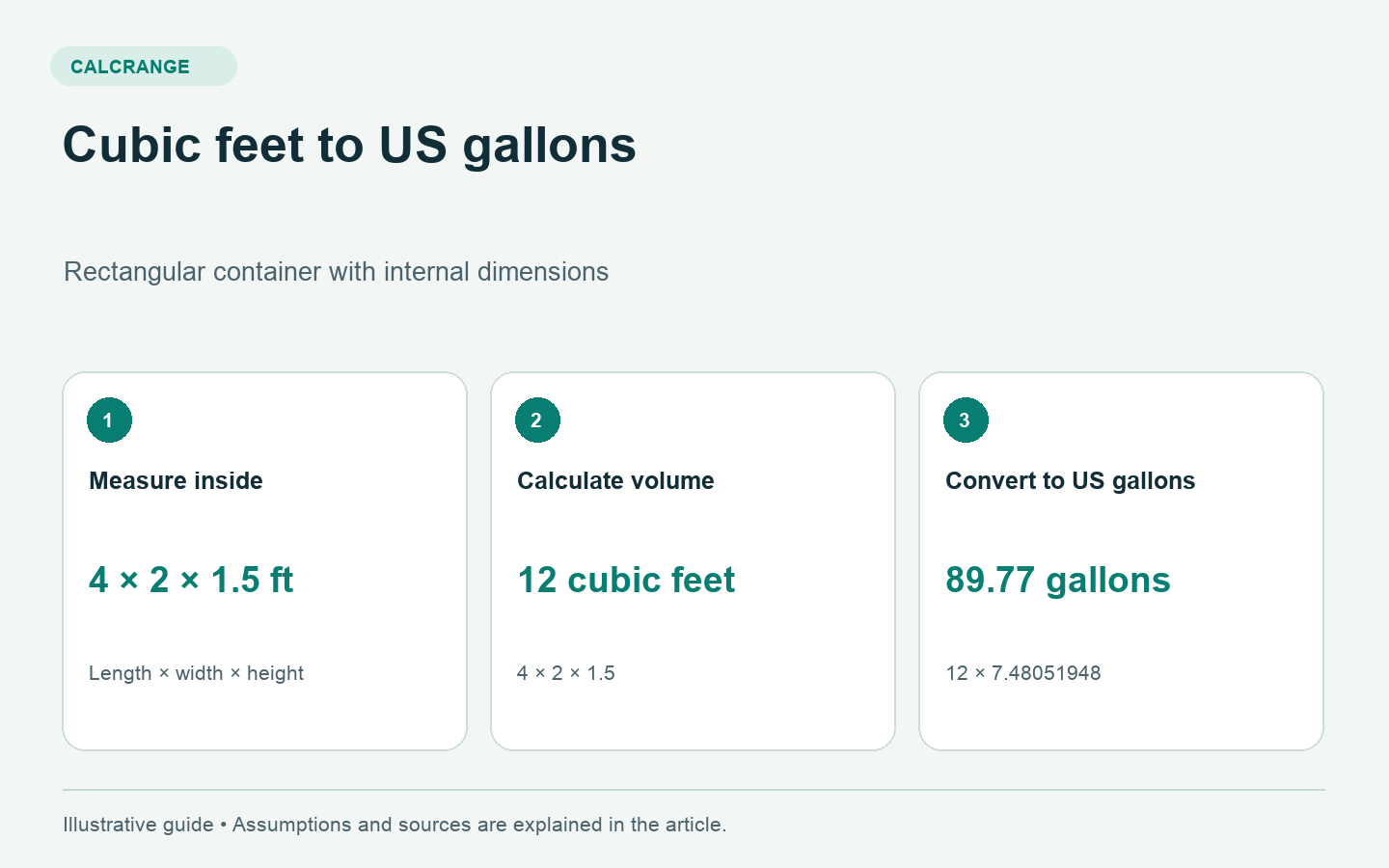
If you start with a container’s dimensions, first calculate its volume in cubic feet. The Volume Calculator can help with supported shapes and volume units; the worked example below shows how to check the conversion.
The cubic-feet-to-gallons formula
For US liquid gallons:
US gallons = cubic feet × 7.48051948.
For the reverse calculation, divide US gallons by 7.48051948. One US liquid gallon occupies approximately 0.133681 cubic feet.
The US relationship can also be derived from cubic inches: one cubic foot contains 12 × 12 × 12 = 1,728 cubic inches, and one US liquid gallon contains 231 cubic inches. Dividing 1,728 by 231 gives the conversion factor. NIST’s measurement references document these volume relationships.
A rectangular container example
Suppose a rectangular container has internal dimensions of 4 feet long, 2 feet wide and 1.5 feet high. Assume a flat base, vertical sides and no internal obstructions.
- Volume: 4 × 2 × 1.5 = 12 cubic feet.
- US liquid capacity: 12 × 7.48051948 ≈ 89.77 US gallons.
- Imperial comparison: 12 × 6.22883546 ≈ 74.75 imperial gallons.
The container has not changed size. The gallon unit is larger in the imperial system, so fewer imperial gallons fit into the same volume.
A quick conversion table
| Cubic feet | Approximate US gallons | Approximate imperial gallons |
|---|---|---|
| 1 | 7.48 | 6.23 |
| 2 | 14.96 | 12.46 |
| 5 | 37.40 | 31.14 |
| 10 | 74.81 | 62.29 |
| 12 | 89.77 | 74.75 |
Round after calculating the full volume. Two decimal places are useful for comparing arithmetic, but a roughly measured container may not justify that level of physical precision.
Use the actual fill depth for usable volume
The full 1.5-foot height in the example measures capacity to the top under the stated assumptions. If you plan to fill only to a depth of 1.25 feet, substitute that depth:
4 × 2 × 1.25 = 10 cubic feet, or approximately 74.81 US gallons. That leaves 0.25 feet, or 3 inches, of vertical space above the liquid. The working volume is about 14.96 US gallons smaller than the full geometric volume.
Wall thickness, rounded corners, pipes, equipment or contents that displace liquid can also reduce the usable amount. Use internal dimensions rather than external measurements when estimating what fits inside.
Convert the dimensions before multiplying
If one dimension is in inches and the others are in feet, put all three in the same unit first. Eighteen inches is 1.5 feet, which is the height used above. Multiplying 4 × 2 × 18 and labelling the result cubic feet would overstate the volume twelvefold.
You can instead work entirely in inches, then divide the resulting cubic inches by 231 for US gallons. The two routes should agree when the inputs and gallon system are consistent.
What this estimate can and cannot tell you
This conversion changes volume units. It does not determine a safe fill level, a container’s load rating or the mass of its contents. Weight requires the material’s density; structural suitability requires information beyond the geometric volume.
For a real product, compare your estimate with the manufacturer’s stated capacity and operating instructions. A nominal capacity may be rounded or defined at a particular fill level.
Use the Volume Calculator to check the shape’s volume, then keep “US liquid gallons” or “imperial gallons” visible beside the final number.