
The BMR change per kilogram in the simplified Mifflin–St Jeor equation is 10 kcal per day when every other input stays fixed. That is a property of the equation, not a promise that a person’s measured metabolism changes by exactly 10 calories after gaining or losing a kilogram. Select Mifflin–St Jeor in the BMR Calculator to reproduce the controlled comparison below.
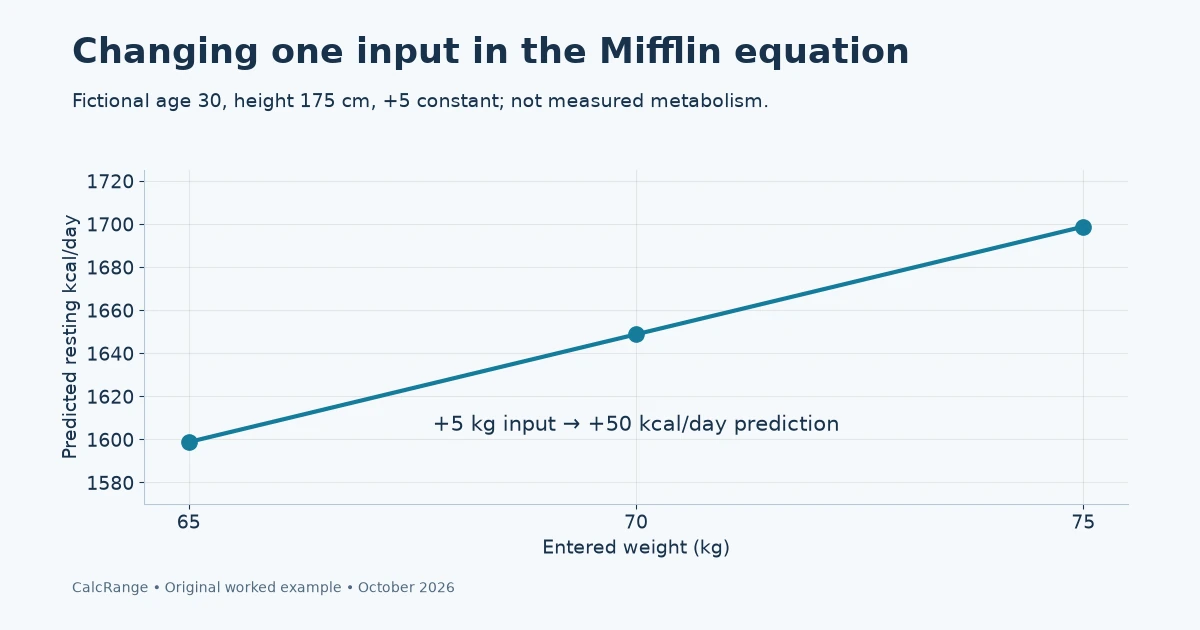
Table of Contents
BMR change: read the equation coefficient
The original Mifflin study developed a prediction of resting energy expenditure from measurements in adults. The commonly used simplified form is 10W + 6.25H − 5A + S, with weight W in kilograms, height H in centimetres, age A in years, and a sex-specific constant S of +5 or −161.
Subtract an earlier calculation from a later one. If only weight changes, the height, age and constant terms cancel. What remains is change in estimate = 10 × change in kilograms.
| Change in entered weight | Change in estimated resting expenditure |
|---|---|
| −5 kg | −50 kcal/day |
| −1 kg | −10 kcal/day |
| +1 kg | +10 kcal/day |
| +5 kg | +50 kcal/day |
These are differences between model outputs. They do not describe the energy contained in a kilogram of tissue, the calories needed to change weight, or the time required for a change. Those are different questions.
BMR change with height and age fixed
Use a fictional adult aged 30, height 175 cm, with the +5 constant. At 70 kg the equation is 700 + 1,093.75 − 150 + 5 = 1,648.75 kcal/day. At 75 kg it becomes 750 + 1,093.75 − 150 + 5 = 1,698.75 kcal/day.
| Entered weight | Weight term | Other terms combined | Resting estimate |
|---|---|---|---|
| 65 kg | 650 | 948.75 | 1,598.75 kcal/day |
| 70 kg | 700 | 948.75 | 1,648.75 kcal/day |
| 75 kg | 750 | 948.75 | 1,698.75 kcal/day |
The 5 kg input change produces a 50 kcal/day output change. The same weight-only difference follows with the −161 constant, although the absolute estimates differ. This does not mean the two versions are interchangeable for choosing an individual’s inputs.
The table deliberately retains two decimal places so the arithmetic is visible. A calculator may display whole calories. Those extra decimals are not evidence that an individual’s expenditure is known to hundredths of a calorie.
BMR change when more than weight changes
The general difference formula for this simplified equation is Δestimate = 10ΔW + 6.25ΔH − 5ΔA + ΔS. It helps explain a software comparison without attributing every difference to body weight.
For example, changing weight from 70 to 75 kg and age from 30 to 31, with height and the constant unchanged, changes the estimate by 50 − 5 = 45 kcal/day. A 2 cm height correction alone changes the estimate by 12.5 kcal/day. That is an input correction, not evidence of newly changed physiology.
Switching formulas changes the coefficients. Revised Harris–Benedict and Katch–McArdle are not expected to reproduce this 10-per-kilogram table. The latter uses estimated lean mass, so changing an entered body-fat estimate can also affect its result. Do not select “average available formulas” for a single-equation audit.
Reproduce the comparison without changing other settings
- Choose metric units and Mifflin–St Jeor.
- Record age, height, sex-specific input and the initial weight.
- Read the resting-energy result, separately from any activity or goal output.
- Change only weight by a known amount, such as 1 kg.
- Compare the two resting estimates and allow for display rounding.
The current tool also has activity, goals and additional adjustment fields. Those outputs answer broader planning questions. They are not needed to verify the equation’s weight coefficient.
If one screen says BMR and another says maintenance calories or TDEE, they are not the same output. Even a mathematically correct activity multiplier introduces an assumption beyond the resting equation. Our BMR formula guide covers the full calculation; the estimate-comparison guide explains why two tools can disagree.
What the sensitivity table does not prove
The original equation is a prediction, not a direct measurement of oxygen use or energy expenditure. Its response to a changed number cannot establish how a particular person’s body responded to weight change.
Scale weight alone does not identify which tissues or fluids changed. Nor does this static calculation capture every change in activity or individual physiology. Treat it as an explanation of calculator behavior, not a diagnosis of a “slow” or “damaged” metabolism.
Do not reduce food intake by the exact difference simply because a recalculation went down. Nutrition planning requires context. The guide to rechecking maintenance estimates concerns that separate planning step; a clinician or registered dietitian can help when medical conditions or individual needs are involved.
Convert a pound change before applying the coefficient
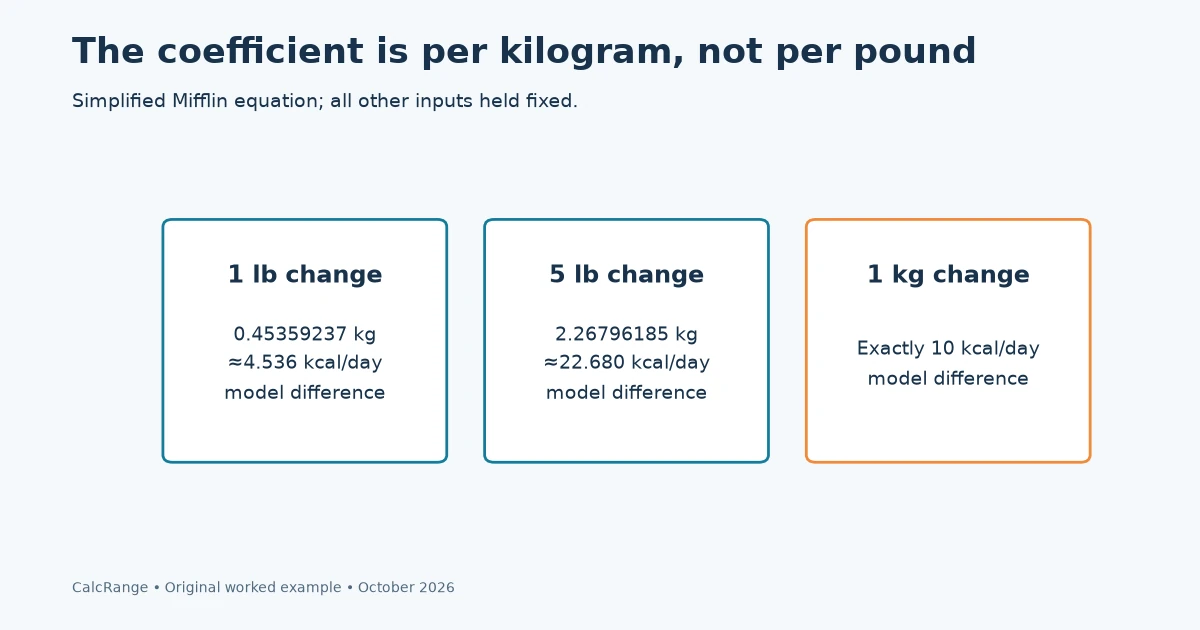
The Mifflin weight coefficient is attached to kilograms. A change of 1 lb is exactly 0.45359237 kg, so a one-pound input change produces about 4.5359237 kcal/day of model difference when the other inputs stay fixed.
A five-pound change is 2.26796185 kg and therefore about 22.6796185 kcal/day in this controlled equation. Multiplying five pounds directly by ten would incorrectly treat them as five kilograms.
| Entered change | Equivalent kg | Predicted difference |
|---|---|---|
| 1 lb | 0.45359237 | 4.5359237 kcal/day |
| 5 lb | 2.26796185 | 22.6796185 kcal/day |
| 1 kg | 1 | 10 kcal/day |
Keep the original unit visible when comparing two screenshots. If one tool converts pounds internally and another expects kilograms, entering the same bare number does not represent the same person.
The extra digits show the conversion arithmetic, not clinical precision. A change of approximately 4.5 kcal in a displayed estimate should not be treated as a measurable change in an individual’s food requirement or a reason to alter a meal.
Separate display rounding from a formula mismatch
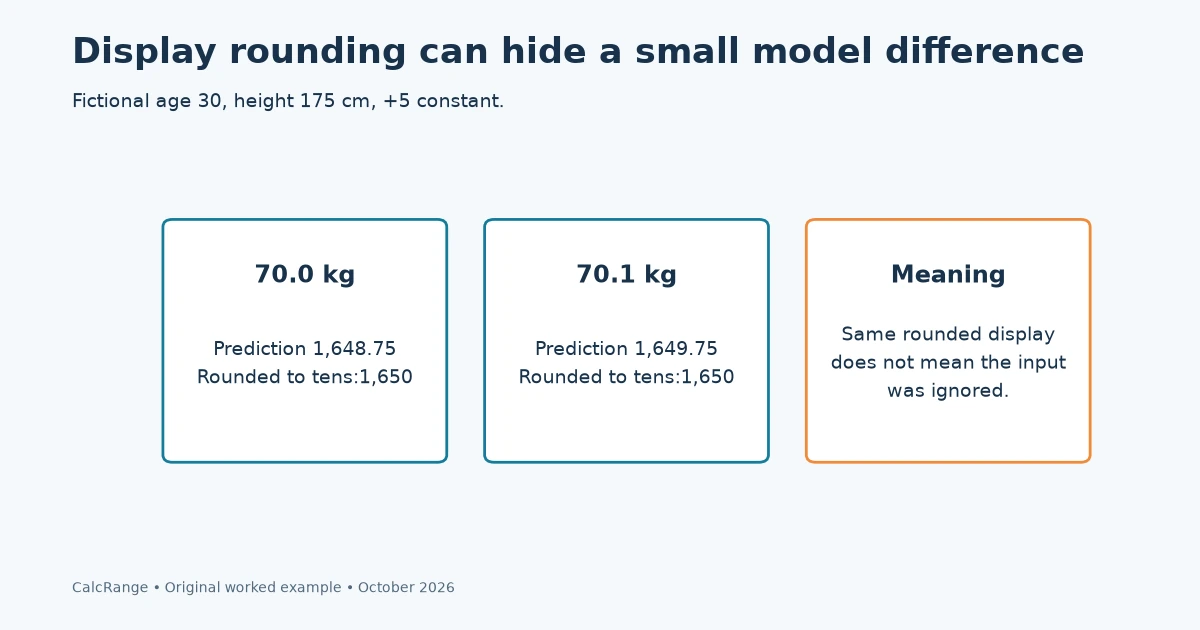
Using the earlier age-30, height-175-cm, +5-constant example, a weight of 70.0 kg gives 1,648.75 kcal/day. Entering 70.1 kg gives 1,649.75. The underlying difference is exactly 1 kcal/day in this model.
A display rounded to whole calories might show 1,649 and 1,650. A coarser display rounded to tens might show 1,650 for both. Equal displayed numbers would not prove that the formula ignored the changed input.
When auditing software, compare the raw arithmetic or a sufficiently large controlled input difference. Record whether the application rounds, truncates or formats the result. Do not use a tiny expected difference as proof of a bug when it falls below the display step.
Also check whether the tool uses the simplified coefficients or another version of an equation. A label alone may not document every implementation choice. Our example states its coefficients explicitly so its output can be reproduced.
This audit tests internal arithmetic consistency. It does not validate the prediction against measured resting expenditure or establish which equation is best for a particular individual.
BMR change: a controlled comparison ledger
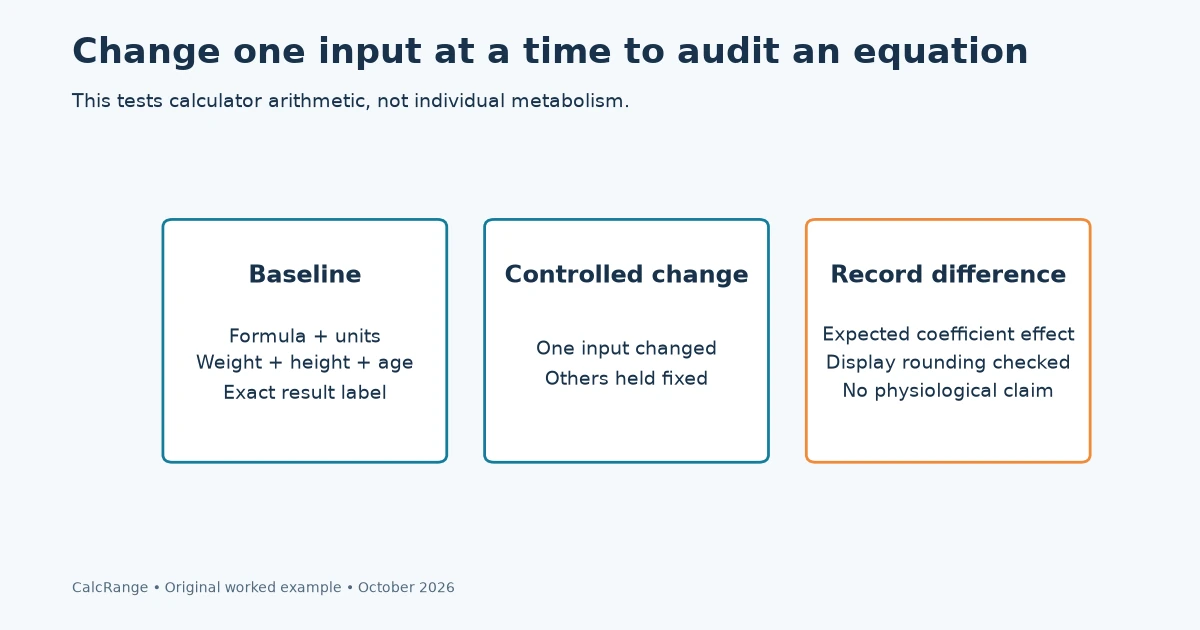
A reproducible comparison needs a baseline row and one changed-input row. Save the equation name, units, age, height, weight, sex-specific constant and the exact result label. Keep activity and goal outputs in different columns.
If weight rises by 5 kg while the recorded age also advances by one year, the predicted difference is 45 kcal/day rather than 50. If a height typo is corrected by 2 cm at the same time, another 12.5 kcal/day enters the difference. Several valid changes can therefore look like a faulty weight coefficient.
For troubleshooting, restore the baseline and change one field at a time. Compare each difference with the relevant coefficient, then put the corrected inputs back together. This isolates the calculation without implying that those inputs independently control physiology in exactly the same way.
Save a note such as “formula changed from 1,648.75 to 1,698.75 because entered weight changed from 70 to 75 kg; all other fields fixed.” Avoid “my metabolism increased by 50” unless that conclusion is supported by appropriate measurement.
If the goal is a personal nutrition decision rather than a software check, stop at the estimate’s boundary. The ledger can explain how the calculator obtained a number, but it does not supply the individual assessment needed to turn it into a plan.
BMR change: common questions
Does losing 1 kg reduce my real metabolism by exactly 10 calories?
No. It reduces this equation’s prediction by 10 kcal/day when all other inputs stay fixed. An individual’s measured response is a different question.
Does the same coefficient apply to pounds?
No. The coefficient is per kilogram. Convert the weight change to kilograms first; 1 pound is approximately 0.4536 kg.
Why did my result change by more than expected?
Check the formula, units, age, height and whether you compared resting expenditure with an activity-adjusted or goal-adjusted result.
Sources and calculation notes
Sensitivity tables and arithmetic are original calculations from the simplified equation. They are not a measured metabolic study, calorie prescription or validation for every population. Sources checked October 30, 2026.