
Calendar days and 24-hour periods count different things. A calendar-day difference compares date labels. A 24-hour period measures elapsed time. They often agree, but a change in the local clock’s UTC offset can make one local date-to-date interval last 23 or 25 hours.
Use the date difference calculator when your inputs are dates. If the task depends on actual hours, record both timestamps and their time zone as well. Do not silently multiply a date count by 24 and assume it describes a shift, flight or timed deadline.
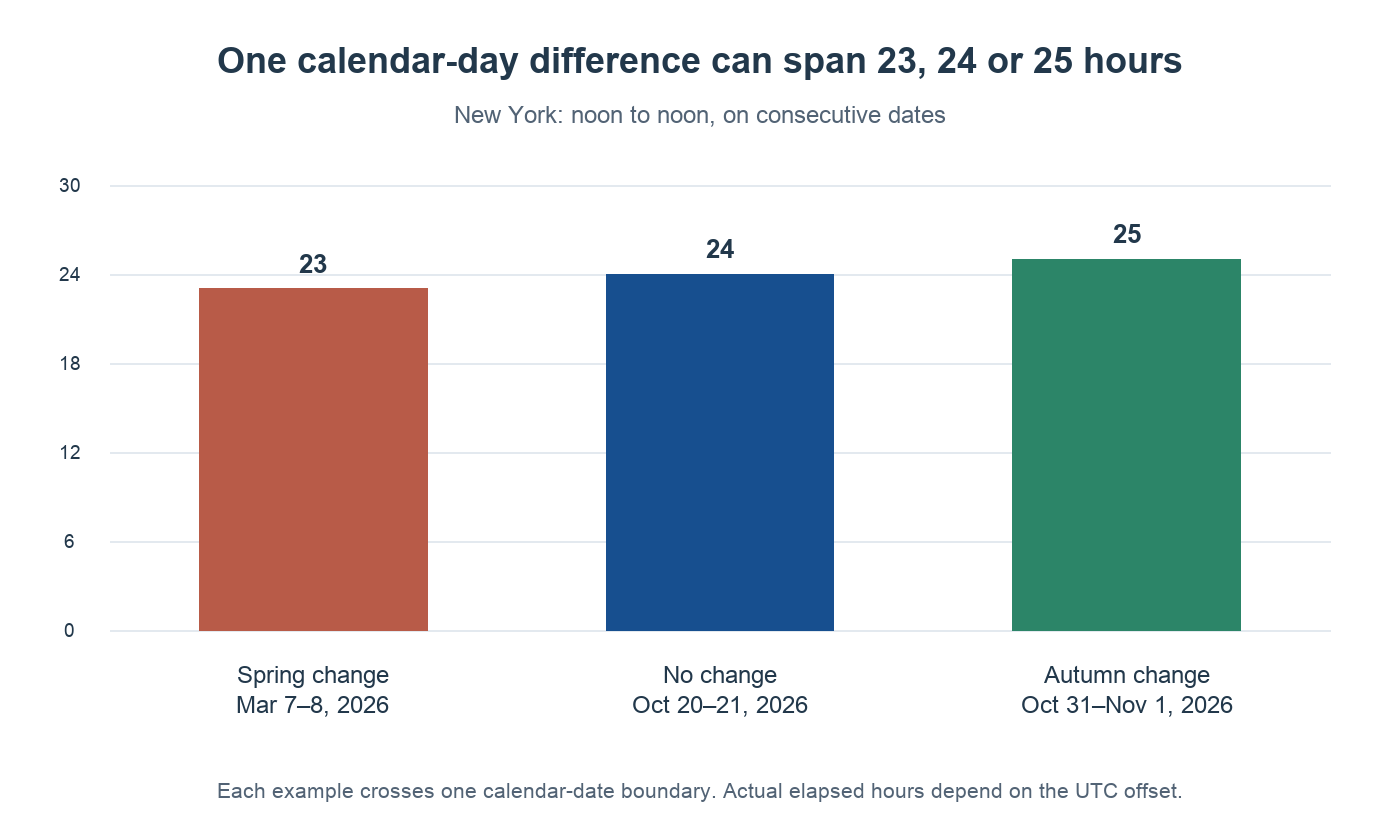
Table of Contents
Calendar days and elapsed hours: three definitions
Calendar-day difference: the difference between two dates in a selected calendar. October 30 to October 31 is a difference of one day, regardless of which clock times you might later attach to them.
Elapsed hours: the duration between two actual instants. Specify a date, time and zone or UTC offset for each endpoint. Subtracting their UTC timestamps gives the elapsed duration without confusing a repeated or skipped local hour.
Number of complete 24-hour periods: divide elapsed hours by 24 and count only complete periods if that is the requested definition. For a positive duration of 25 hours, there is one complete 24-hour period plus one hour. The decimal duration is about 1.0417 days; these are two ways to describe the same interval.
“Day” can also mean a business day, billing day or policy-defined period. Those definitions need their own rules. A date calculator does not decide which definition a contract or official process uses.
Calendar days across New York clock changes
New York’s 2026 spring clock change occurs on March 8, and its autumn change occurs on November 1. The NIST daylight-saving page documents the U.S. transition schedule and the skipped or repeated hour. The examples below use local noon to avoid an ambiguous or nonexistent endpoint.
| New York local interval | Calendar-day difference | Elapsed hours | Complete 24-hour periods |
|---|---|---|---|
| March 7, 2026 noon → March 8 noon | 1 | 23 | 0, plus 23 hours |
| October 20, 2026 noon → October 21 noon | 1 | 24 | 1 |
| October 31, 2026 noon → November 1 noon | 1 | 25 | 1, plus 1 hour |
For the spring interval, March 7 noon is 17:00 UTC because the offset is UTC−5. March 8 noon is 16:00 UTC because the offset is UTC−4. The UTC difference is 23 hours.
For the autumn interval, October 31 noon is 16:00 UTC, while November 1 noon is 17:00 UTC. The difference is 25 hours. The calendar has still advanced from one date to the next.
These are specific examples, not a rule that every location changes by one hour twice a year. Some places do not observe daylight saving, and time-zone rules can change. Use a named zone and the correct year rather than applying today’s offset to every date. The IANA Time Zone Database maintains historical and updated zone data used by many systems.
Inclusive calendar days are a separate choice
Suppose a project covers October 30, October 31 and November 1. The difference between its first and last dates is two calendar days, but it touches three labelled dates when both endpoints are included.
Exclusive difference: November 1 − October 30 = 2 days
Inclusive forward count: 2 + 1 = 3 dates
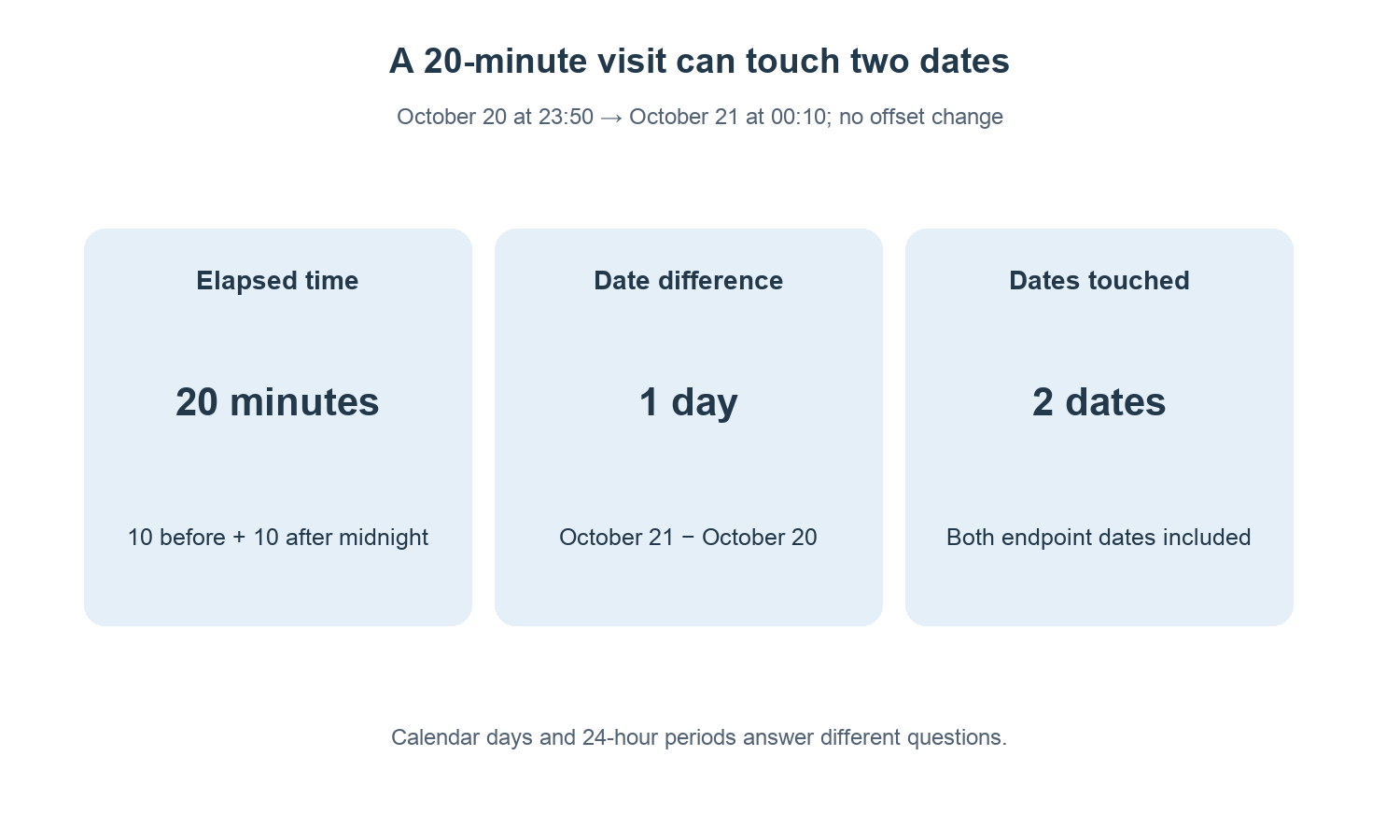
That extra one does not add 24 hours to a timestamp interval. It changes a counting convention. A same-date visit can touch one calendar date while lasting only 45 minutes. Conversely, a short visit across midnight touches two dates even if it lasts only 20 minutes.
For more examples of endpoint rules, see inclusive vs exclusive date counting. Keep the endpoint rule separate from time-zone calculations so you do not fix one discrepancy by introducing another.
A calendar days worksheet that prevents mixed definitions
- Write the question. Is it a number of date boundaries, dates included, elapsed hours or complete 24-hour periods?
- Record complete inputs. Dates are sufficient for a date count. Hours require clock times and zones.
- Check endpoint validity. A local time within a spring gap may not exist; an autumn repeated time needs its intended offset.
- Calculate in the right model. Use date arithmetic for calendar labels and timestamp arithmetic for elapsed duration.
- State the remainder. If you report complete periods, include leftover hours rather than discarding them without explanation.
For cross-city events, the time zone converter can help identify local and UTC times. Copy the date as well as the hour, because conversion can move an endpoint to the previous or following date.
What to enter in the date calculator
The date difference tool accepts start and end dates. Its option to include both dates affects the calendar-day count; it should not be interpreted as adding a day to an elapsed timestamp duration.
For the spring example, entering March 7 and March 8 answers the date-only question: the dates differ by one. The date fields do not capture “New York at noon,” so they cannot establish the 23-hour duration used in the separate timestamp example.
Similarly, a displayed hours-equivalent derived from date-only values is a mathematical conversion of the date count. It is not evidence about a real journey or work shift until its actual time and zone information are included.
Twenty minutes can touch two calendar dates
Consider a short visit from 23:50 on October 20 to 00:10 on October 21 in a location with no offset change during the visit. Ten minutes occur before midnight and ten afterward, so the elapsed duration is twenty minutes.
The calendar days differ by one date label, and the visit touches two dates if you count both endpoints’ dates. It contains zero complete 24-hour periods. All three descriptions can be correct when their definitions are stated.
| Quantity | Result | Question answered |
|---|---|---|
| Date-only difference | 1 day | How far apart are the two date labels? |
| Elapsed duration | 20 minutes | How much time passed between the instants? |
| Included calendar dates | 2 dates | Which dated calendar boxes were touched? |
This example explains why counting accommodation nights, recording attendance dates and measuring a stopwatch interval can produce different totals. Choose the measure relevant to the task rather than trying to make every total agree.
Check elapsed time by accounting for offset changes
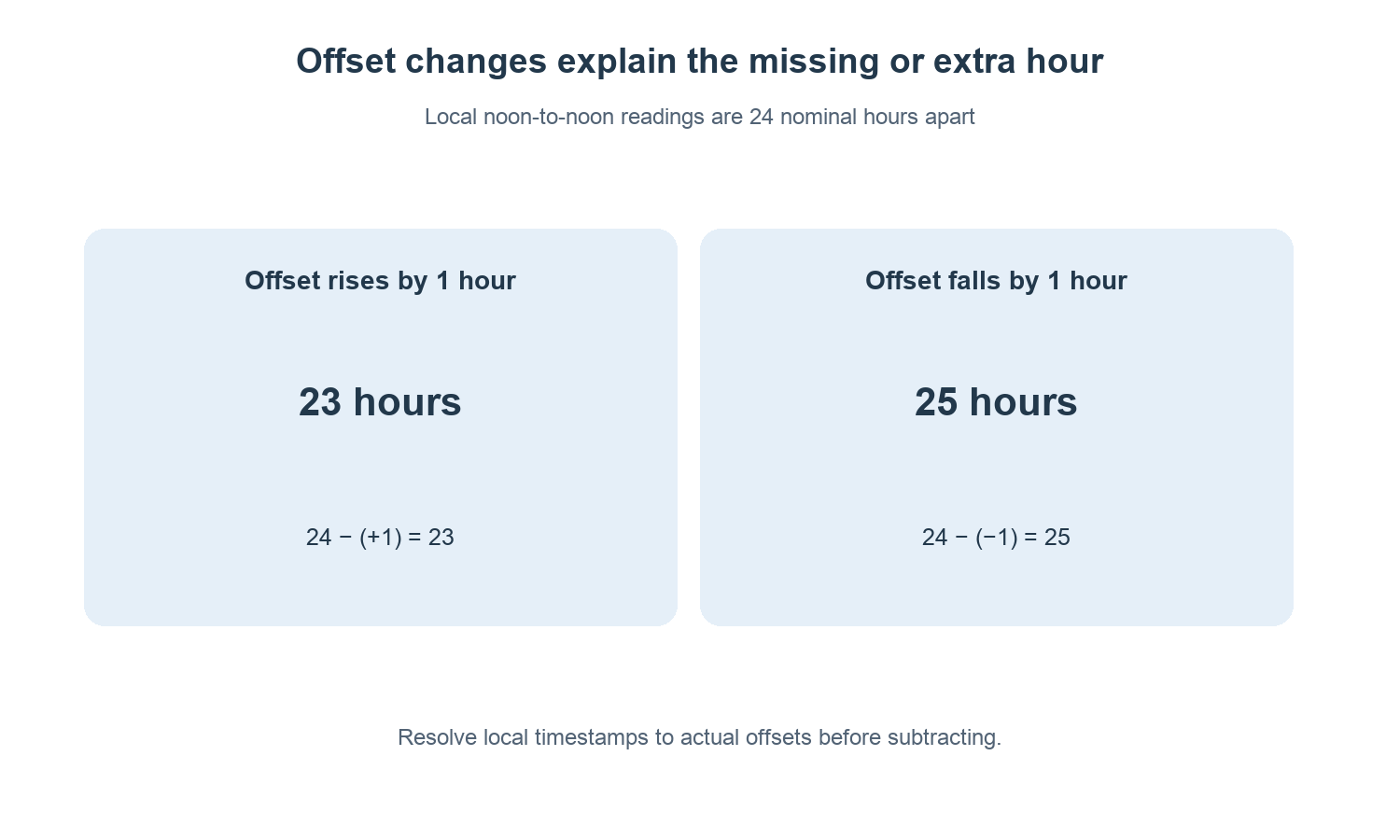
For two fully specified local timestamps, elapsed time equals the difference in local clock readings minus the change in UTC offset. This is a useful check when the offsets are known and the local readings have been resolved to unambiguous instants.
In the New York spring example, the local readings are 24 nominal hours apart. The offset increases from −5 to −4 hours, a change of +1 hour. Subtracting that offset change gives 24 − 1 = 23 elapsed hours.
In the autumn example, the offset changes from −4 to −5, a change of −1 hour. The calculation is 24 − (−1) = 25 elapsed hours. Keeping the minus sign in the second expression prevents a common mistaken second subtraction.
Converting both endpoints to UTC is usually clearer than doing signed-offset arithmetic by hand. Do not use this shortcut with an unresolved repeated local time; the intended offset must be known first.
Different cities can show different dates at the same instant
A dated timestamp of 2027-01-01 00:00 UTC and a timestamp of 2026-12-31 19:00 at UTC−05:00 describe the same instant. Subtracting only their visible date labels would suggest a one-day difference, even though zero time separates them.
The example uses explicit offsets, so it does not need an assumption about which city is using that offset. It illustrates why a travel or meeting worksheet should preserve the zone information instead of stripping every timestamp down to a date.
State how you turn hours into days
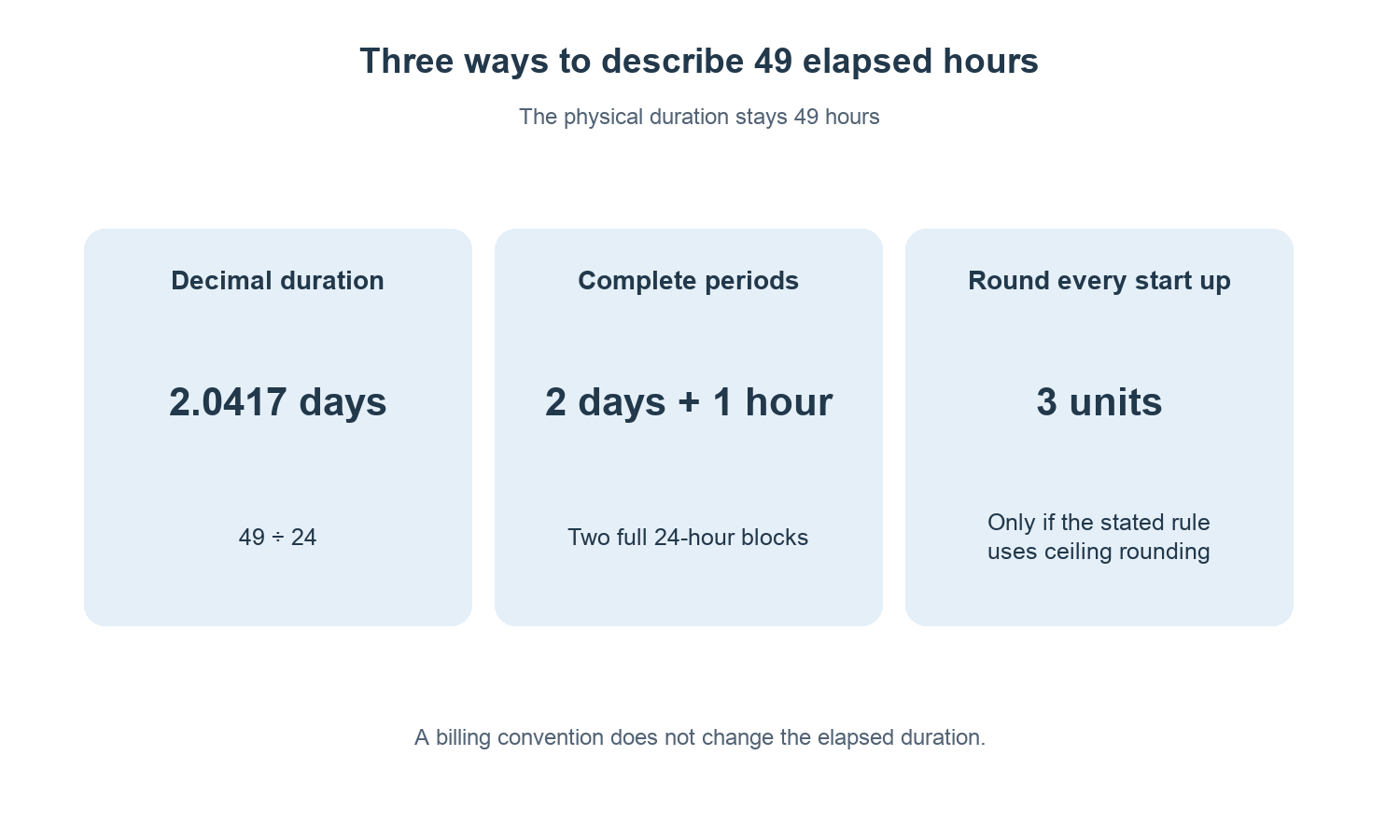
For a duration of 49 hours, division by 24 gives about 2.0417 decimal days. Counting completed periods gives two days plus one hour. Rounding upward gives three units for a system that explicitly charges for every started 24-hour period.
The last result is a billing convention, not a new physical duration. A calculator can implement floor, nearest or ceiling arithmetic, but the applicable contract or policy determines which convention is relevant. Keep the unrounded 49-hour value in the record so the chosen transformation can be audited.
For negative intervals, first decide whether you want a signed difference or the magnitude of the duration. “One day before” and “one day apart” carry different meanings. Reversing the inputs should not silently erase that distinction.
Common questions
Does daylight saving change the number of calendar dates?
No. It changes the relationship between local clock readings and elapsed time. March 7 and March 8 remain adjacent dates.
Is a 48-hour deadline the same as two calendar days?
Not automatically. Around a clock change, the same local time two dates later may be 47 or 49 elapsed hours away. A deadline also may have specific legal or business rules, so use the issuer’s definition.
Can I round 23 hours up to one day?
You can describe it as approximately a day if approximation is suitable, but it contains zero complete 24-hour periods. Label the rounding and avoid it where exact timing matters.
Define calendar days and elapsed duration first, then use the date calculator for the calendar portion of the problem.
Pingback: Overnight Shift Hours: 4 Simple Time Checks