 Skip to content
A BMR calculator estimates energy used at rest from a formula. It does not measure your oxygen use or heat production. Two tools can perform their arithmetic correctly and still return different estimates because they use different equations or input assumptions.
The BMR Calculator lets you explore resting-energy estimates. When comparing outputs, write down the equation name, units and inputs; otherwise, the comparison may mix several differences at once.
Prediction is different from measurement
The Mifflin–St Jeor equation was developed to predict resting energy expenditure. Its original study used measured expenditure from 498 adults to derive relationships involving weight, height, age and sex. An equation summarizes patterns in a group; it does not capture every individual’s physiology.
Many tools label this estimate “BMR,” although the original equation predicts resting expenditure. For the measurement distinction, see our BMR versus RMR guide. Here, the practical task is checking why predicted numbers differ.
A calculation you can reproduce
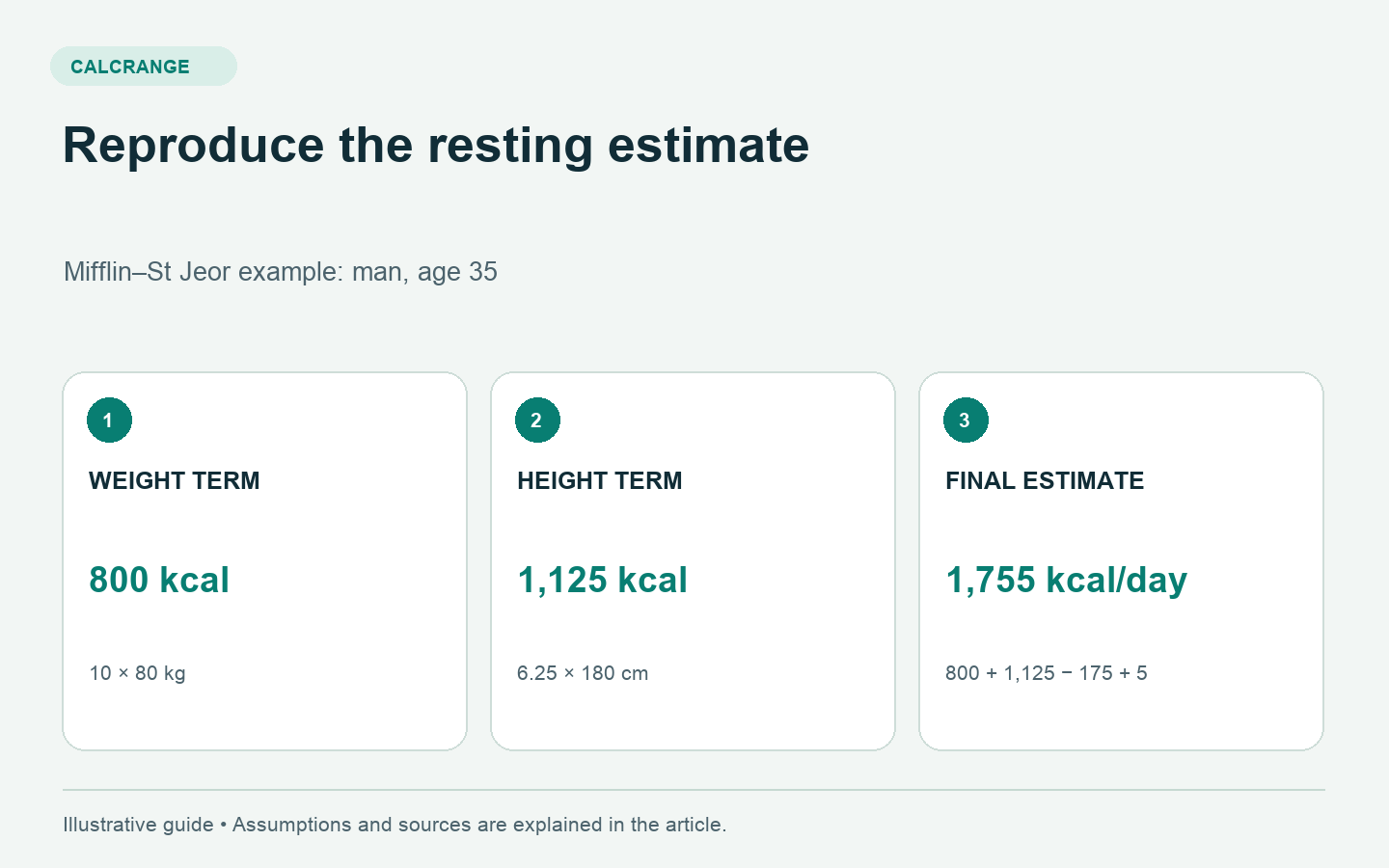
For the male version of the simplified Mifflin–St Jeor equation:
Estimated kcal/day = 10 × weight in kg + 6.25 × height in cm − 5 × age in years + 5.
For an illustrative 35-year-old man weighing 80 kg at 180 cm, the result is 800 + 1,125 − 175 + 5 = 1,755 kcal/day. This is a formula output, not a measured metabolism or a recommended food intake.
Change one input at a time
| Change from the example | Effect in this equation | New estimate |
|---|---|---|
| Weight 80 to 78 kg | −20 kcal/day | 1,735 |
| Height 180 to 178 cm | −12.5 kcal/day | 1,742.5 |
| Age 35 to 36 years | −5 kcal/day | 1,750 |
Each row changes only one input. This makes a useful diagnostic check: a large unexplained gap between calculators may indicate different equations, a unit mismatch or an added activity multiplier, rather than a one-year age difference.
The equation’s separate female form uses a different constant, so the selected input matters too. Choose inputs that match the model’s instructions; a clinician can advise when the model’s categories do not adequately describe the individual’s situation.
What does “within 10%” mean?
A systematic review of common prediction equations found Mifflin–St Jeor comparatively reliable in the adult groups studied, while emphasizing meaningful individual error. That finding is not a guarantee that every person’s prediction falls within 10%.
For arithmetic context, 10% of 1,755 is 175.5. Values 10% below and above the example are 1,579.5 and 1,930.5 kcal/day. This is an illustration of a percentage difference, not a validated personal confidence interval. A calculator has not measured enough information to create one.
Compare like with like
A resting estimate of 1,755 multiplied by an assumed activity factor of 1.4 becomes 2,457. Comparing that daily-total estimate with an unmultiplied resting value would create a 702-calorie gap without any disagreement in the resting formula.
Record whether each output is resting energy or total daily expenditure. Also note which formula is selected, whether body-fat information is used and how results are rounded. Do not average unrelated outputs simply because an average looks reassuring.
When a more individual assessment matters
NIDDK describes metabolic carts that assess expenditure through respiratory measurements. A clinician or registered dietitian can advise whether measurement would help when accurate nutrition planning matters. Illness, pregnancy and specialized athletic needs require more than a generic calculator. Never treat a resting estimate as a universal minimum, maximum or weight-loss prescription.
Sources and method
Sources checked September 18, 2026. Numerical examples are illustrative calculations, not patient or animal records.