 Skip to content
Body fat percentage describes a proportion; fat mass describes an amount. A person weighing 60 kg at 25% body fat has an estimated 15 kg of fat, while a person weighing 80 kg at the same percentage has 20 kg. The percentage is identical, but the amounts differ.
The Body Fat Calculator produces an estimate from body measurements. Once you have a percentage, the conversion below can help interpret it. The conversion cannot make the underlying estimate more accurate.
The two calculations
Estimated fat mass = body weight × body fat percentage ÷ 100.
Estimated fat-free mass = body weight − estimated fat mass.
Use the same mass unit throughout. Kilograms produce kilograms; pounds produce pounds. The percentage itself has no mass unit. Typing 25 rather than 0.25 into a formula that expects a decimal proportion creates an answer 100 times too large.
Worked example: 80 kg at 25%
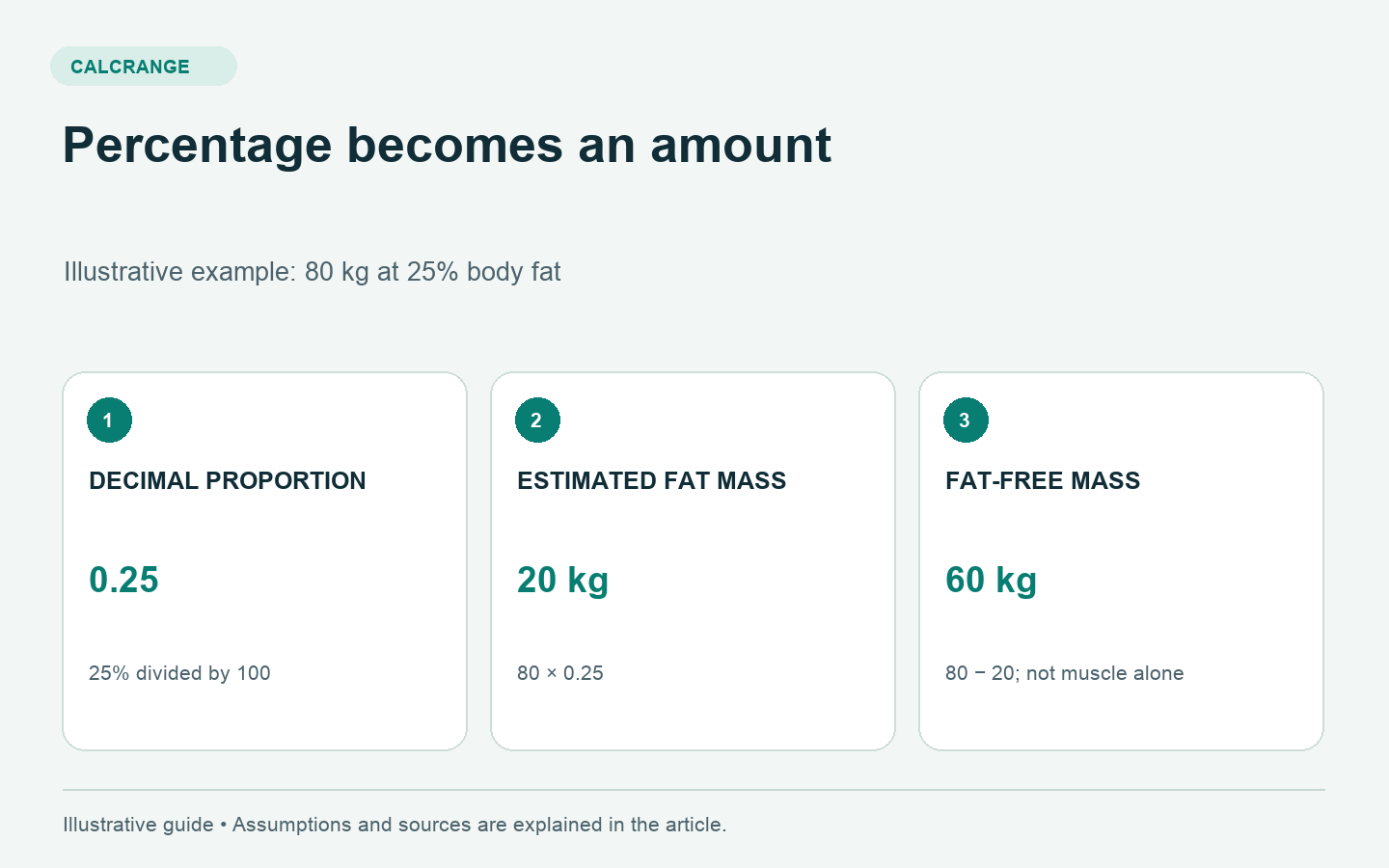
Convert 25% to 0.25, then multiply: 80 × 0.25 = 20 kg of estimated fat mass. Subtract from total weight: 80 − 20 = 60 kg of estimated fat-free mass. Check that the two components add back to the original 80 kg.
| Quantity | Calculation | Result |
|---|---|---|
| Fat proportion | 25 ÷ 100 | 0.25 |
| Fat mass | 80 kg × 0.25 | 20 kg |
| Fat-free mass | 80 kg − 20 kg | 60 kg |
Fat-free mass should not be relabeled “muscle.” NIDDK’s body-composition overview explains that the body includes bone, organs, water and muscle as well as fat. A two-part calculation does not isolate skeletal muscle.
Why a lower percentage does not tell the whole story
Compare two illustrative records: 80 kg at 25%, and 76 kg at 24%. The first implies 20 kg of fat and 60 kg fat-free mass. The second implies 18.24 kg of fat and 57.76 kg fat-free mass.
The total change is −4 kg. Within this mathematical model, estimated fat changed by −1.76 kg and estimated fat-free mass by −2.24 kg. You cannot conclude that 2.24 kg of muscle was lost. The input percentages may contain error, and fat-free mass includes more than muscle.
Also distinguish percentage points from relative change. Moving from 25% to 24% is a one-percentage-point drop. Relative to 25%, it is a 4% reduction in the percentage value. Neither statement says that exactly 1% or 4% of total body weight was lost as fat.
Check sensitivity before trusting small changes
At a fixed 80 kg, an estimate of 23% implies 18.4 kg of fat; 25% implies 20 kg; 27% implies 21.6 kg. A two-percentage-point input difference shifts the calculated fat mass by 1.6 kg.
This is a sensitivity example, not a claim that every measurement method has a two-point error. It shows why carrying several decimal places into the result can overstate certainty. A precise multiplication of an uncertain percentage remains an uncertain estimate.
Make repeated records comparable
Record weight, percentage, date, method and measurement conditions together. When using a tape-based estimate, follow the same measurement instructions each time. If you switch from a tape calculation to another method, label the change rather than treating every number as directly interchangeable.
For health interpretation, consider the wider picture with a qualified professional. CDC discusses the distinction between BMI and body-composition assessment; neither a BMI number nor a calculated fat mass supplies a complete health assessment. This article demonstrates conversions, not a target body-fat percentage or a recommendation to lose a specific amount of weight.
Sources and method
Sources checked September 18, 2026. Numerical examples are illustrative calculations, not patient or animal records.