 Skip to content
If two BMI calculators give different answers, start by checking the height format and measurement units. BMI follows a simple formula, so inconsistent inputs can create a larger difference than the number of decimal places shown.
Use the BMI Calculator after checking the examples below. This guide is about the arithmetic for adults; the resulting number still needs appropriate health interpretation.
Start with one complete set of units
CDC gives two standard forms: weight in kilograms divided by height in metres squared, or weight in pounds divided by height in inches squared and multiplied by 703. Do not combine the kilograms numerator with an inches denominator.
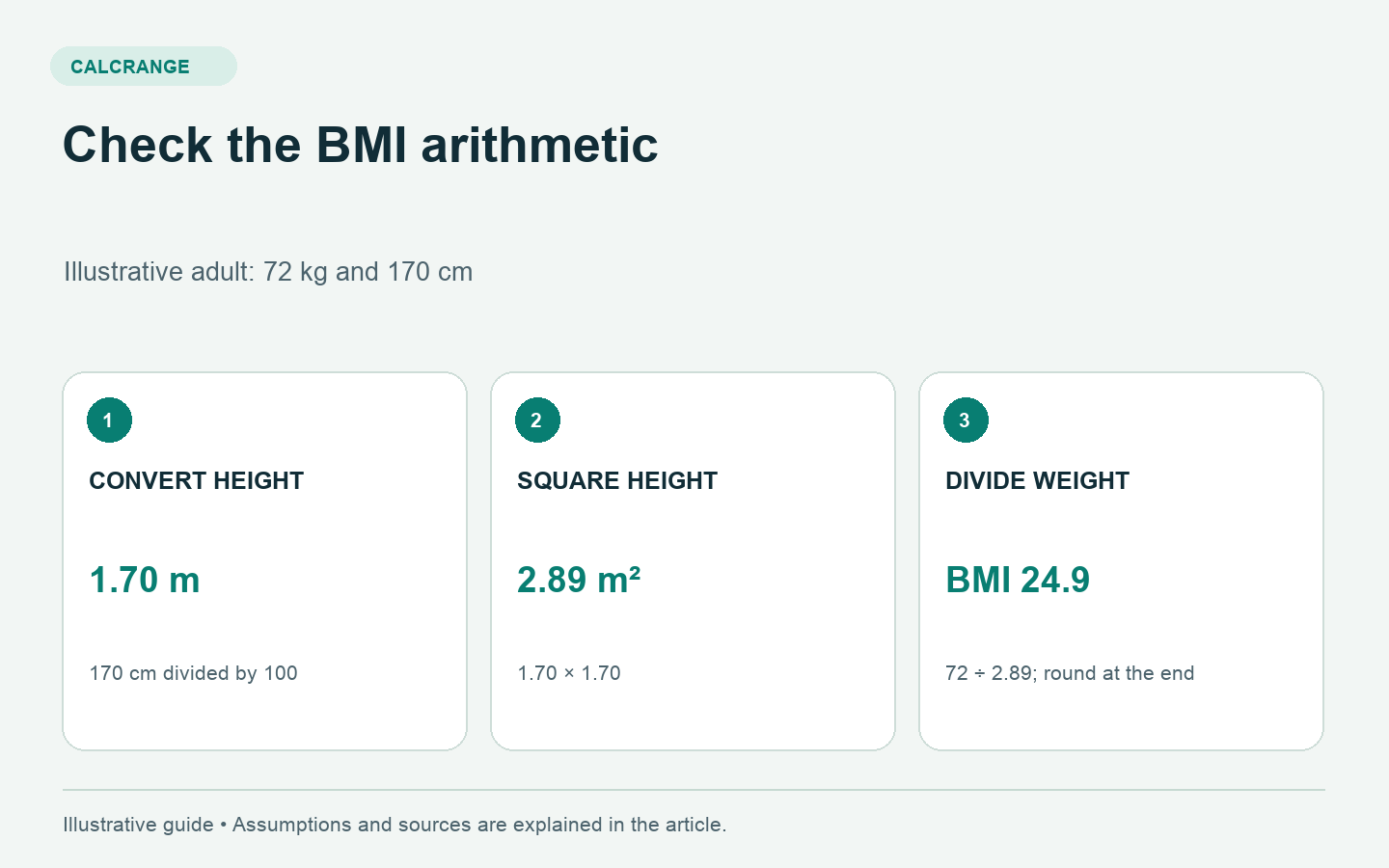
For an illustrative adult weighing 72 kg at 1.70 m, square the height first: 1.70 × 1.70 = 2.89. Then calculate 72 ÷ 2.89 = 24.9135, displayed as 24.9 to one decimal place. The centimetre version uses 72 ÷ 170 ÷ 170 × 10,000 and gives the same result.
Feet and inches are not decimal feet
A height of 5 feet 10 inches is 70 inches because 5 × 12 + 10 = 70. It is approximately 5.833 feet as a decimal. Typing 5.10 into a decimal-feet field instead means 5.1 feet, or 61.2 inches.
Consider a 160 lb example. At 70 inches, BMI is 160 ÷ 70² × 703 = 22.96. At the mistaken 61.2-inch height, it becomes about 30.03. Nothing about the person’s body changed; the entry convention caused the difference.
Use separate feet and inches fields when the calculator provides them. If a tool offers a single decimal-height field, read its unit label rather than assuming a period separates feet from inches.
Why a small height difference changes the answer
| Weight | Height entered | Calculated BMI |
|---|---|---|
| 72 kg | 1.68 m | 25.5 |
| 72 kg | 1.70 m | 24.9 |
| 72 kg | 1.72 m | 24.3 |
The formula squares height, so an input change affects the denominator twice. This table is a sensitivity check, not three different health assessments of one person. If a result is unexpected, recheck the measurement and entered value before drawing conclusions.
Round the result at the end
Keep the full converted height through the calculation, then round the final BMI. For example, converting 5 feet 7 inches gives 170.18 cm. Rounding that to 170 cm for entry creates a small difference; rounding to 1.7 feet would create a major one because the unit changed.
Also distinguish the displayed result from the underlying value. A number close to a category boundary can appear on one side after rounding. Extra decimals do not make a measurement exact. Treat the calculation as a screening result rather than a pass-or-fail score to manipulate through rounding.
A quick check before interpreting BMI
- Confirm that weight is entered in the selected unit.
- Check whether height requires metres, centimetres or separate feet and inches.
- Look for a misplaced decimal, a transposed digit or an old measurement.
- Compare calculators using the same original inputs, not an already rounded output.
- Save the date and units if tracking results over time.
CDC explains that BMI does not directly measure body fat and should be considered alongside other health information. The adult approach is not the interpretation used for growing children and teenagers. A numerically correct answer therefore does not, by itself, establish an individual’s health status.
Sources and method
Sources checked September 18, 2026. Numerical examples are illustrative calculations, not patient or animal records.