 Skip to content
One acre is 43,560 square feet. An acre measures area, so it can describe a square, a long rectangle or an irregular piece of land. It does not tell you the length of each boundary.
The practical way to understand acreage is to separate two questions: how much ground is there, and what shape is it? Use the Area Calculator to calculate a regular shape, then compare its square-foot area with an acre.
How many square feet are in common acre sizes?
Multiply acres by 43,560 to convert to square feet. To convert the other way, divide square feet by 43,560. The conversion is based on the acre relationship documented in NIST’s unit conversion factors.
| Acres | Square feet |
|---|---|
| 0.10 | 4,356 |
| 0.25 | 10,890 |
| 0.50 | 21,780 |
| 1 | 43,560 |
| 2 | 87,120 |
| 5 | 217,800 |
For example, a 100-foot by 120-foot rectangular lot has an area of 12,000 square feet. Dividing 12,000 by 43,560 gives approximately 0.2755 acres. It is a little larger than a quarter acre, rather than one third of an acre.
What are the dimensions of one acre?
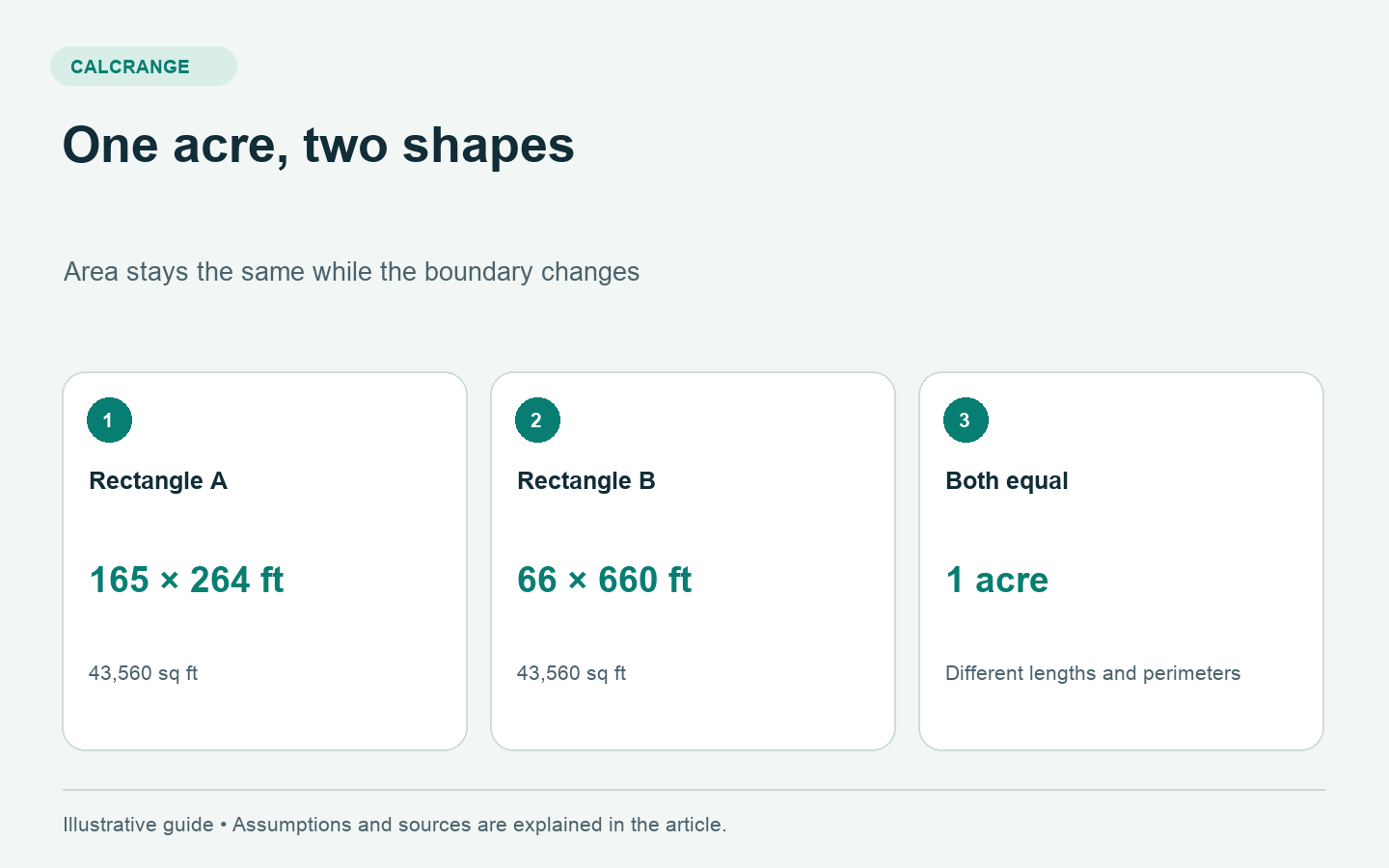
There is no single set of dimensions. A rectangle measuring 165 feet by 264 feet is one acre because 165 × 264 = 43,560. A rectangle measuring 66 feet by 660 feet is also one acre. Both contain the same area, but they would feel quite different when you walked through them.
If the acre is a perfect square, each side is the square root of 43,560: approximately 208.71 feet. This is a rounded dimension. Multiplying 208.71 by itself will therefore produce a small rounding difference rather than exactly 43,560.
Do not use the square’s side length as an assumed boundary for a real property. The actual shape could be narrow, angled, curved or divided by an exclusion.
Why equal acreage can need different amounts of fencing
Area tells you how much ground a shape contains. Perimeter tells you the length around its outside edge. For the two rectangular examples above:
- The 165-by-264-foot acre has a perimeter of 2 × (165 + 264) = 858 feet.
- The 66-by-660-foot acre has a perimeter of 2 × (66 + 660) = 1,452 feet.
The long, narrow rectangle needs 594 more feet around its boundary, even though the area is identical. Gates, existing walls and terrain would also affect an actual fencing estimate. An acreage figure alone cannot tell you the materials required.
How to estimate an irregular area
For a rough garden or layout estimate, draw the outline and divide it into rectangles and triangles that do not overlap. Calculate each area in the same square unit, then add the results. Subtract any excluded patch once. Label every measured dimension so another person can check the method.
A shape made from a 60-by-80-foot rectangle and a right triangle with a 20-foot base and 80-foot height has 4,800 + 800 = 5,600 square feet, or about 0.1286 acres. This example assumes those shapes exactly describe the outline; guessed dimensions will produce a guessed area.
When the number needs more precision
A listing’s rounded acreage is useful for comparison, but purchasing land, locating a boundary or checking development rules calls for the relevant survey and official records. Legacy U.S. survey-foot records can also need careful interpretation; NIST distinguishes them from modern international-foot conversions.
For everyday estimates, keep the units consistent, calculate the square area first and round the final acreage to a useful number of decimal places. Start with the Area Calculator when your measurements describe one of its supported shapes.