
Leap-day birthdays create a small calendar problem: February 29 is not available in most years. They do not change how quickly someone ages. A person born on February 29, 2004 reaches the February–March boundary 21 years later in 2025, although the date used to recognize that anniversary can depend on the purpose.
Use the age calculator to compare a birth date with a chosen date. For a February 29 birth, also check what convention the result uses in a non-leap year. A calendar calculator cannot establish the rule for a licence, benefit, school admission or other legal decision.
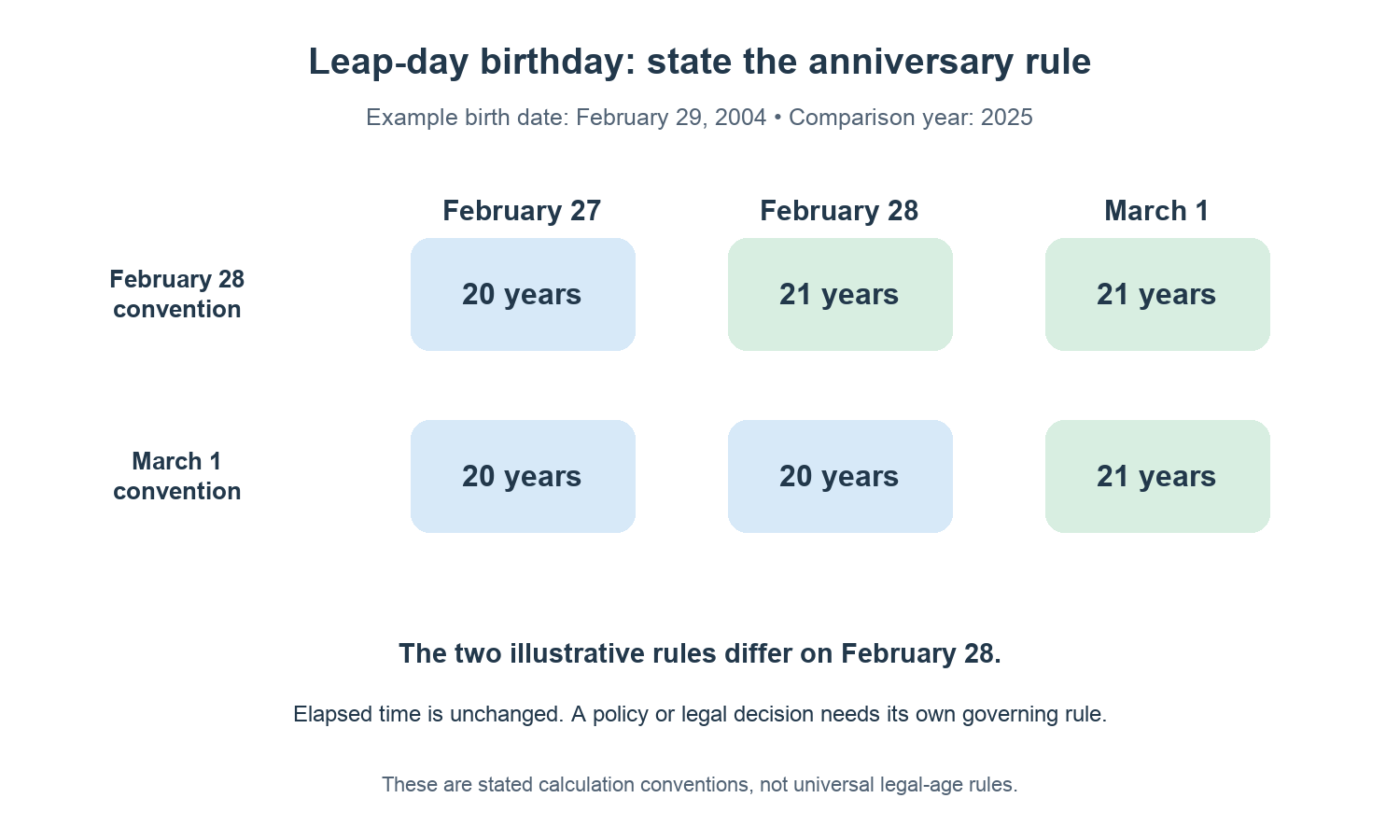
Table of Contents
Leap-day birthdays involve three different questions
How much time has passed? This is a duration question. Two specified dates have a definite calendar-day difference under a specified calendar. If you need hours or minutes, you also need actual times and a time zone.
When do we celebrate? A family might choose February 28 or March 1 in a non-leap year. That is a celebration convention. It does not turn the chosen date into a February 29 entry in a database.
When does a particular age rule take effect? That is a policy or legal question. The relevant authority may define how a February 29 birth is treated. Do not infer its answer from a party date or from the number a general website displays.
Keeping those questions separate makes a disagreement easier to resolve. Two calculators can use different anniversary conventions at the boundary without disagreeing about the person’s recorded birth date.
Leap-day birthdays: a February 29, 2004 example
Consider two explicitly defined arithmetic conventions. Under the first, the non-leap-year anniversary is February 28. Under the second, it is March 1. Neither is presented here as a universal legal rule.
| Comparison date | February 28 convention | March 1 convention |
|---|---|---|
| February 27, 2025 | 20 completed years | 20 completed years |
| February 28, 2025 | 21 completed years | 20 completed years |
| March 1, 2025 | 21 completed years | 21 completed years |
| February 29, 2028 | 24 completed years | 24 completed years |
For leap-day birthdays, the disagreement is concentrated around the missing anniversary date. On March 1, both illustrative conventions have passed their anniversary point. In 2028, the date February 29 exists, so that particular ambiguity disappears.
A worksheet for leap-day birthdays records the birth date, comparison date and selected convention together. Writing only “age 21” hides the assumption that produced the answer. If a form asks for date of birth, enter the actual February 29 date rather than changing it to make the arithmetic easier.
Elapsed-day checks for leap-day birthdays
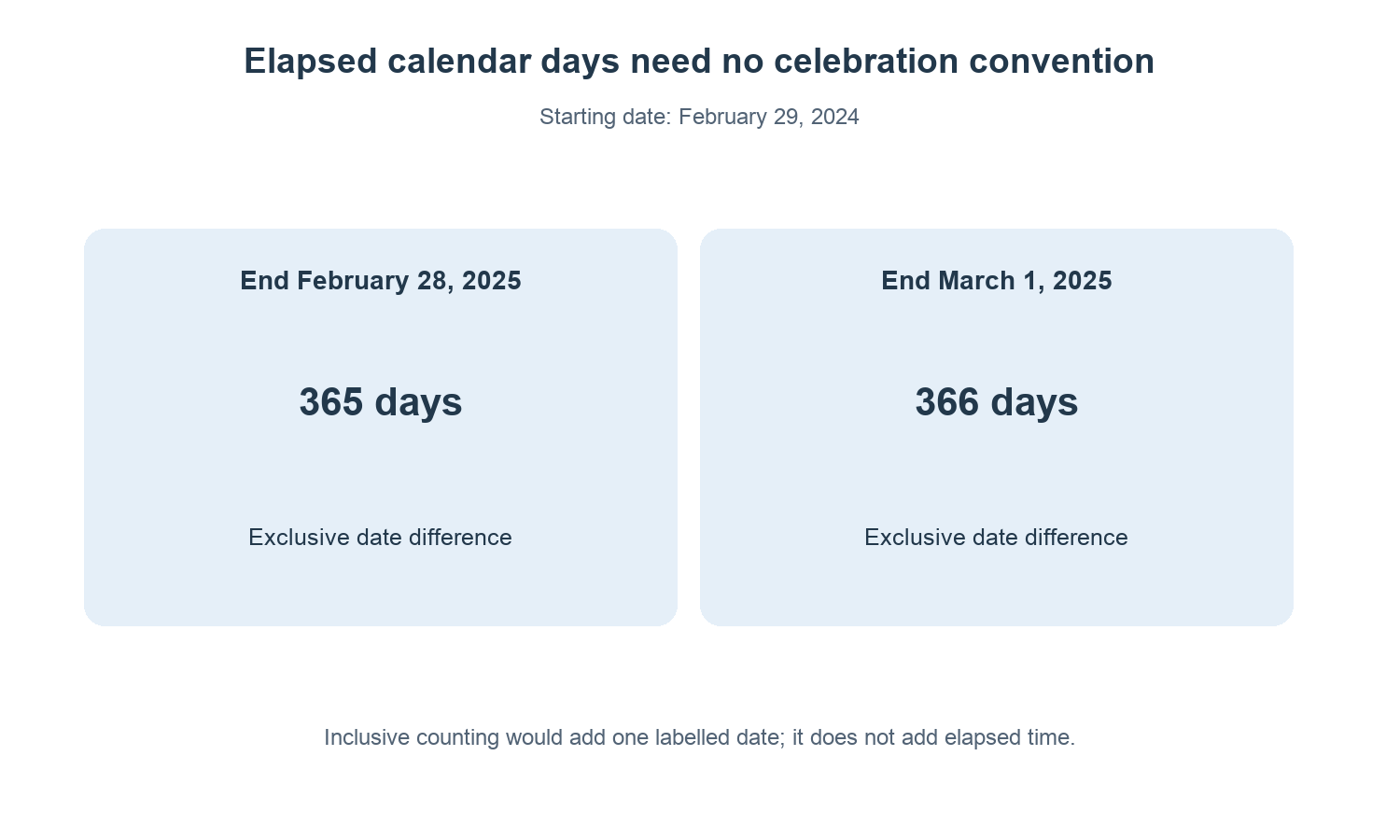
For a date-only example, February 29, 2024 to February 28, 2025 spans 365 elapsed calendar days. Extending the end date to March 1, 2025 makes it 366 days. These differences do not depend on which day someone chooses for a celebration.
Use the date difference calculator for this separate question. Leave inclusive counting off when you want the difference between the dates. Counting every labelled date touched, including both endpoints, adds one to these forward date ranges. That is a different definition of the total, not an additional day of age.
Dividing elapsed days by 365 is not a reliable way to get completed calendar years. The interval can contain leap days, and a birthday anniversary is a calendar boundary rather than a fixed number of identical 365-day blocks. Similarly, dividing by an average year length gives an approximate decimal duration, not a universally valid legal age.
For two children, compare their actual birth dates directly. Subtracting their current whole-number ages can lose nearly a year of detail. Our sibling age-gap guide explains that separate calculation.
Which years actually contain February 29?
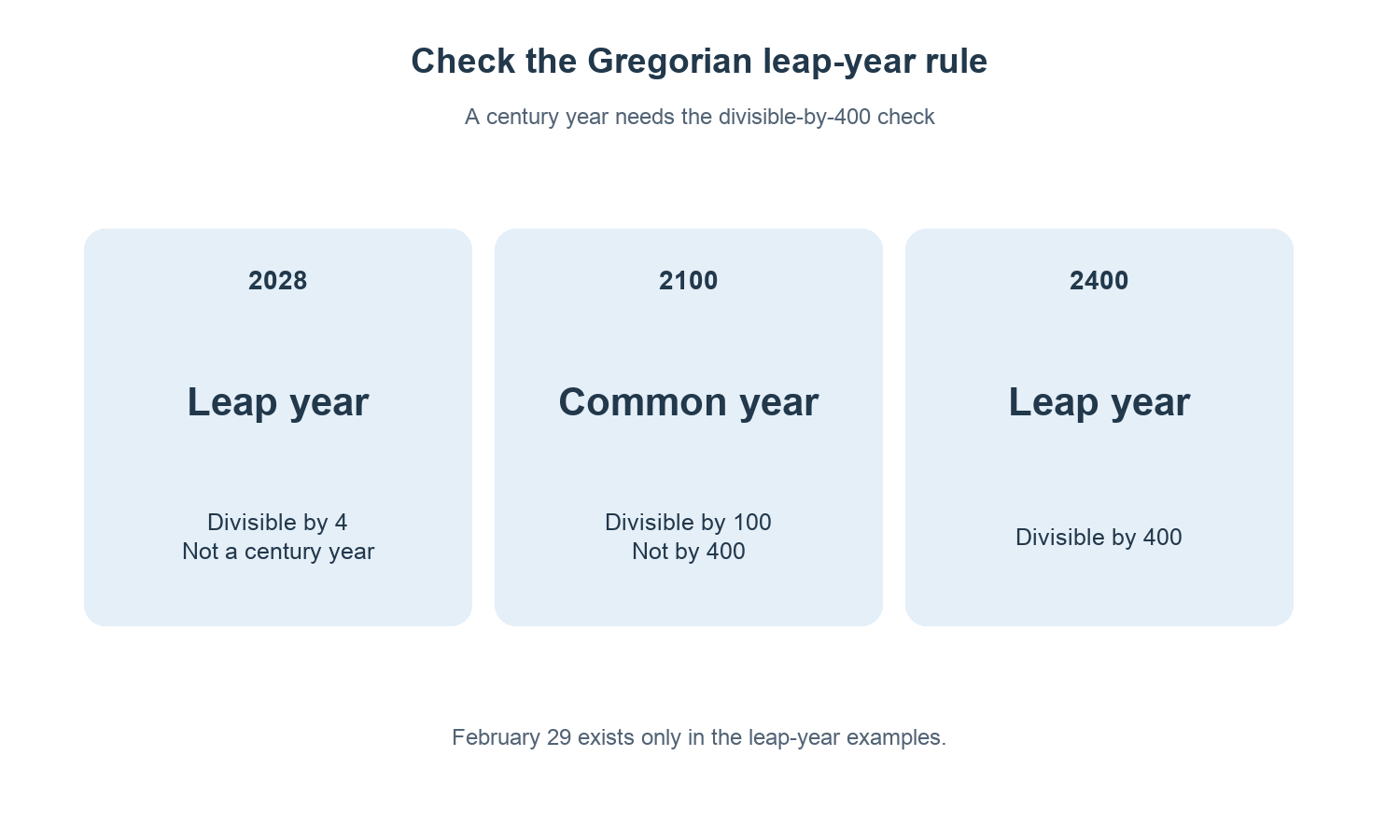
In the Gregorian calendar, a year divisible by four is generally a leap year. Century years are exceptions unless divisible by 400. The U.S. Naval Observatory’s leap-year rule therefore identifies 2000 as a leap year and 2100 as a common year.
| Year | February 29 exists? | Reason |
|---|---|---|
| 2024 | Yes | Divisible by four, not a century year |
| 2025 | No | Not divisible by four |
| 2028 | Yes | Divisible by four, not a century year |
| 2100 | No | Century year not divisible by 400 |
| 2400 | Yes | Divisible by 400 |
The exception matters when creating long-running software or historical timelines. “Every fourth year forever” is an incomplete rule. Very old dates may also require knowing which calendar was used locally; this article’s examples use the Gregorian calendar throughout.
A practical check before relying on an age result
- Confirm the input. The birth year must actually permit February 29.
- Choose the comparison date. Use an explicit date instead of a moving “today” result when documenting a decision.
- Check the boundary. Compare February 27, February 28 and March 1 in the same non-leap year to see how the calculator behaves.
- Record the output’s meaning. Completed years, years–months–days and decimal years are different displays.
- Verify the governing rule. For eligibility or a deadline, use the authority’s current instructions and ask it about a leap-day birth if the wording is unclear.
Count February 29 occurrences separately from age
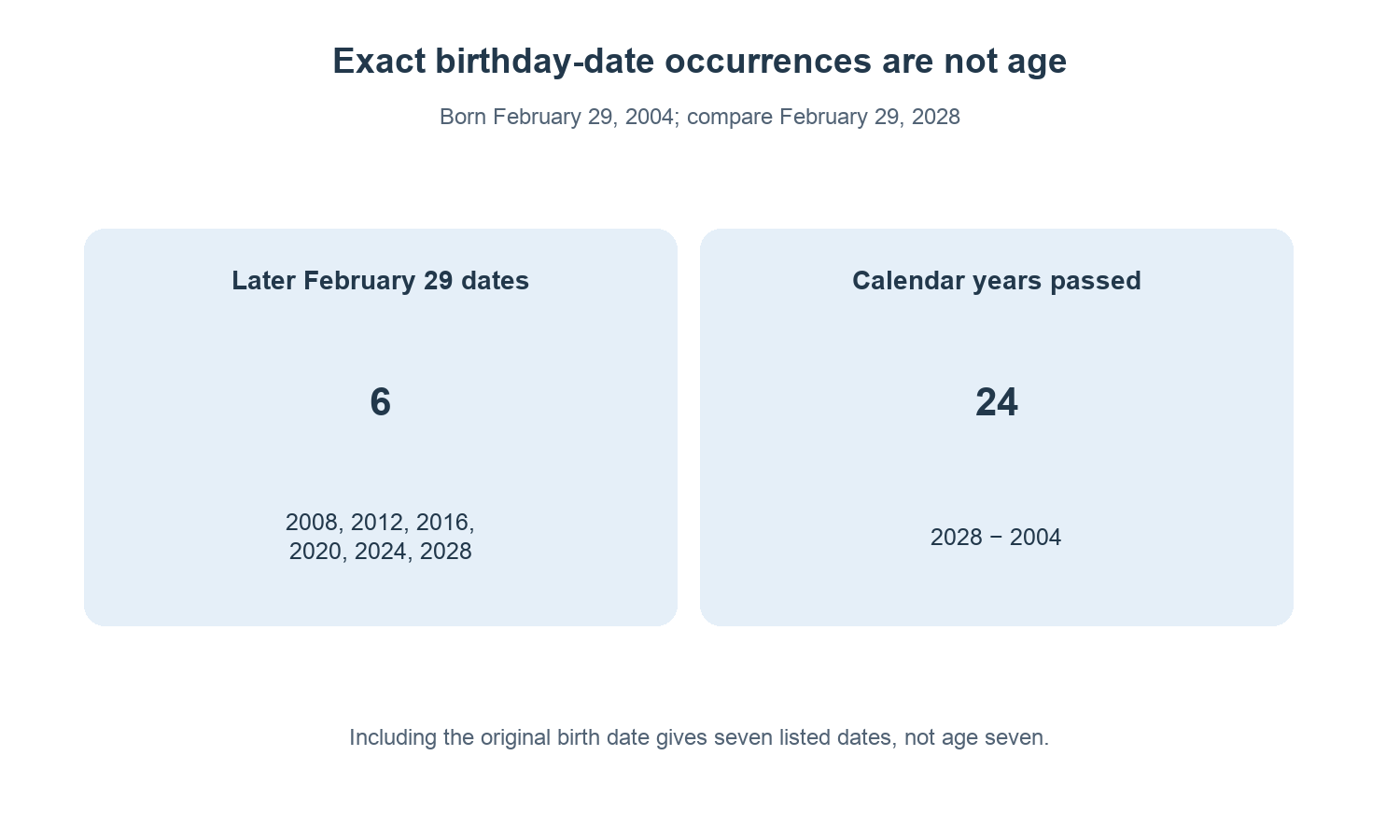
A person born on February 29, 2004 encounters later February 29 dates in 2008, 2012, 2016, 2020, 2024 and 2028. By February 29, 2028, there have been six subsequent occurrences of the exact month-and-day combination, while 24 calendar years have passed.
Including the birth date itself would make seven listed February 29 dates. That is an inclusive count of matching dates, not an age of seven. State whether the starting occurrence is included whenever you build this kind of birthday calendar.
| Comparison date | Subsequent February 29 occurrences since 2004 | Completed calendar years on that leap date |
|---|---|---|
| February 29, 2008 | 1 | 4 |
| February 29, 2016 | 3 | 12 |
| February 29, 2028 | 6 | 24 |
This is a useful way to explain the familiar “sixth birthday at age 24” joke without confusing a child or a form entry. The joke counts exact date occurrences. The age calculation counts calendar years under its stated anniversary convention.
Test leap-day birthdays across three boundary dates
When comparing calculators for leap-day birthdays, do not test only an ordinary date in July. A July result may agree under both conventions and reveal nothing about how the missing anniversary is handled.
Use one valid birth date and compare February 27, February 28 and March 1 of the same non-leap year. Save the completed-year result for each. A change on February 28 indicates one arithmetic convention; a change on March 1 indicates another. If the tool produces a different pattern, examine its documentation and date interpretation before using it.
Do not mistake this test for a legal validation. It establishes software behaviour with those inputs. A rule governing a particular eligibility decision may define a different effective moment, including how the date or time of birth is treated.
Date-only age does not identify an exact birth instant
A birth date without a time cannot establish an age to the minute. Someone born at 18:00 and someone born at 06:00 on the same calendar date share a date-only input but differ by twelve hours in elapsed time.
If an application displays seconds from date-only inputs, it has introduced a time-of-day assumption. The additional digits do not mean the missing birth time was discovered. Use the birth time and appropriate zone only when that level of precision is relevant and documented.
For personal celebrations of leap-day birthdays, a date-only anniversary may be entirely sufficient. For a historical timeline, precise duration or official process, identify the required convention first rather than adding apparent precision after the calculation.
A short record for leap-day birthdays
Write four fields together: recorded birth date, comparison date, purpose and anniversary convention. A fifth field can identify the source of that convention, such as the organization’s current instructions or the calculator’s documentation.
For example: “Born 2004-02-29; compare 2025-02-28; family calendar; celebrate on February 28.” This accurately describes the chosen calendar plan without claiming that every official age threshold changes on that date.
If the same date is used for another purpose, make a separate record. Keeping the assumptions explicit is more useful than forcing every system to display the same number without checking what its result means.
Common questions
Does someone born on February 29 have a birthday only every four years?
The exact calendar date occurs only in leap years, but the person continues to age every year. Counting occurrences of February 29 is a count of matching dates, not their age.
Should I enter February 28 into a form that rejects February 29?
Do not silently change a recorded birth date. Check that the correct birth year is selected and contact the organization if its form still rejects a valid date.
Why can years, months and days look unusual around the anniversary?
Months have different lengths, and software needs a rule for borrowing days or handling an absent day of the month. Compare the exact input dates and the documented convention before treating a different decomposition as an error.
Start with the two dates in the age calculator, then document the anniversary convention whenever February 28 or March 1 changes the decision.