 Skip to content
The age difference between siblings is the time between their birth dates. For an exact answer, compare the dates themselves rather than subtracting their current ages in whole years. Two children described as 6 and 3 may be separated by anything from a little over two years to almost four years.
Use the CalcRange Age Calculator with the older sibling’s birthday as the birth date and the younger sibling’s birthday as the end date. The result describes how old the older child was when the younger child was born.
A worked example using two birth dates
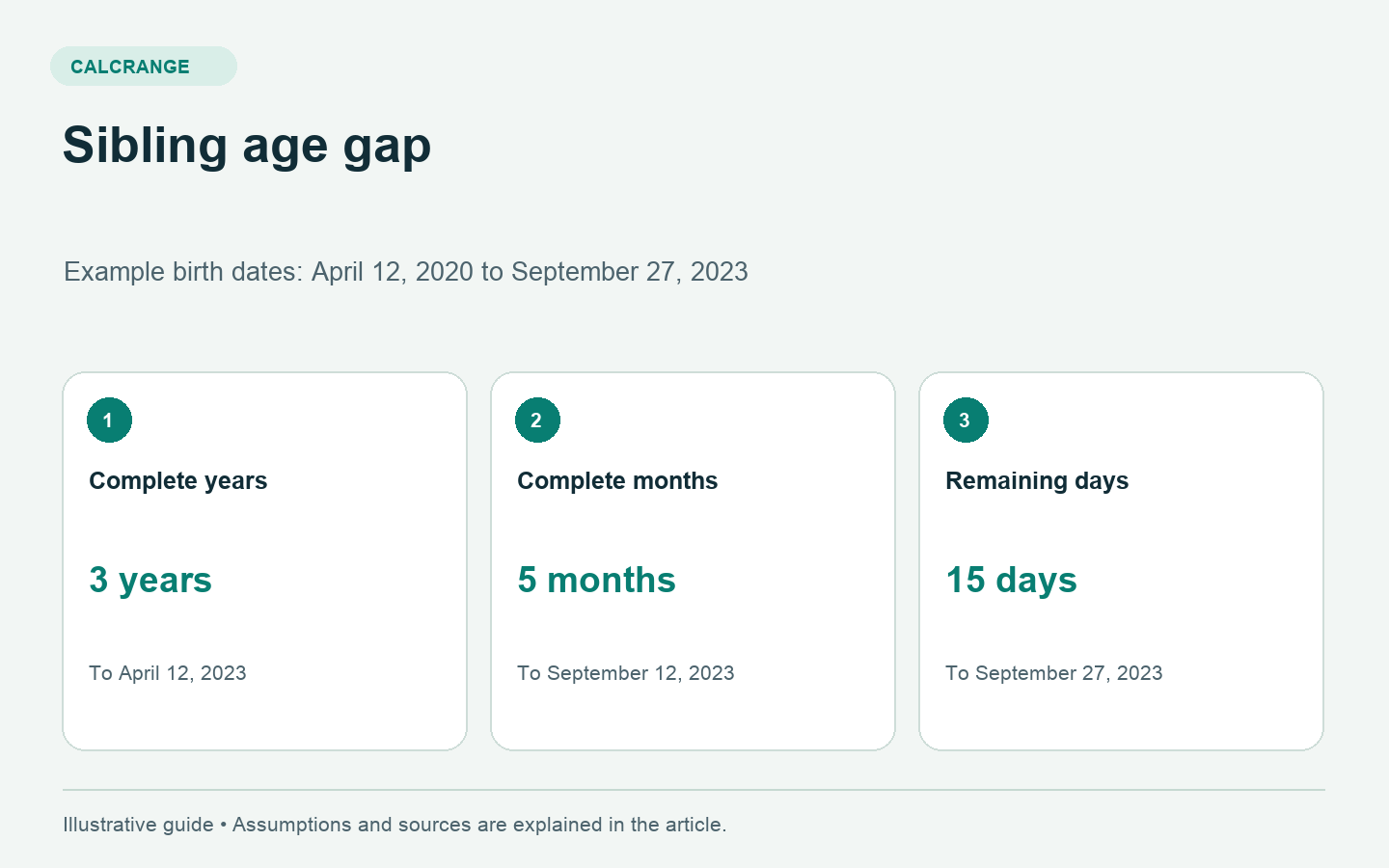
Suppose one sibling was born on April 12, 2020, and the other on September 27, 2023. These dates are an illustrative example, not a family case study.
- Count complete years: April 12, 2020, to April 12, 2023, is 3 years.
- Count complete months: April 12 to September 12 is 5 months.
- Count the remaining days: September 12 to September 27 is 15 days.
The calendar age gap is 3 years, 5 months and 15 days. Counting elapsed calendar days between the same dates gives 1,263 days. These are two ways to describe the same interval; neither requires today’s date.
Why subtracting current ages gives different answers
On January 1, 2026, the older child in this example is 5 and the younger child is 2. Subtracting the rounded ages gives 3. On May 1, the older child has turned 6 while the younger is still 2, so the same shortcut gives 4. Their birth-date gap has not changed.
This is why whole-year ages are useful in conversation but unreliable for documenting an exact gap. A birthday changes a person’s completed-year label. It does not change when either person was born.
Which format should you use?
| Purpose | Useful format |
|---|---|
| A family timeline | Years, months and days |
| A simple conversation | About 3 years and 5 months |
| A spreadsheet comparing intervals | Total elapsed days |
| A form with a specific rule | The format requested on the form |
Do not divide the day total by 365 and treat the decimal result as an exact calendar age. Months have different lengths, and a date interval can cross February 29. The U.S. Naval Observatory’s leap-year explanation sets out the Gregorian calendar rule used to determine those extra days.
How to check your result
Write the dates with the month spelled out before entering them. The numeric date 04/12 can mean April 12 or December 4 depending on the date format. Confirm which date belongs to the older sibling, and make sure the calculator’s end date is the younger sibling’s birthday, rather than the current day.
Then add the displayed complete years and months to the older birth date and check the remaining days. At month ends, different systems can use different borrowing conventions for the months-and-days display. If a formal process specifies a counting convention, use that rule; a total elapsed-day comparison is often easier to reconcile.
Does the same method work for twins or other relatives?
Yes, any two birth dates can be compared. A date-only calculator shows zero days for twins born on the same date even if they were born minutes apart. Measuring that smaller interval needs the actual birth times and, if the births occurred in different places, their time zones.
An age-gap calculation is a calendar comparison. It does not establish a preferred spacing between pregnancies, predict sibling relationships or determine school eligibility. Those are different questions with additional information and, where relevant, professional or institutional guidance.
To calculate your own dates, open the Age Calculator and compare the earlier birth date with the later one.