 Skip to content
Whether zakat is due on money saved for a house requires more than multiplying a bank balance by 2.5%. Published scholarly rulings differ on some savings reserved for basic housing needs. Establish the applicable ruling, ownership, nisab and timing first; then use the Zakat Calculator for the arithmetic.
This article compares specific published guidance and supplies a conditional worksheet. It does not issue a personal fatwa or claim that all scholars give the same answer.
Two published approaches
The Assembly of Muslim Jurists of America answer, dated June 29, 2009, treats savings intended for a house as zakatable when the other conditions of zakat are fulfilled. Under that approach, naming a savings account “house deposit” does not itself remove it from the calculation.
Egypt’s Dar al-Ifta answer, dated February 23, 2015, discusses differing Hanafi reasoning about basic needs and concludes that the specified money for a marital house and marriage expenses is exempt as a basic need. That answer concerns its stated circumstances; it should not be expanded into a blanket exemption for every property investment or savings account.
These positions cannot be collapsed into an unconditional yes or no for every reader. A qualified scholar who understands the facts can help determine which guidance applies consistently to your situation.
What to establish before entering numbers
Record whose money it is, the purpose of the purchase, whether a binding transaction has occurred and what money you still own on the assessment date. Note your zakat anniversary and the nisab basis used. Keep money merely intended for future spending separate from money whose ownership or legal status has already changed.
Islamic Relief’s zakat FAQ distinguishes cash savings from personal-use belongings such as an owned home and discusses the gold and silver nisab measures. The value of a threshold can change with the underlying metal price. Do not reuse an old currency amount without checking its date and methodology.
A conditional worked example
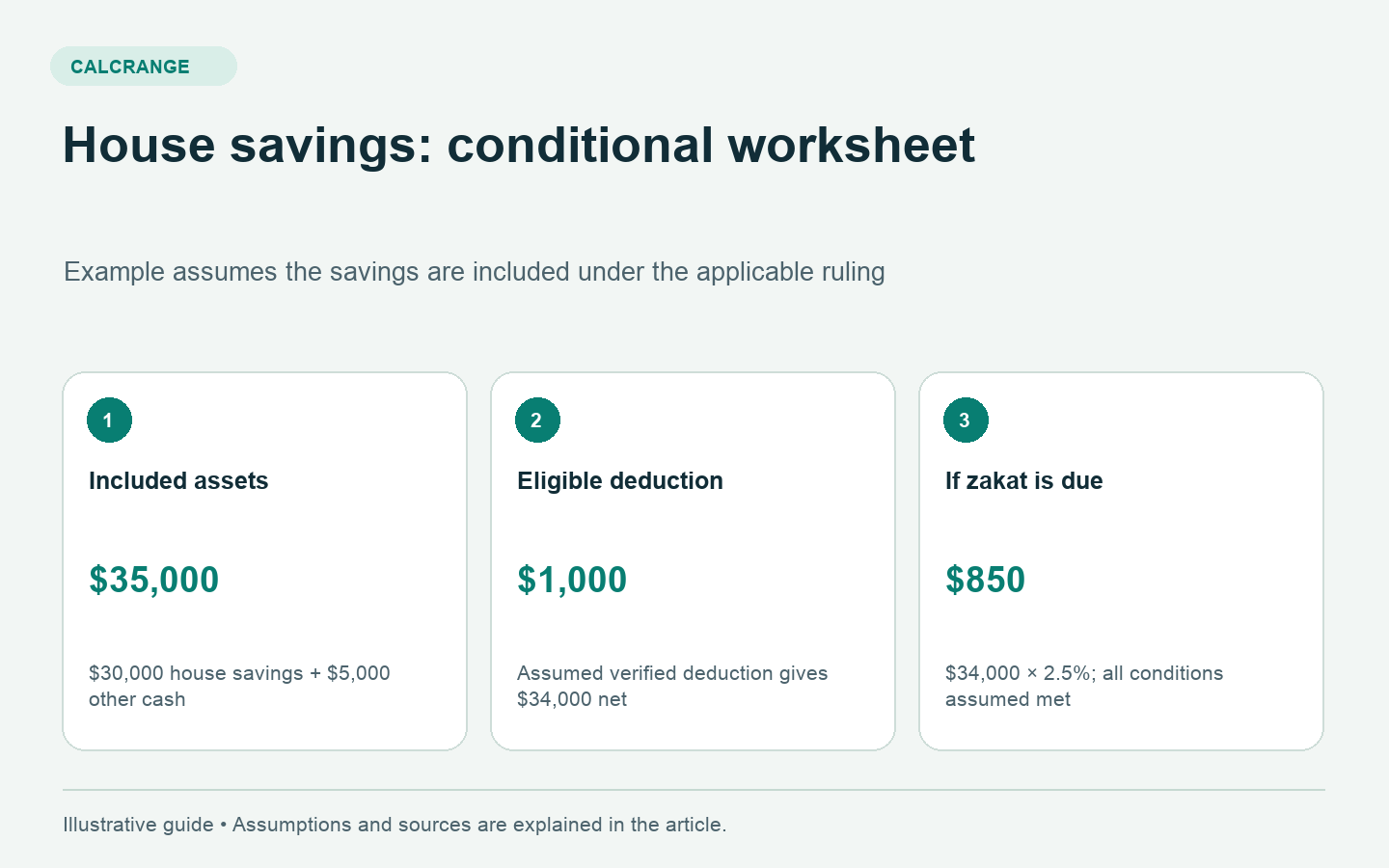
Assume the applicable ruling includes the house savings. Also assume the relevant lunar-year conditions are met, the net zakatable amount exceeds the applicable nisab, and a $1,000 deduction has been confirmed as eligible. These are assumptions for teaching the calculation, not findings about a real person.
| Item | Illustrative amount |
|---|---|
| House savings included under the assumed ruling | $30,000 |
| Other included cash | $5,000 |
| Eligible deduction | −$1,000 |
| Net zakatable amount | $34,000 |
| 2.5% calculation | $850 |
The arithmetic is ($30,000 + $5,000 − $1,000) × 0.025 = $850. Dividing by 40 produces the same result. The percentage is straightforward once the correct asset base has been established.
What if the savings are excluded under the applicable ruling?
Do not simply erase the $850 result and assume no zakat exists. Rebuild the asset list. In the same invented worksheet, removing the $30,000 house fund would leave $5,000 of other included cash before considering any eligible deduction. That remaining amount still needs its own eligibility, threshold and timing assessment.
The example’s $1,000 deduction is not automatically transferable to every alternative calculation. Its eligibility and relationship to the included assets must remain valid. A calculator cannot adjudicate that question.
A worksheet to take to a scholar
List each account, your ownership share, balance on the chosen date, intended use and supporting documents. Add the purchase stage, any amounts already paid, any refund conditions and debts for which you seek guidance. Ask specifically how the house savings, deductions and lunar-year treatment should be handled.
After receiving guidance, label each included and excluded amount with the reason. This creates a calculation that can be repeated next year without guessing which assumptions produced the result. Keep exchange-rate dates consistent when balances are held in different currencies.
Use the calculator after deciding the ruling
Enter the assets and deductions supported by the chosen guidance, confirm the nisab setting and save the result with its assessment date. The tool can check addition and percentages; it cannot establish religious eligibility, verify ownership or replace a contextual ruling. The practical aim is a transparent calculation that follows the guidance applicable to you.
Sources and method
Source links checked September 18, 2026. Examples are original educational calculations using the assumptions stated above.