 Skip to content
Sweat rate estimates how much fluid you lose per hour during a particular exercise session. It uses the change in body mass, adjusts for drinks and urine, then divides by the session duration. It is more specific than assuming every workout requires the same amount of water.
The Water Intake Calculator can help express a chosen fluid goal in cups or bottles. It does not measure sweat loss. Use the calculation below to understand the numbers, then discuss an individual exercise-fluid plan with a qualified professional when needed.
The sweat-rate formula
The National Athletic Trainers’ Association position statement gives an approximate method:
Sweat loss in litres = body mass before in kg − body mass after in kg + drinks in litres − urine in litres.
Sweat rate in litres per hour = estimated sweat loss ÷ exercise time in hours.
The practical approximation treats one kilogram of short-term mass change as about one litre of fluid. Accurate measurements and consistent conditions matter. The estimate is about that session, not a permanent property of your body.
Worked example: a 90-minute session
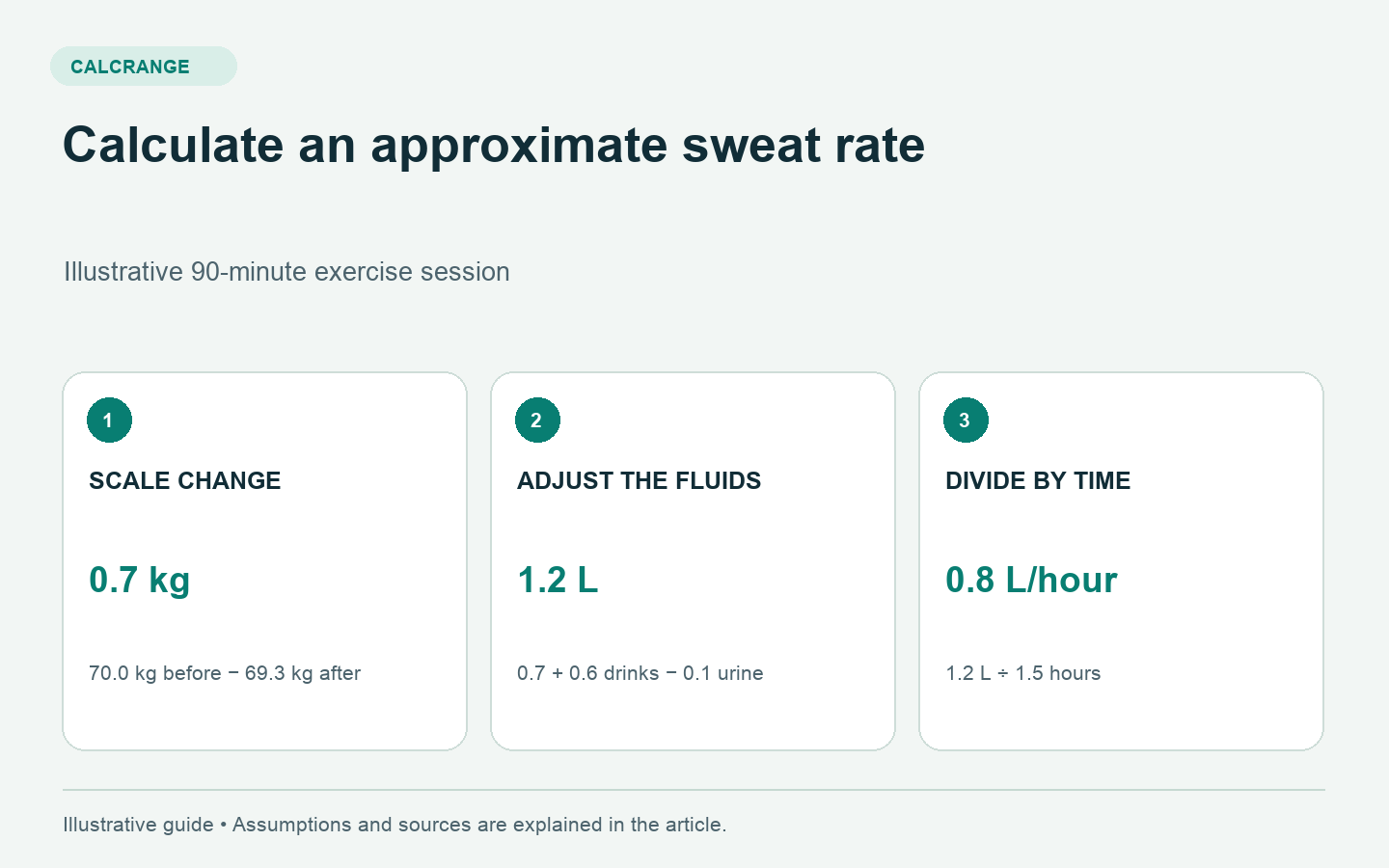
Assume a pre-exercise mass of 70.0 kg and post-exercise mass of 69.3 kg, with 0.6 L consumed and 0.1 L of urine passed during the session. The body-mass decrease is 0.7 kg.
Add the drinks and subtract urine: 0.7 + 0.6 − 0.1 = 1.2 L estimated sweat loss. Ninety minutes is 1.5 hours. Divide 1.2 by 1.5 to obtain 0.8 L/hour, or 800 mL/hour.
| Input | Example value |
|---|---|
| Body-mass decrease | 0.7 kg |
| Fluid consumed | 0.6 L |
| Urine passed | 0.1 L |
| Calculated sweat loss | 1.2 L |
| Session duration | 1.5 hours |
| Calculated rate | 0.8 L/hour |
Why drinks are added back
The scale’s 0.7 kg change does not show all the fluid that left as sweat, because 0.6 L was consumed along the way. Adding that intake accounts for fluid that replaced some of the loss. Urine is then subtracted because it contributed to the scale change without being sweat.
If you used only the scale difference, the example would give 0.7 ÷ 1.5 ≈ 0.47 L/hour. Omitting drinks would therefore understate this example’s estimate. Forgetting to convert 90 minutes into hours would create a different unit error.
Make the record usable
Record the scale readings, drink volume, urine volume if relevant, session length, weather and type of exercise. Use comparable weighing conditions and account for wet clothing or equipment that could distort the reading. Do not drink or avoid drinking merely to produce a preferred result.
NATA recommends evaluating sweat rate under realistic conditions because environment, intensity and other factors change fluid needs. Repeat observations can show how much a cool easy session differs from a hotter or harder one. Do not transfer one session’s rate to every future workout.
A loss estimate is not a mandatory drinking rate
The example’s 800 mL/hour is an estimated loss rate, not a command to consume that amount regardless of thirst, tolerance, duration or medical circumstances. Drinking more is not automatically safer. NATA’s guidance highlights the risks of both fluid deficit and excess and advises against gaining fluid weight during exercise when starting hydrated.
If you have fluid restrictions or a condition affecting fluid balance, follow individual clinical advice. Confusion, collapse or severe illness during exercise requires urgent assessment, not a calculator adjustment. A useful estimate helps explain a session and plan sensibly; it cannot diagnose dehydration, heat illness or low blood sodium.
Sources and method
Sources checked September 18, 2026. Numerical examples are illustrative calculations, not patient or animal records.