
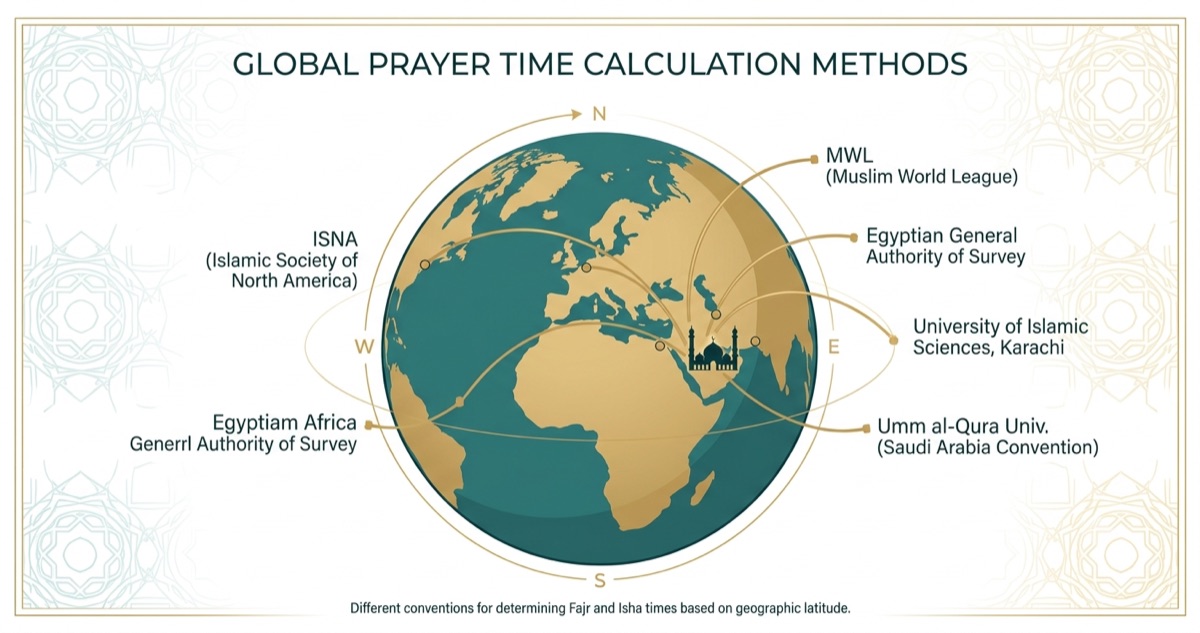
The main prayer time calculation methods differ mostly in the Fajr and Isha sun angles they use — here’s how the big ones compare.
Every prayer app has a “Calculation Method” dropdown, and most people never touch it. But that one setting quietly decides your Fajr and Isha times. Here’s what each method is, how they differ, and which to pick.
Prayer time calculation methods: the quick answer
Calculation methods mostly differ in the Fajr and Isha sun angles they use. The big ones are the Muslim World League (18°/17°), ISNA (15°/15°), Umm al-Qura (18.5°, and a fixed 90 minutes after Maghrib for Isha), the Egyptian Authority (19.5°/17.5°), and Karachi (18°/18°). Choose the one your country or local mosque follows.
The main methods at a glance
| Method | Fajr angle | Isha angle | Common in |
|---|---|---|---|
| Muslim World League | 18° | 17° | Much of the world, Europe |
| ISNA | 15° | 15° | North America |
| Umm al-Qura | 18.5° | 90 min after Maghrib | Saudi Arabia |
| Egyptian Authority | 19.5° | 17.5° | Egypt, Africa, parts of Middle East |
| Karachi (Univ. of Islamic Sciences) | 18° | 18° | Pakistan, India, Bangladesh, Afghanistan |
Notice Umm al-Qura is the odd one out: instead of an Isha angle, it uses a fixed 90 minutes after Maghrib (120 minutes in Ramadan). That’s a practical choice suited to Makkah’s latitude.
Why the differences exist
All these methods are trying to pin down the same two moments — the start of true dawn and the end of evening twilight. The trouble is that twilight fades gradually, so scholars and astronomers in different regions settled on slightly different depression angles based on local observation. A 15° Fajr (ISNA) assumes dawn is detectable a little later than a 19.5° Fajr (Egyptian). Neither is “wrong”; they’re regional conventions. The mechanics of angles are covered in Fajr and Isha angles explained.
What the method does NOT change
Your calculation method only affects Fajr and Isha. It does not change:
- Sunrise, Dhuhr and Maghrib — these are fixed by the sun crossing the horizon or the meridian.
- Asr — that’s set by a separate “Asr school” toggle (Hanafi or standard), explained in Asr time: Hanafi vs Shafi’i.
Which method should you choose?
Match your local community. A few sensible defaults:
- North America: ISNA (or MWL if your mosque prefers it).
- UK & Europe: Muslim World League is common.
- South Asia: Karachi.
- Saudi Arabia: Umm al-Qura.
- Egypt / much of Africa: Egyptian Authority.
When in doubt, ask which method your local mosque’s timetable uses and match it. For the full background, see how prayer times are calculated.
Frequently asked questions
Which method is the most accurate?
There’s no single “most accurate” method — each is a reasonable convention. The best choice is the one your community and local mosque follow, so your times match everyone around you.
Does the method change my Asr time?
No. Asr is controlled by a separate Hanafi/standard setting, not by the calculation method.
Why does Umm al-Qura not use an Isha angle?
It uses a fixed 90 minutes after Maghrib (120 in Ramadan) instead — a practical standard for the Makkah region.
Can I just leave the default?
You can, but the default may not match your area. It’s worth setting it once to your local method so your Fajr and Isha are right.
For more background, see Salah times on Wikipedia.
Want to compare methods for your own city? Use the free prayer times calculator and switch methods to see how Fajr and Isha shift.