
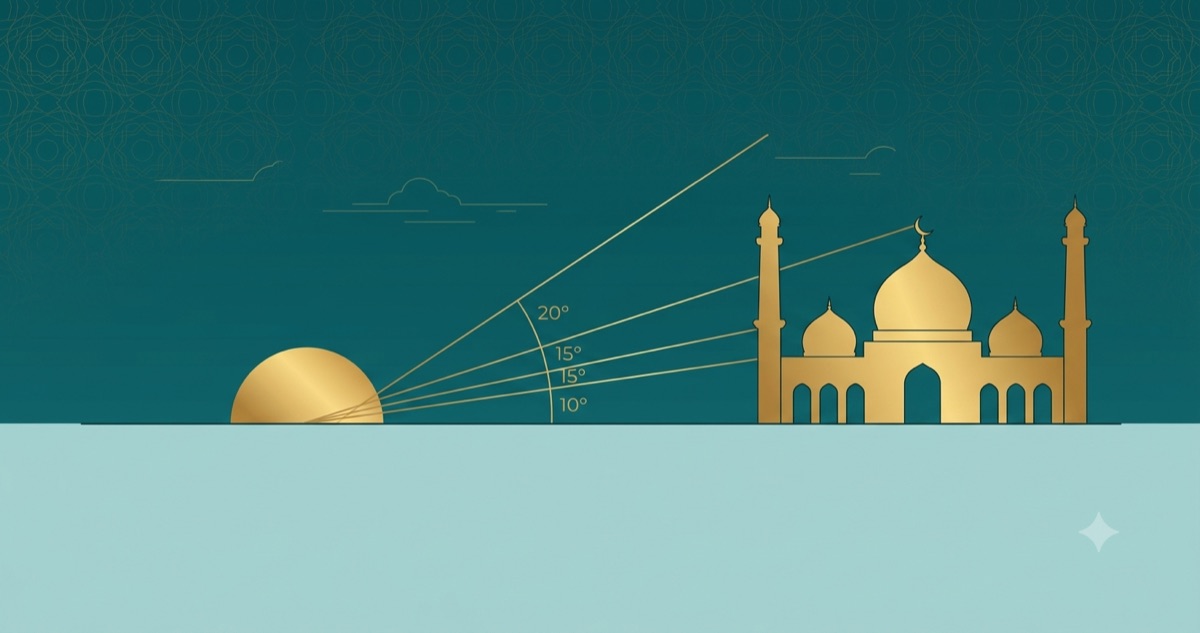
The Fajr Isha angle is how far the sun sits below the horizon when Fajr begins and Isha ends — that one number sets both times.
Dig into any prayer app’s settings and you’ll eventually meet a number like “18°”. It looks technical, but the idea behind it is simple, and understanding it clears up almost every “why is my Fajr different?” question. Here’s what the angle actually measures.
Fajr Isha angle: the quick answer
The angle is how far the sun sits below the horizon at the moment Fajr begins or Isha ends. A Fajr angle of 18° means Fajr starts when the sun is 18 degrees below the horizon. A bigger angle means the sun is lower (darker sky), so the time is earlier for Fajr and later for Isha.
What “depression angle” means
Think of the horizon as 0°. Before sunrise the sun is still below it, climbing toward the surface. When it’s 18° below, the sky has a specific amount of pre-dawn light. That’s the “18° Fajr” moment. The same idea works in reverse after sunset for Isha: once the sun has sunk to, say, 17° below the horizon, evening twilight is considered gone and Isha begins.
So the angle is really a stand-in for a level of darkness. Bigger angle = deeper below the horizon = darker sky.
How the angle shifts the time
| Fajr angle | Effect on Fajr time |
|---|---|
| 15° (ISNA) | Later Fajr (sky is lighter) |
| 18° (MWL, Karachi) | Middle ground |
| 19.5° (Egyptian) | Earlier Fajr (sky is darker) |
For Isha it’s the mirror image: a bigger Isha angle (say 18° vs 15°) means you wait longer after sunset, so Isha is later. This is the entire reason different calculation methods produce different Fajr and Isha times.
Common angle pairs
- 15° / 15° — ISNA (North America)
- 18° / 17° — Muslim World League
- 18° / 18° — Karachi
- 19.5° / 17.5° — Egyptian Authority
- 18.5° / (90 min after Maghrib) — Umm al-Qura
Why angles struggle at high latitudes
Near the poles in summer, the sun may never sink 18° below the horizon at all — so a pure angle can’t produce a Fajr or Isha time. That’s why special rules (like the “nearest latitude” or “middle of the night” methods) exist for those regions. If you live far north or south, that’s worth knowing when your app shows unusual times.
How this fits the bigger picture
Angles only govern the twilight prayers — Fajr and Isha. Sunrise, Dhuhr and Maghrib come straight from the sun’s position, and Asr from shadow length. For the whole system, see how Islamic prayer times are calculated, and for the dawn side specifically, when does Fajr begin.
Frequently asked questions
Does a bigger Fajr angle make Fajr earlier or later?
Earlier. A bigger angle means the sun is lower and the sky darker, which happens sooner before sunrise.
What angle should I use?
Use the angle tied to your community’s calculation method — 15° for ISNA, 18° for MWL/Karachi, and so on.
Why can’t my app calculate Fajr some nights?
At high latitudes the sun may never reach the required angle in summer, so the app falls back to an approximation rule.
Do angles affect Dhuhr or Maghrib?
No. Those are fixed by the sun crossing the meridian and the horizon, not by a depression angle.
For more background, see Twilight on Wikipedia.
Curious how a different angle changes your times? Use the free prayer times calculator and switch methods to watch Fajr and Isha move.