 Skip to content
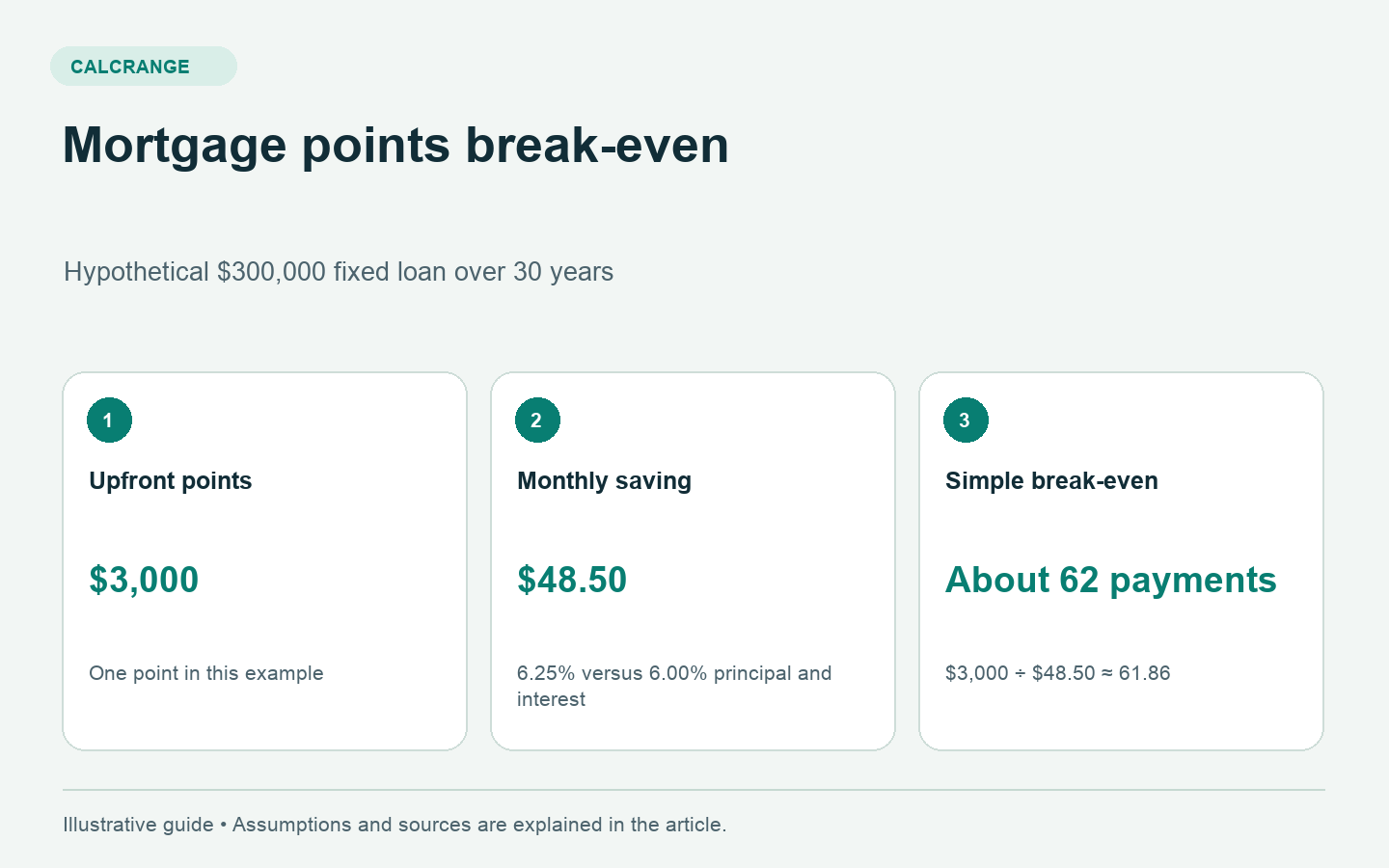
A simple mortgage points break-even estimate is extra upfront cost ÷ monthly payment savings. The answer is the number of monthly payments needed for the savings to recover that upfront cost. It is a useful screening calculation, not a complete comparison of two mortgages.
Use the Mortgage Calculator to estimate each principal-and-interest payment with the same loan amount and term. Then compare the extra cost of the lower-rate offer.
What a mortgage point buys
A discount point is an upfront charge associated with a lower mortgage interest rate. One point is 1% of the loan amount, but it does not guarantee a fixed reduction in the rate. The offered reduction depends on the lender and the quote. The CFPB’s points and lender credits guide explains this tradeoff.
Keep discount points separate from other closing charges. Comparing a points fee from one offer with the full closing-cost total of another is not a like-for-like calculation.
A worked $300,000 example
Suppose two hypothetical offers have a $300,000 loan amount, 30-year term and fixed monthly payments. Offer A has a 6.25% nominal annual rate and no discount points. Offer B has a 6.00% rate and a $3,000 points charge. Assume every other cost is identical and the points are paid in cash.
| Item | Offer A | Offer B |
|---|---|---|
| Loan amount | $300,000 | $300,000 |
| Rate | 6.25% | 6.00% |
| Monthly principal and interest | $1,847.15 | $1,798.65 |
| Points paid upfront | $0 | $3,000 |
The payment saving is about $48.50 a month. Divide $3,000 by $48.50 to obtain approximately 61.86 months. Because payments occur in whole installments, the cumulative payment savings first exceed $3,000 after about the 62nd payment.
After 60 payments, the accumulated savings are about $2,910, which is $90 short of the upfront charge. After 84 payments, the savings are about $4,074, or $1,074 above it. These figures isolate the payment difference and ignore other economic effects.
Use the time you keep the mortgage
The relevant horizon is how long you keep that particular loan. Selling the home, refinancing or otherwise paying off the mortgage changes the comparison. A plan to live in the home for ten years is not the same as keeping the original mortgage for ten years.
The CFPB’s analysis of discount points describes the cost-divided-by-savings shortcut and why the expected holding period matters. A break-even estimate does not predict future refinance opportunities or interest rates.
What the shortcut leaves out
At any earlier payoff date, the two amortization schedules can have different remaining balances. A fuller comparison adds upfront cash, payments made and the remaining payoff balance at the same date. It also considers the value of retaining the upfront cash, taxes where applicable and any differences in fees.
If the $3,000 is financed, the lower-rate loan’s principal is no longer $300,000 under this example. Recalculate with the increased amount before estimating savings. If extra principal payments are planned, use matching extra-payment assumptions for both schedules.
A quote-comparison worksheet
- Request comparable loan types, amounts and terms.
- Record the rate, points charge, lender credits and other lender charges.
- Calculate the payment difference using the same assumptions.
- Divide the net extra upfront cost by the positive monthly saving.
- Compare several holding periods and check remaining balances.
If the lower-rate offer has no extra upfront cost, this particular recovery calculation is unnecessary. If it produces no payment saving, dividing by zero or a negative saving does not give a useful break-even period.
The CFPB home loan toolkit can help organize official loan documents. This article supplies educational arithmetic, not a recommendation to buy points or a substitute for reviewing the actual Loan Estimates and your cash needs.
Sources and method
Source links checked September 18, 2026. Examples are original educational calculations using the assumptions stated above.